
You can’t miss the castor bean plant. It has huge star-shaped leaves, reddish stems and spiky seed pods. Inside those pods are glossy, speckled seeds that look almost like polished stones.
Those same seeds give us castor oil, one of the most useful plant oils in the world. They also contain ricin, one of nature’s most potent toxins.
So which is it, a useful plant or a dangerous one? It’s both. This guide explains how to identify the plant, what it’s used for, what the science supports, and where Ayurveda and yoga actually fit in.
Quick Answer: What is a castor bean?
The castor bean is the seed of Ricinus communis, a fast-growing plant in the spurge family (Euphorbiaceae). The raw seeds contain ricin, a highly toxic protein, and must never be eaten. Castor oil is a separate product made by processing the seeds. Commercial castor oil is used in cosmetics, medicine and industry.
Key takeaways
- Castor “beans” are seeds, not true beans, and they are poisonous if chewed and swallowed.
- Castor oil and castor beans are not the same thing. Ricin doesn’t end up in properly processed oil.
- Castor oil is valuable mainly because it is very rich in ricinoleic acid.
- Ayurveda uses castor (Eranda) in specific therapies, but eating the seeds has no “yogic benefit.”
- If someone swallows castor beans, get medical help right away.
What Is a Castor Bean?
“Castor bean” is the common name for the seed of Ricinus communis. Despite the name, it isn’t a legume like chickpeas or kidney beans. It’s a seed that looks a bit like a bean.
The plant goes by several names:
- castor oil plant
- castor plant
- Eranda in Sanskrit and Ayurveda
- Arandi in Hindi
According to Kew’s Plants of the World Online, the plant is native to northeastern tropical Africa. Today it grows wild in warm regions around the world, including across India. In warm climates it can grow from a shrub into a small tree.
10 Interesting Facts About the Castor Bean
1. Its scientific name is Ricinus communis
The plant belongs to the spurge family, Euphorbiaceae. The scientific name matters because common names change from region to region.
2. It isn’t a true bean
The name comes from how the seed looks. It has nothing to do with the bean family, and it is not a food.
3. Every seed has its own pattern
Castor seeds are smooth and shiny, with mottled patterns in grey, brown, cream, black or maroon. They grow inside spiny, three-lobed capsules. Their beauty is exactly why children are sometimes tempted to pick them up.
4. The seeds contain ricin
Ricin is a natural poison, and it occurs in the seeds. According to the CDC, chewing and swallowing whole castor beans can cause poisoning with ricin.
5. Castor oil is not the same as the raw seed
Castor oil is pressed from the seeds and then refined. Ricin is a water-soluble protein, so it stays behind in the leftover seed cake instead of passing into the oil, and heat processing makes the oil safer still. That’s why commercial castor oil isn’t toxic in the way raw seeds are. You still should never make homemade castor oil from raw seeds.
6. Castor oil has a rare chemical makeup
About 85–90% of castor oil’s fatty acids are ricinoleic acid. Very few plant oils contain much of it, and it is what makes castor oil so useful in industry.
7. It’s an industrial workhorse
Some of the uses of Castor oil and its derivatives are:
- lubricants, including high-performance engine oils
- paints, coatings and adhesives
- nylon-11 or bio-based plastics
- cosmetics and soaps
- pharmaceutical formulations and drug-delivery systems
The majority of castor seed in the world comes from India, Gujarat being the principal growing state.
8. It has a long history in traditional medicine
Folk healers in many cultures have used the oil, leaves and roots of the castor plant. Traditional use, however, isn’t the same as clinical proof. Many claimed benefits still need proper human studies.
9. It’s grown as an ornamental plant
The large leaves and red-stemmed varieties make it a popular garden plant. That’s also why people need to know about its seeds.
10. One plant, two sides
Few plants show it as clearly. The same species is economically valuable, used in medicine, decorative in gardens, and poisonous all at once.
How to Identify a Castor Bean Plant
Knowing what the plant looks like helps prevent accidents, especially if you have children or pets. Look for:
- Leaves: Very large, palm-shaped, with 5–11 deep, pointed lobes
- Leaf stalks: Long, attached near the center of the leaf
- Stems: Green, red or purplish, depending on the variety
- Flowers: Clusters on upright spikes
- Fruit: Three-lobed capsules, usually covered in soft spines
- Seeds: Oval, glossy and mottled
Varieties differ in appearance, so don’t rely on seed color alone to identify the plant.
Castor Bean Uses
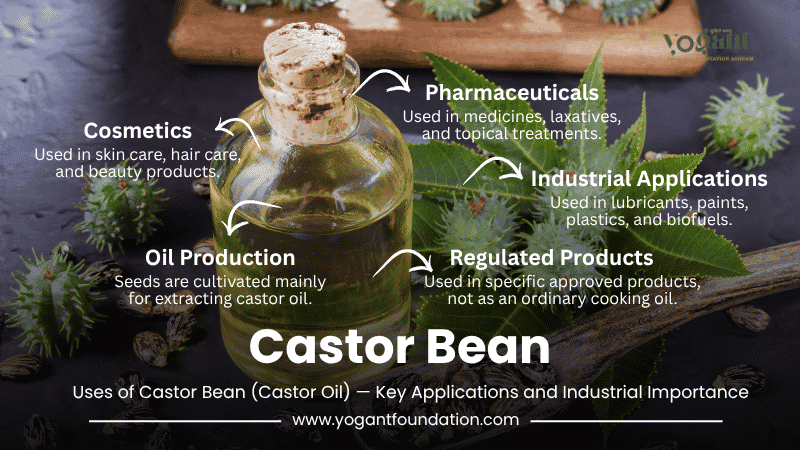
When people talk about castor bean uses, they usually mean uses of the oil, not the raw seed.
- Castor oil production: This is the main commercial use.
- Cosmetics: Castor oil appears in lipsticks, hair oils, creams and soaps because of its thick texture and the way it holds moisture.
- Medicine: Castor oil is a recognized stimulant laxative. Its derivatives are also used as pharmaceutical ingredients.
- Industry: Lubricants, polymers, coatings and specialty chemicals.
- Agriculture: Castor seed cake is used as an organic fertilizer after processing.
Castor Oil Benefits: What Does the Evidence Support?
The word “benefits” deserves an honest answer here.
- Laxative: This is the best-established medical use. It should be taken only occasionally and under guidance.
- Skin moisturizing: Castor oil works as an emollient that helps reduce water loss from the skin.
- Hair care: It’s popular for adding shine and conditioning hair. There’s little strong evidence that it makes hair grow faster.
- Formulation and industrial value: Its unusual chemistry makes it useful in many products.
Note on safety: Pregnant women should never take castor oil to induce labor unless a doctor tells them to. It can cause severe cramping and dehydration.
Castor Bean Toxicity: The Most Important Section
The raw seeds contain ricin. According to the CDC, symptoms depend on how someone was exposed and how much. If seeds are chewed and swallowed, poisoning can cause:
- vomiting and diarrhea, which may be bloody
- severe dehydration
- in serious cases, organ damage
If someone may have swallowed castor beans:
- Don’t try home remedies or induce vomiting on your own.
- In India: Call 112 or go to the nearest hospital emergency department straight away.
- In the US: Call Poison Help at 1-800-222-1222.
- Anywhere else: Contact your local emergency or poison service.
Pets: The ASPCA lists the castor bean plant as toxic to dogs, cats and horses.
Castor Bean vs. Castor Oil
| Feature | Castor bean (raw seed) | Castor oil (processed) |
|---|---|---|
| What it is | Seed of Ricinus communis | Oil pressed and refined from the seed |
| Ricin | Present, highly toxic | Not present in properly processed oil |
| Edible? | No, poisonous | Only in regulated medicinal doses |
| Key chemistry | Ricin, proteins, oil | About 85–90% ricinoleic acid |
| Main uses | Raw material for oil | Cosmetics, medicine, industry |
The bottom line: Never confuse the raw castor bean with commercially processed castor oil.
How to Handle a Castor Bean Plant Safely
- Never eat the seeds.
- Keep children and pets away from the seeds and pods.
- Wear gloves when pruning or clearing the plant.
- Wash your hands after touching it.
- Don’t make homemade oil from raw seeds.
- Don’t use unidentified plant parts as home remedies.
This isn’t a reason to fear the plant. Like many useful plants, it just needs to be handled with care.
5 Common Myths About Castor Bean
- “It’s a bean, so it’s edible.” It isn’t. The name only describes how the seed looks.
- “Castor beans and castor oil are the same.” They aren’t. Processing changes both the composition and the safety.
- “Traditional use proves it works.” Traditional use is valuable, but it isn’t the same as clinical evidence.
- “It’s a yoga herb.” Eating castor beans has no known benefit for yoga practice.
- “Natural means safe.” Ricin is a natural toxin, and it’s one of the strongest known.
Castor in Ayurveda and Yoga: What’s the Real Connection?
In Ayurveda, the castor plant is called Eranda. Its oil, Eranda Taila, is traditionally used for:
- Virechana: a purgation therapy that is part of Panchakarma
- external massage and packs for stiffness and Vata-related discomfort
Trained practitioners use these therapies with processed oil, in measured doses, and under supervision. None of this involves eating raw seeds.
Ayurveda and yoga are sister sciences, but they aren’t the same thing. Castor oil is part of Ayurvedic therapy, not yoga practice. If you practice yoga, you’ll get far more benefit from asana, pranayama, meditation and mindful eating than from experimenting with any plant seed.
From a yogic point of view, the castor plant teaches viveka, or discernment: learning to tell what nourishes from what harms, even when both come from the same source.
Frequently Asked Questions
1. Are castor beans poisonous?
Yes. Raw castor beans contain ricin, and chewing and swallowing them can cause serious poisoning.
2. Is castor bean the same as castor oil?
No. The castor bean is the raw seed. Castor oil is a processed product made from it, and the two have different compositions and safety profiles.
3. What is the scientific name of castor bean?
Castor scientifically called Ricinus communis L. belongs to the Euphorbiaceae family.
4. Can you eat castor beans?
No. They are not food and are toxic to humans and animals.
5. If castor beans are toxic, why is castor oil safe?
Ricin is a protein present in the seed cake after oil extraction and processing makes this oil safe for use. Only use castor oil produced commercially.
6. What are castor beans used for?
Mainly to make castor oil. Oil is used in cosmetics, medicine, lubricants, polymers and other industrial product.
7. Does castor bean have yogic benefits?
No. There’s no evidence that eating castor beans helps yoga, meditation or pranayama. Ayurveda uses castor oil in specific supervised therapies, which is a different thing.
8. Is it safe to grow a castor plant at home?
It can be grown as an ornamental, but it’s best avoided in homes with small children or pets because the seeds are toxic.
9. What does a castor bean plant look like?
It has large, deeply lobed, palm-shaped leaves, often reddish stems, spiny three-lobed seed pods and glossy, mottled seeds.
Conclusion
The castor bean is one of the most fascinating plants you’ll come across. It gives the world a valuable oil, it has a long history in traditional medicine, and it brightens gardens. It also carries one of nature’s strongest toxins.
The key is to keep four things separate: the raw bean, the processed oil, Ayurvedic therapy, and yoga practice. Learn to recognize the plant, respect its toxicity, and use only properly made castor oil products.
Disclaimer: This article is for educational purposes only and not intended as a source of medical advice. Before you go for castor oil medicine, it is suggested that talk to a certified doctor or Ayurveda and Ayurvedic specialist.