
What Is Vipassana Meditation? A Complete Beginner’s Guide
One of the meditation techniques Vipassana is an ancient Buddhist tradition in which you learn to observe your body sensations without reacting. The word itself is translated to mean someone’s “clear-seeing”, or an ability to see things as they really are. By watching each sensation arise and fade, you learn impermanence and slowly loosen the tendencies of craving and aversion that cause suffering. It is traditionally taught over 10 consecutive days in a free residential course but the basic practice can be learned to do at home.
Quick facts:
- Meaning: “Clear-seeing” or “insight” (Pali)
- Origin: India, rediscovered by the Buddha about 2,500 years ago
- Core method: Breath awareness first, then a slow body scan
- Religious? No. It is taught as a practical technique, without rituals
- Best-known modern teacher: S.N. Goenka (1924–2013)
- Standard course: 10 days, residential, run on donations
Why Is Vipassana Different from Other Meditation?
Life gets heavy for all of us. Work pressure, arguments, money worries and old resentments pile up, and we don’t just carry that weight ourselves. When we feel low or irritated, we pass it on to the people around us. The old advice “know thyself” points at the fix, but it doesn’t mean knowing about yourself through thoughts and theories. It means actually experiencing the truth of who you are, from deep within.
That is the gap the Buddha set out to close when he taught Vipassana in India around 2,500 years ago. People have long treated it as a way to deal with problems that are universal, not personal.
Most meditation advice tells you to relax. Vipassana asks you to observe, and the difference is bigger than it sounds.
- Five minutes of deep breathing can calm you for a while, but it rarely changes how you react the next time stress hits.
- Stress fades when you stop reacting to it on autopilot.
- Vipassana trains exactly that skill: feeling a tight chest, a restless mind or an itchy knee without immediately wanting it to change or pushing it away.
- So it is not relaxation training. It is de-conditioning, the slow unlearning of old reaction habits.
What Is the History of Vipassana?
The word Vipassana comes from Pali and means “clear-seeing.” It is one of the oldest meditation techniques practiced in India, and it is a self-help method in the truest sense, because everything rests on your own observation.
The Buddha’s era
- The Buddha taught this technique for roughly 45 years, mostly in northern India.
- It freed many practitioners from suffering in his lifetime.
- It then spread to neighbouring countries like Myanmar, Sri Lanka and Thailand.
The decline in India
- About 500 years after the Buddha, the practice faded out of India.
- Its teachings were overshadowed by other traditions and interpretations elsewhere.
Preservation in Myanmar
- A small chain of dedicated teachers in Myanmar kept the technique intact, passing it from teacher to student for centuries.
The modern revival (19th–20th century)
- Ledi Sayadaw (1846–1923): One of Myanmar’s most respected monks, and among the first to make the practice available to lay people, not only monks.
- Saya Thetgyi (1873–1945): A lay teacher in the Ledi Sayadaw lineage. He ran a meditation center where thousands learned.
- Sayagyi U Ba Khin (1899–1971): Saya Thetgyi’s student and the first Accountant General of Burma. He taught Vipassana to people inside and outside the country, proving that a householder with a demanding government career could carry the tradition.
- S.N. Goenka (1924–2013): Born in Burma to an Indian family, he became a successful businessman. He met U Ba Khin and learned the technique in 1955. After about 14 years of practice and training, he was asked to take it back to India, the land where it began. He left Burma in 1969 and started teaching courses in India. From there it spread across the world.
How Does Vipassana Work? (Sensations, Reactions and Freedom)
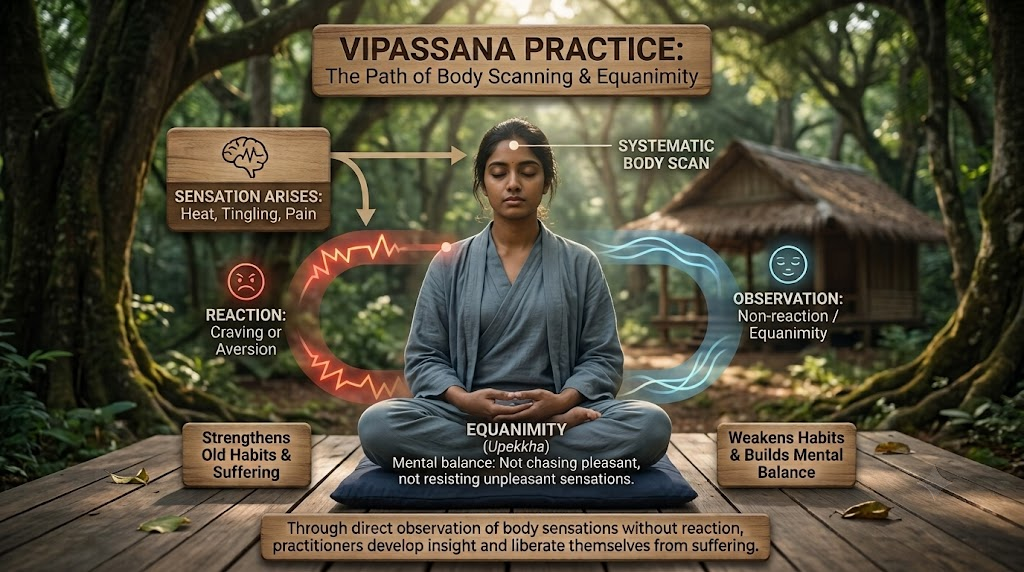
Vipassana rests on one simple observation: every emotional reaction shows up as a physical sensation in the body.
- Anger: heat in the chest
- Anxiety: tightness in the stomach
- Craving: restlessness in the hands
Most people never notice this loop. A sensation arises, we react by craving more or pushing it away, and each reaction reinforces the pattern. Next time, the trigger hits faster and harder.
Vipassana interrupts that loop. When you observe a sensation without reacting, you weaken the old habit of craving and aversion. Over time, the mind stops manufacturing fresh suffering from old triggers. You don’t become numb. You become less automatic.
What Are the Two Stages of Vipassana Practice?
Vipassana is not one technique. It is a progression of two, and the order matters.
Stage 1: Anapanasati (Breath Awareness)
- Observe the natural breath at the nostrils or the upper lip.
- No counting, no forcing, no special breathing. Just watching.
- This builds samadhi (concentration) and calms the mind enough to notice subtler sensations later.
- If the mind is extremely agitated, you may breathe slightly harder for a few minutes until your awareness steadies, then return to natural breathing.
Stage 2: Vipassana (Body Scanning)
- Once awareness is steady, scan the body systematically from head to feet and back again.
- Observe whatever is present: tingling, heat, pressure, pain, numbness.
- Don’t label any of it good or bad.
- The instruction never changes: observe, don’t react, and notice impermanence.
How Do You Practice Vipassana at Home? (Step by Step)
This routine is for daily sitting. It is not a substitute for a 10-day course. Total time: about 40–50 minutes.
Step 1: Set up (about 5 minutes)
- Look for a place where you will not be distracted.
- Cross your legs Indian style, or sitting in a chair. Keep your back straight but do not keep it stiff.
- Now close your eyes and take three slow breaths to ground yourself.
Step 2: Anapanasati (10–15 minutes)
- Focus your attention on the breath at the nostrils.
- Feel the air entering and leaving.
- When the mind wanders, and it will, bring it back gently. No judgment, no irritation.
Step 3: Transition to Vipassana (20–30 minutes)
- Shift your attention to the crown of your head.
- Notice anything: tingling, warmth, pressure, or nothing at all.
- Then move slowly downward: face, neck, shoulders, arms, chest and abdomen, back, legs and feet.
- Key rule: Don’t stay too long in one place. Keep moving.
- If you feel nothing, that is a sensation too. Note it and move on.
Step 4: Close with metta (2–3 minutes)
- Take a break and stuff your mind with good will.
- Silently Repeat: All beings be peaceful. May all beings be happy.”
- Open your eyes slowly.
Practical tips for beginners
- Sit at the same time every day. Early morning works well for many people.
- Start with 15–20 minutes and build up. A short daily sit beats a long occasional one.
- Expect a wandering mind. Noticing that it wandered is the practice, not a failure.
What Are the Benefits of Vipassana?
Here is what practitioners report, and what the practice is designed to build.
- Reduced reactivity: You notice anger arising before it hijacks you. That half-second gap changes a lot.
- Emotional balance (equanimity): Pleasant sensations stop triggering craving, and unpleasant ones stop triggering panic.
- Clearer insight into impermanence: You witness for yourself that no feeling lasts, and then all of them become less important. That frees up the hold of anxiety and rumination.
- Better concentration and self-awareness: People who practice on a daily basis say that they can focus better and view their minds with more objectivity.
- Stress reduction: Many people feel real relief from stress-related tension and emotional reactivity.
One honest note: Vipassana is not therapy, and it is not a cure for any medical or psychiatric condition.
What Are the Most Common Vipassana Mistakes?
Mistake 1: Trying to control sensations
- Problem: You want the tingling to continue or the pain to stop. That is craving and aversion, the very things the practice is meant to weaken.
- Fix: Return to the breath and tell yourself, “This is just a sensation. It will change.”
Mistake 2: Practicing only when you feel calm
- Problem: Vipassana is most useful when the mind is messy. Skipping difficult sits defeats the purpose.
- Fix: Commit to the time, not the mood. Sit for 10 minutes even when you’re agitated. Especially then.
Mistake 3: Treating it as relaxation
- Problem: You expect bliss, get boredom, and quit.
- Fix: Adjust your expectations. Vipassana is awareness training, not entertainment.
Mistake 4: Mixing techniques too early
- Problem: You add visualization, mantra or breath manipulation, and the mind gets confused.
- Fix: For at least the first few months, stick to one technique and give it a fair trial.
Mistake 5: Ignoring mental health cautions
- Problem: You go to an intensive retreat at a time when you have active trauma or psychiatric symptoms.
- Fix: Vipassana is not a substitute for professional care. First, see a clinician if you’re in real mental trouble. Meditation centers say this themselves.
What Is the 10-Day Vipassana Course Really Like?
The 10-day Goenka course is free (run on donations), residential and intense. It is worth knowing the reality before you apply.
What to expect
- You live at the center for the full ten days.
- Meditate roughly 10 hours a day.
- You observe Noble Silence and follow a strict code of discipline.
Day by day
- Days 2–3: Often miserable. The mind rebels, the body aches and doubt creeps in. This is normal and almost everyone goes through it.
- Day 4: This is when Vipassana actually begins. Until then, you are building concentration with Anapanasati.
- Days 5–10: The practice deepens, and on the final days, the silence is lifted and the course closes with metta.
The real challenge
- The hardest part isn’t the sitting. It is returning home and keeping up a daily practice once life resumes.
If you are considering a course, go in with clear eyes. It is not a holiday or a spa retreat. It is work, but the kind that changes how you relate to your own mind.
How Are Vipassana and Yoga Connected?
If you already practice yoga or pranayama, Vipassana is a natural next step.
- Anapanasati builds on the same breath sensitivity that pranayama develops.
- Yogis often find the shift to body scanning easier because they are already attuned to subtle sensations.
- The goal differs: Pranayama cultivates and directs energy. Vipassana observes without interfering.
- Both are valuable. They serve different purposes on the path of self-understanding.
Frequently Asked Questions About Vipassana
What is Vipassana meditation in simple words?
Vipassana is where you observe your breath and then the sensations of the body responding to them without reacting. The goal is to see things as they really are and lessen the habit of desire and aversion that generate stress. This started about 2,500 in India.
How is Vipassana different from mindfulness?
Breath focus One of the most common notions in mindfulness that refers to breath focus, body awareness and space-time presence. This active insight practice called Vipassana uses body sensations to understand the principle of impermanence and mold increased non-reactivity. Now this is not an very clear exist in the philosophy, though admittedly it overlaps with your second and has close neurobuddhistic quasi-philosophings — Vipassana.
Can I practice Vipassana at home without a course?
Yes. Anapanasati into body scan at home — Begin with 15–20 minutes daily. A 10-day course, however, gives most people what they need — the structure and teacher to provide a good basic foundation.
How long does it take to see results?
Most practitioners observe change to shrink reactivity within some weeks of daily practice. More profound shifts, such as reduced restlessness and increased composure, unfold over several months or years. Vipassana is not a return to your old mind, because vipassana is skills you work on for a lifetime, and there will be failure upon viscous failure, but with practice you can become more skilled at that.
Is Vipassana religious?
No. It is based on Buddhist teachings but taught purely as a technique for observing the mind and body. People of all faiths, and those with no faith, practice it. The courses are non-religious and free of ritual.
Is Vipassana safe if I have depression or anxiety?
Vipassana is not a treatment for clinical anxiety or depression. It can help with stress and emotional reactivity, but if you have a diagnosed condition, talk to a professional before enrolling in an intensive course. Centers also advise caution for people with serious mental health conditions.
Is the 10-day Vipassana course really free?
Yes. Goenka-tradition courses charge no fee for teaching, food or lodging. They run on voluntary donations from people who have completed a course and wish to give others the same opportunity.
What is the difference between Anapanasati and Vipassana?
Anapanasati is breath awareness, used to build concentration. Vipassana is the body-scanning stage that follows, used to observe sensations and develop insight into impermanence. Anapanasati prepares the mind, and Vipassana works with it.
Conclusion: Start with One Sincere Breath
Vipassana is not a weekend workshop you read about and forget. It is an ongoing process of really looking, one sensation, one breath and one moment at a time. Its strength is its simplicity: don’t react, just observe. Beneath that simplicity sits real potential for change.
The practice doesn’t ask you to believe anything. It only asks you to observe. With time, impermanence stops being a pleasant idea and becomes something you experience. You watch craving and aversion rise and pass away, and the loop of reactivity that feeds your suffering starts to loosen.
Whether you begin with ten minutes at home or a full ten-day retreat, the message is the same: stop running away and start observing. The path is old, but the next step is yours. Begin today, not with grand ambitions, but with one sincere breath.