
Akhrot is the Hindi and Urdu name for walnut, the wrinkled, brain-shaped nut that grows inside a hard green husk and a woody shell. People search for it for four main reasons: to confirm what it is, to learn what akhrot khane ke fayde (the benefits of eating it) really are, to find the best way to eat it, and to check what it costs.
This guide answers all four in plain language. It also says where the evidence is strong, where it is only promising, and who should be careful. Take it as general food information, not medical advice.
What is akhrot?
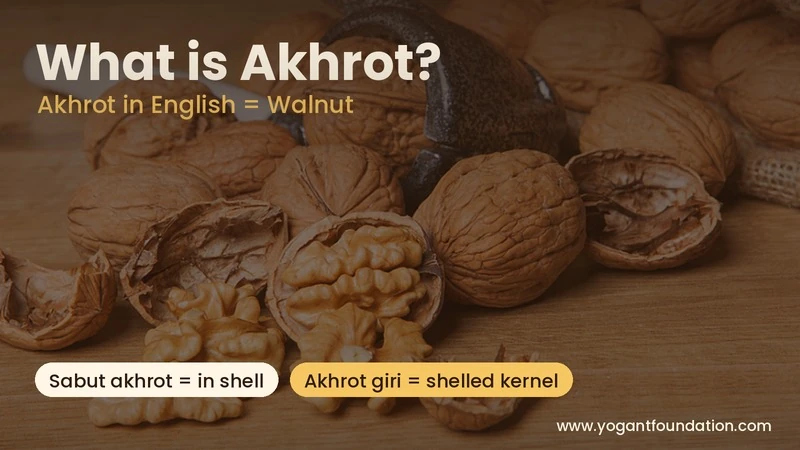
Akhrot is the edible seed of the walnut tree, most commonly the English or Persian walnut (Juglans regia). It is sold in two forms in India: sabut akhrot (whole, in the shell) and akhrot giri (the shelled kernel).
The kernel is rich in fat, mostly the unsaturated kind, and it also gives protein, fibre and minerals. That mix is why Walnut is a staple of dry fruit boxes, winter snacks, sweets and Kashmiri cooking.
What is akhrot called in English?
Akhrot in English is “walnut.” The same word, akhrot, is used in Urdu, and Bengali speakers use a very similar name written আখরোট. If you are shopping online or reading a nutrition label, search for “walnut” or “walnut kernels.”
Is akhrot a fruit or a nut?
The akhrot fruit is botanically a drupe, like a peach or a plum, and the walnut we eat is the seed inside it. In the kitchen, though, it is treated as a nut or dry fruit, and nutrition guides group it with tree nuts. Both descriptions are correct, depending on whether you are talking to a botanist or a cook.
Where does akhrot come from?
Walnut trees grow in cool, hilly regions. In India the main growing area is Jammu and Kashmir, with smaller production in Himachal Pradesh and Uttarakhand. India also imports walnuts, especially shelled kernels, with Chile and the USA as major suppliers (Tradologie market guide). This matters when you buy, because origin affects taste, size and price.
What nutrients does akhrot contain?
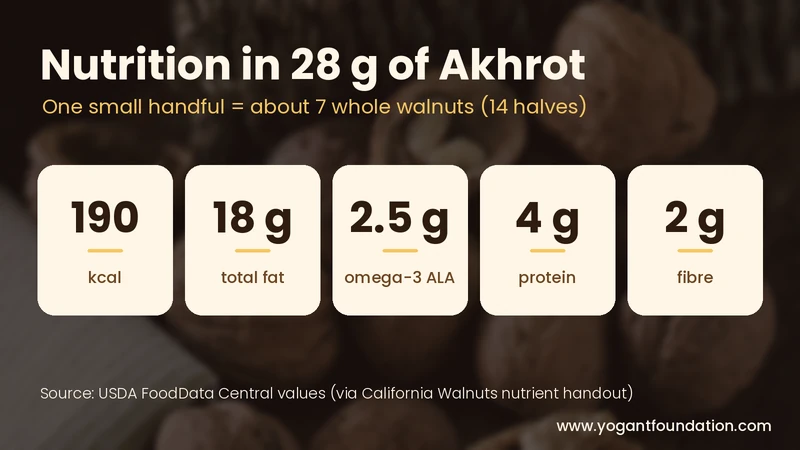
A 28 g serving of walnuts (about 14 halves, or a small handful) gives roughly the following, based on USDA FoodData Central values:
| Nutrient | Per 28 g |
|---|---|
| Calories | about 190 kcal |
| Total fat | 18 g (1.5 g saturated) |
| Omega-3 (ALA) | about 2.5 g |
| Protein | 4 g |
| Carbohydrate | 4 g |
| Fibre | 2 g |
| Cholesterol | 0 mg |
Source: California Walnuts nutrient handout citing USDA FoodData Central. Different databases round slightly differently, so you may see 183 to 190 kcal elsewhere. Note that the California Walnut Commission is an industry body, so the figures are best treated as a USDA-based reference, not independent advice.
What are the benefits of akhrot?
The best-supported benefit of akhrot is heart health. Other benefits are plausible but less certain. Here is how the evidence looks, from strongest to weakest.
1. Heart health and cholesterol
In 2004 the US Food and Drug Administration allowed a qualified health claim for walnuts. It says that eating 1.5 ounces (about 42 g) a day, as part of a diet low in saturated fat and cholesterol, may reduce the risk of coronary heart disease. The FDA described the research as supportive but not conclusive (UPI report on the FDA decision).
A randomised crossover trial in healthy adults found that eating 43 g of walnuts daily for 8 weeks lowered non-HDL cholesterol and apolipoprotein B, two markers linked to heart risk (Metabolism, 2013). It was a small study, so it supports the idea without settling it.
2. A plant source of omega-3
Walnuts are among the richest tree nuts in alpha-linolenic acid (ALA), a plant omega-3 fat. One handful covers a large share of the daily adequate intake for ALA. This is useful for vegetarians who do not eat fish. Keep in mind that the body converts only a small part of ALA into the omega-3s found in fish oil, so Walnut complements fish, not replaces it.
3. Fibre, fullness and everyday snacking
With protein, fat and fibre together, a small portion keeps you satisfied for longer than a biscuit would. Swapping a refined snack for a few Walnut is a sensible, low-effort change. The catch is that Walnut is calorie-dense, so portion size matters.
4. Brain health: promising, not proven
Walnut is often called brain food, partly because of its shape. Some studies link nut intake with better thinking skills in older adults, but they cannot prove that walnuts alone cause the effect. Treat it as a healthy habit, not a memory treatment.
What akhrot cannot do
No single food cures diabetes, blocks weight gain or reverses ageing. Walnut works best as part of a balanced diet with vegetables, pulses, whole grains and regular movement. Claims that say otherwise, especially on dry fruit sellers’ pages, should make you cautious.
How to eat akhrot
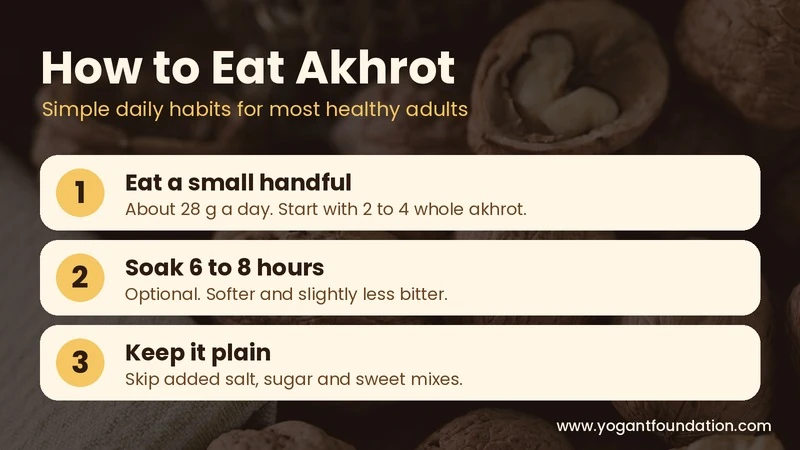
For most healthy adults, one small handful a day is a sensible amount: about 28 g, or roughly 7 whole walnuts (14 halves). Beginners can start with 2 to 4 whole akhrot and see how they feel. Larger portions add calories quickly, at about 190 kcal per 28 g.
Simple ways to eat akhrot
- Plain and raw: crack the shell, eat the kernel as it is. This is the simplest option and keeps the natural taste.
- Soaked: soaked akhrot is softer and slightly less bitter. Many families prefer it in the morning.
- Lightly roasted: a few minutes in a dry pan brings out the flavour. Skip added salt, sugar or oil.
- In breakfast: stir chopped walnuts into oats, porridge, curd, or a fruit bowl.
- In meals: blend into chutneys, sprinkle on salads, or add to parathas, halwa and rotis.
- With milk or smoothies: grind a few kernels into a glass of milk or a banana smoothie.
How to soak akhrot (step by step)
- Take 2 to 4 whole akhrot (4 to 8 halves) and rinse them in clean water.
- Put them in a bowl and cover with drinking water.
- Leave for 6 to 8 hours, or overnight.
- Drain, rinse once more, and eat them the same morning.
- Peel the thin skin if you find it too bitter. Leaving it on is fine.
Soaking changes texture and taste. Nutrition per dry gram stays about the same, so do not expect soaked Walnut to be far “stronger” than raw (FoodNutrify walnut calculator).
Should you eat akhrot in the morning or at night?
There is no proven best time. Morning works for many people because it fits into breakfast. A handful as an evening snack works just as well. Choose the time you will actually stick with.
Who should be careful with akhrot?
- People with a tree nut allergy: walnut is a common cause of allergic reactions, which can be severe. Avoid it if you have been diagnosed with a nut allergy.
- Young children: whole nuts are a choking risk for small children. Use finely chopped or ground walnut, and ask a paediatrician about when to start.
- People with kidney stones: some nuts contain oxalates, which matter for certain stone types. Ask your doctor how much is right for you.
- People watching calories or weight: akhrot is healthy but dense in energy. Count it as part of your daily intake.
- People on medication or with a medical condition: check with your doctor or a registered dietitian before making big changes to your diet.
Common mistakes when buying and eating akhrot
- Eating too much. A fistful three times a day is not a bigger benefit, only more calories.
- Buying old stock. Walnut oils turn rancid with heat, light and time. Rancid kernels taste bitter or like old paint. Throw them away.
- Ignoring mould. If a kernel is mouldy, musty or has a grey-black stain, discard it. Do not cut off the bad part and eat the rest.
- Storing them badly. Keep kernels in an airtight container in a cool, dry place, or in the fridge in warm weather (California Walnuts storage guidance).
- Choosing flavoured or sugar-lined mixes when your intention is a healthier snack.
- Expecting clinical consequences. Akhrot helps a healthful weight loss plan; it does now not update remedy.
What is the akhrot price in India?
In past due October 2026, shelled akhrot (akhrot giri) charges kind of ₹1150 to ₹2,150 consistent with kg online, even as complete akhrot in the shell prices form of ₹585 to ₹930 in step with kg. Wholesale and mandi prices are decrease. Prices move with season, festive name for, starting place and grade, so use those as a manual, not a hard and fast charge.
| Type | Approximate price per kg (Oct 2026) | Where this range comes from |
|---|---|---|
| Akhrot in shell (sabut), online retail | ₹585 to ₹930 | Chau Foods price page, 21 Oct 2026 |
| Akhrot in shell, Delhi wholesale | ₹400 to ₹650 | Same page and IndiaMART Delhi listings |
| Akhrot giri (kernels), online retail | ₹1,150 to ₹2,150 | Chau Foods, My Pahadi Dukan |
| Akhrot kernels, supplier listings | ₹800 to ₹1,400 | IndiaMART Mumbai, Aug 2026 |
These figures come from seller and marketplace pages, which list asking prices and not independent market data. Always check the current price on the day you buy.
Why is akhrot price so different between sellers?
- Origin: Kashmiri, Chilean and Californian walnuts are priced differently.
- Kernel colour and size: light, whole halves cost more than broken pieces.
- Shell vs kernel: the kernel is only about 45 to 50 percent of an in-shell walnut’s weight, so a kilo of kernels costs far more than a kilo in the shell.
- Pack size: small packs of 200 g usually cost more per kg than 1 kg packs.
- Seller type: local markets, wholesalers and branded online shops each add different margins.
In Bangladesh, Pakistan and the UK, walnut prices depend on local currency, import costs and the retailer, so check a trusted local store instead of relying on Indian rates.
How to choose good quality akhrot
- Look at the colour. Light to golden-brown kernels are usually fresher. Dark, dry or shrivelled kernels suggest age.
- Smell them. Fresh akhrot smells mildly nutty. A sharp, oily or paint-like smell means rancid.
- Check in-shell nuts. Pick ones that feel heavy for their size, with clean, unbroken shells. A rattling sound often means a dried-out kernel.
- Buy small and fresh. A packed or harvest date is a good sign. Buy what you can finish in a few weeks.
- Taste one first if you can. A bitter, stale taste is a reason to return the pack.
Frequently asked questions about akhrot
Question: Can I eat akhrot every day?
Answer: Yes, most healthy adults can eat a small handful (about 28 g) daily, unless they have a nut allergy or a doctor has advised otherwise. Daily portions matter more than occasional large ones.
Question: Does akhrot help with weight loss?
Answer: Not by itself. Akhrot is filling, but it holds about 190 kcal per 28 g. It can fit into a weight-loss plan when it replaces a less healthy snack, not when it is added on top of everything else.
Question: Does akhrot raise cholesterol?
Answer: Walnuts contain no cholesterol, and trials have linked regular intake with lower non-HDL cholesterol. Results vary between people, so follow your doctor’s advice if you have high cholesterol.
Question: Can people with diabetes eat akhrot?
Answer: Akhrot is low in carbohydrate, with about 4 g per 28 g serving and 1 g of sugar. Many people with diabetes include it, but portion size and medication differ, so check with your doctor or dietitian.
Question: Is akhrot safe during pregnancy?
Answer: Walnuts are commonly part of pregnancy diets while the person isn’t allergic. Eat sparkling, easy kernels sparsely and verify together with your physician or midwife.
Question: Is akhrot “hot” or “cold” in nature?
Answer: In traditional Indian food belief, akhrot is known as warming. This is a traditional class, no longer a scientific measurement. If you experience uncomfortable in warm weather, genuinely eat a smaller portion.
Question: How long does akhrot stay fresh?
Answer: Shelled kernels typically live fresh for some weeks to 3 months in a groovy, airtight field, and longer in the fridge. Exact time relies upon on the batch and garage. Discard any that odor rancid or look mouldy.
Conclusion: what to remember about akhrot
Akhrot, or walnut, is a simple, affordable way to add healthy fats, plant omega-3 and fibre to your day. The strongest evidence points to heart health, while brain and weight claims need more caution. A handful a day, fresh stock and sensible storage are enough for most people. If you have a nut allergy, kidney stones or a medical condition, speak with your doctor first.
Walnuts also fit naturally into a simple, plant-based, sattvic way of eating. If you would like to experience that approach in practice, Yogant Foundation’s yoga and meditation retreats in Rishikesh include sattvic vegetarian meals alongside daily practice.