
You bring home a “giloy” cutting, plant it with enthusiasm, water it every morning—and two weeks later, nothing happens. Or worse, the vine grows beautifully, but you are not completely sure whether it is actually giloy. That is exactly where most beginners get stuck. Learning how to grow giloy plant at home is not difficult.
The real secret is starting with the correct plant, choosing a healthy stem cutting, giving it excellent drainage, and providing a strong support before the vine starts spreading. This guide also explains how to identify giloy plant correctly, what giloy in English is called, how to grow it in a pot or garden, and how to adapt its care for India, the UAE, the US, the UK, Germany, Switzerland, and Austria.
Most importantly, we will separate traditional Ayurvedic beliefs from proven medical evidence, so you can grow this fascinating plant without falling for exaggerated health claims.
What Is a Giloy Plant?
Giloy (Tinospora cordifolia), also called Guduchi or Amrita, is a perennial climbing vine in the Menispermaceae family. In English, it is commonly called heart-leaved moonseed. It is native from the Indian subcontinent to Indo-China and is widely known as an important Ayurvedic herb with a long history of traditional use.
Kew Science recognizes Tinospora cordifolia as an accepted species and describes it as a liana associated mainly with tropical conditions.
Giloy Plant at a Glance
| Feature | Details |
|---|---|
| Botanical name | Tinospora cordifolia |
| Family | Menispermaceae |
| English name | Heart-leaved moonseed |
| Common Indian names | Giloy, Guduchi, Amrita, Giloe, Gulancha |
| Plant type | Perennial woody climbing vine |
| Native range | Indian subcontinent to Indo-China |
| Best home propagation method | Stem cutting |
| Soil preference | Fertile but well-draining soil |
| Main requirement | Strong trellis or climbing support |
| Major problem | Waterlogged soil |
| Traditional system | Ayurveda |
| Common research term | Immunomodulator |
The English common name “heart-leaved moonseed” is documented in Indian medicinal-plant literature, while Guduchi and Amrita are among its widely used traditional names.
Giloy Plant in English: What Is It Called?
If you are searching for giloy in English, the most useful answer is:
Giloy is commonly called “heart-leaved moonseed” in English. Its scientific name is Tinospora cordifolia.
You may also see names such as:
- Heart-leaved tinospora
- Indian tinospora
- Giloe
- Gulancha
- Guduchi
- Amrita
ICAR-associated medicinal-plant literature specifically records “heart leaved moonseed” as an English name for Tinospora cordifolia. Using the botanical name is especially important when purchasing a medicinal plant. Common names can vary between regions, while Tinospora cordifolia gives you a much clearer identification target.
Why Grow Giloy Plant at Home?
Giloy is much more interesting as a home plant than its reputation as an “immunity herb” suggests.
1. It Is an Attractive Climber: Once established, giloy develops long climbing stems and broad, heart-shaped foliage. Give it a railing, pergola, trellis, fence, or sturdy vertical frame and it can become an attractive part of a terrace or garden.
2. It Is Easy to Propagate: Commercial cultivation guidance recommends stem cuttings as the preferred planting material. Older stems containing healthy nodes can establish new plants, making vegetative propagation practical for home gardeners as well.
3. It Has Strong Cultural Value: Guduchi has a long history in Indian systems of medicine and is especially associated with Ayurveda. The Sanskrit name Amrita is traditionally connected with the idea of an immortal or life-giving nectar. For a home herbal garden, therefore, giloy has botanical, cultural, and educational value even if you never consume it.
4. It Is an Important Ayurvedic Herb: Ayurvedic literature traditionally classifies Guduchi as a Rasayana, a category associated with rejuvenation and resilience.
Modern researchers have also studied the immunomodulatory, antioxidant, anti-inflammatory, metabolic and other biological activities of Tinospora cordifolia. However, much of this evidence is preclinical or comes from relatively limited clinical research. A 2024 scientific update stated that more research is needed to better define therapeutic efficacy.
5. It Works Well in Vertical Gardens: Giloy naturally wants to climb rather than remain a compact bush. That makes it useful where horizontal garden space is limited but a balcony railing, trellis, boundary wall, or vertical frame is available.
What Does “Immunomodulator” Mean for Giloy?
Giloy is frequently described in research and Ayurvedic discussions as an immunomodulator. However, “immunomodulatory activity” is not the same as saying that drinking giloy automatically “boosts immunity” or prevents disease. Laboratory, animal, and limited human studies have investigated immune-related mechanisms of Tinospora cordifolia, but the overall human evidence is not strong enough to justify sweeping medical claims.
For trustworthy content, it is better to describe giloy as an Ayurvedic herb being studied for immunomodulatory properties rather than a scientifically proven cure or universal immunity booster.
Yogic Benefits of Giloy Plant
Giloy belongs primarily to the tradition of Ayurveda, not to yoga asana or pranayama itself.
There are currently no established clinical “yogic benefits” unique to giloy. Therefore, claims that giloy directly improves meditation, chakras, pranayama capacity, or spiritual energy should not be presented as proven facts.
Still, growing giloy can fit naturally into a yoga-inspired lifestyle.
Gardening mindfully
Watering, trimming, watching new growth, tending plants can be a quiet daily ritual. For those who already practice yoga or meditation, a herb garden could be a peaceful place to slow down and reconnect with everyday routines.
Traditional Wellness Connection
Yoga and Ayurveda developed within related Indian wellness traditions, although they are not identical systems. Growing plants such as Guduchi, tulsi, aloe vera, lemongrass, or brahmi can help people learn more about the botanical traditions surrounding Ayurveda without assuming that every traditional use has been clinically proven.
Greener Practice Space
A trained giloy vine can provide natural greenery around a balcony, courtyard, meditation area, or terrace. The benefit here is environmental and psychological rather than a specific medicinal effect.
How to Identify Giloy Plant Correctly
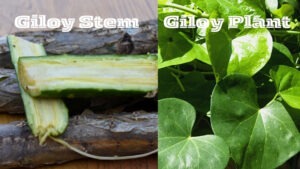
Knowing how to identify giloy plant is even more important than knowing how to grow it. Several climbing plants can look similar from a distance. Identification should therefore rely on multiple characteristics rather than one leaf.
1. Look at the Leaves
Giloy generally produces simple, broad leaves with a strongly heart-shaped or cordate base.
The leaves occur alternately along the vine rather than as pairs directly opposite each other.
Do not identify a plant only because it has heart-shaped leaves. Many unrelated climbers have similar foliage.
2. Inspect the Stem
Young giloy stems are generally green and succulent-looking.
Older vines become thicker, grey-brown to pale in appearance, and develop a rougher or cork-like surface. White lenticel-like markings may also be visible.
Medicinal-plant descriptions note that older stems can develop corky bark and that the thin outer bark can peel relatively easily.
3. Check for Aerial Roots
One of the most memorable characteristics of mature giloy is its ability to produce thin aerial roots from stems or branches.
They may hang downward like cords before eventually reaching another surface or the ground.
Aerial roots are useful supporting evidence—but again, use several traits together.
4. Observe Flowers
Giloy produces very small yellowish or greenish-yellow flowers.
They are much less noticeable than the leaves, so flowers are rarely the easiest identification feature for a beginner.
Botanical cultivation descriptions record flowering mainly around May–June in Indian conditions.
5. Observe Mature Fruits
When pollination and conditions allow, mature fruits become small, glossy red drupes.
Fruit is useful for confirmation, but you should not wait for fruit before establishing the identity of a nursery plant.
The Quick Giloy Plant Identification Checklist
A likely Tinospora cordifolia plant should show several of these traits together:
- Heart-shaped leaves
- Alternate leaf arrangement
- Long climbing or twining habit
- Green younger stems
- Rougher, corky older stems
- Visible nodes
- Aerial roots on established vines
- Small yellow-green flowers
- Red fruits at maturity
If the plant will be used medicinally, visual identification from an internet article is not sufficient.
Giloy Plant vs Tinospora crispa: Why Identification Matters
Correct identification is not just a gardening issue.
The Indian Ministry of AYUSH has specifically highlighted the importance of distinguishing Tinospora cordifolia from related species such as Tinospora crispa. Its technical material notes differences involving stem surface, leaf characteristics, wax, and secretion.
| Feature | Tinospora cordifolia | Tinospora crispa |
| Leaf form | Broadly ovate/heart-shaped | Broadly ovate to more rounded |
| Leaf base | Characteristic heart-shaped notch | Notch may differ |
| Stem | Green, becoming older and corky | Often greenish-grey |
| Rounded stem projections | Not characteristic in the same way | More noticeable |
| Milky secretion | Not characteristic | May be present |
| Safe identification for ingestion | Requires authentication | Should not be confused with Guduchi |
Never decide that a wild vine is safe to consume simply because its leaves resemble photos of giloy. If medicinal use is intended, obtain authenticated Tinospora cordifolia material from a reliable source or have the plant checked by a qualified botanist or appropriate professional. AYUSH guidance has also emphasized botanical authentication because related species can be confused.
Giloy Plant: Scientific Proof of its Benefits
Giloy is a natural supplement that has been shown to have many health benefits. Journal of Ethnopharmacology reports that Giloy can stabilize blood sugar. The AYU Journal published results that confirm the ability of this product to change your immune system. Indian Journal of Pharmacology discusses a great deal about the way it can reduce inflammation.
गिलोय के फायदे हिंदी में (Giloy Plant Benefits in Hindi)
1. शरीर की अपनी “सुरक्षा सेना” को मजबूती देना (Immunity Booster)
वो मौसम जब बदल रहा होता है, या ऑफिस-स्कूल में कोई छींक रहा होता है, तो लगता है कि अब हमारी बारी है। ऐसे में गिलोय एक प्राकृतिक ढाल का काम करती है। यह हमारे शरीर की रोग प्रतिरोधक क्षमता को इस तरह मजबूत करती है जैसे घर की दीवारें मजबूत हों। रोजाना इसका रस या काढ़ा, एक प्राकृतिक टॉनिक की तरह काम करता है।
2. बुखार का प्राकृतिक “वारंट ऑफिसर”
डेंगू, मलेरिया या साधारण वायरल बुखार हो, गिलोय का काढ़ा हमारे घरों में दादी-नानी के ज़माने से एक अचूक नुस्खा रहा है। यह शरीर के अंदरूनी तापमान को संतुलित करने में मदद करता है। इसे “अमृता” (अमरता) भी कहा जाता है, और बुखार में इसके प्रभाव को देखकर लगता है कि नाम सार्थक है।
3. शरीर की अंदरूनी “स्प्रिंग क्लीनिंग” (Detoxification)
आजकल के खान-पान और प्रदूषण में शरीर में कई तरह के विषैले तत्व (Toxins) जमा हो जाते हैं। गिलोय एक प्राकृतिक क्लींजर की तरह काम करती है। यह खून साफ़ करती है और लीवर को स्वस्थ रखने में मदद करती है। साफ़ खून का मतलब है, स्वस्थ शरीर और दमकती त्वचा।
4. शुगर लेवल का “नैचुरल रेगुलेटर”
मधुमेह (डायबिटीज) के मरीजों के लिए गिलोय एक वरदान साबित हो सकती है। यह धीरे-धीरे और प्राकृतिक रूप से ब्लड शुगर के स्तर को नियंत्रित करने में सहायक है। हालाँकि, अगर आप पहले से दवा ले रहे हैं, तो डॉक्टर से सलाह ज़रूर लें।
5. जोड़ों के दर्द में “तेल की मालिश” जैसी राहत
उम्र बढ़ने के साथ या सूजन की वजह से जोड़ों में अकड़न और दर्द होना आम है। गिलोय में एंटी-इंफ्लेमेटरी गुण होते हैं। इसका सेवन करने से धीरे-धीरे जोड़ों का दर्द और सूजन कम होती है, जैसे कोई अंदरूनी मालिश चल रही हो।
6. त्वचा का “ग्लोइंग सीक्रेट”
मुहाँसे, दाग-धब्बे, खुजली या बार-बार होने वाली एलर्जी – इन सबकी जड़ अक्सर खराब खून में होती है। गिलोय रक्त शुद्ध करके त्वचा की समस्याओं को जड़ से ठीक करने में मदद करती है। साफ़ खून चेहरे पर एक प्राकृतिक चमक लाता है, जो किसी भी ब्यूटी प्रोडक्ट से ज़्यादा असरदार होती है।
7. पाचन तंत्र का “बेस्ट फ्रेंड”
भारी भोजन, तला-गला खाने से गैस, अपच और कब्ज की शिकायत होना आम बात है। गिलोय पाचन अग्नि को दुरुस्त करती है। यह भोजन को ठीक से पचाने और पोषक तत्वों को अवशोषित करने में शरीर की मदद करती है।
8. दिमाग की “शांति का घोंसला” (Stress Buster)
आज की भागदौड़ भरी ज़िंदगी में तनाव और चिंता लगी रहती है। गिलोय एक अच्छा एडाप्टोजेन है, यानी यह शरीर को तनाव के अनुकूल बनाने में मदद करती है। इसका सेवन मन को शांत करता है, नींद अच्छी लाता है और मानसिक थकान को दूर करता है।
कैसे करें सेवन? (सरल तरीके)
- काढ़ा (Decoction): गिलोय की ताज़ी डंडी (स्टेम) को उबालकर शहद या अदरक के साथ पिएँ।
- पाउडर (Powder): सूखे गिलोय के पाउडर को गुनगुने पानी या शहद के साथ लें।
- रस (Juice): ताज़े गिलोय के पत्तों और डंडियों का रस निकालकर पिएँ।
- घरेलू नुस्खा: दाल या सब्ज़ी में करी पत्ते की जगह एक-दो गिलोय की पत्तियाँ डाल सकते हैं।
How to Grow Giloy Plant at Home: Step-by-Step
The easiest answer to how to grow giloy plant is to start from a healthy stem cutting. Official cultivation guidance describes stem cuttings as the preferred propagation material and notes that the vine needs a support structure as it develops.
1. Choose a Healthy Giloy Cutting
Select a healthy, disease-free stem from a correctly identified mature plant.
Avoid:
- Extremely soft new tips
- Rotten sections
- Completely dry wood
- Damaged or diseased stems
Choose a semi-mature section containing several visible nodes.
Best Cutting Setup: For a home plant, a cutting around pencil thickness or somewhat thicker is generally easier to handle than a very fragile green shoot. Keep several nodes on the cutting because nodes are important growing points.
Quick Check: If you do not know the mother plant’s botanical identity, buy an authenticated Tinospora cordifolia plant instead of collecting a random roadside climber.
2. Choose the Right Pot
Giloy becomes a vigorous perennial vine, so do not expect a tiny decorative pot to support it permanently.
A practical starting container should have:
- Plenty of root space
- Several drainage holes
- Enough weight to remain stable
- Space for a trellis or support
For long-term container growing, a pot approximately 30–40 cm wide is a practical starting point. Larger containers make moisture management and root development easier.
3. Prepare Well-Draining Soil
Giloy dislikes prolonged waterlogging. Cultivation guidance recommends organically rich, adequately drained soil and specifically notes that waterlogged conditions are unsuitable.
A simple home mix can contain:
- 40% garden soil
- 30% mature compost or vermicompost
- 30% coarse sand, perlite, coco chips, or another drainage-improving material
The exact percentages are flexible.
The goal is simple: water should soak through the root zone instead of sitting around the stem for hours.
4. Plant the Cutting
Fill the container with your prepared mix. Insert the lower portion of the cutting so at least one or two nodes sit beneath or close to the soil surface. Firm the soil gently. Do not compress it into a hard block. Water thoroughly once after planting and allow excess water to drain away.
5. Keep It Warm
Kew describes Tinospora cordifolia as a liana native from the Indian subcontinent toward Indo-China and primarily associated with tropical conditions. Therefore, warmth strongly suits its natural growth habit. Newly planted cuttings generally do better in a warm, protected location than in cold wind or frost.
6. Give Bright Light
Place the plant where it receives plenty of bright light. Morning sunlight is especially useful for container plants. In very hot, dry climates, harsh afternoon sun reflected from walls or glass may stress newly established plants. Observe the leaves. Healthy new growth is a better guide than blindly following a fixed number of sunlight hours.
7. Water Only When Needed
This is where many beginners fail. Do not water giloy every day simply because it is a medicinal plant. Instead, check the soil. If the upper few centimetres still feel moist, wait. If they have begun to dry, water deeply and let the excess drain. During monsoon weather, reduce watering. During very hot, dry conditions, inspect the pot more frequently.
8. Install a Strong Support Early
Giloy is a climber, not a compact shrub. Commercial cultivation recommendations specifically provide stakes, trellises, shrubs, or trees as climbing support.
At home, use:
- Bamboo poles
- Metal trellis
- Balcony railing
- Fence
- Pergola
- Strong garden netting
- Wall-mounted wire system
Guide young shoots gently rather than letting them form a tangled mass.
9. Feed Lightly
- Giloy does not need aggressive feeding in a home garden.
- Every few weeks during active growth, add a modest layer of mature compost or vermicompost.
- Don’t use high-strength fertilizer too much to promote fast growth.
- Healthy roots, drainage, warmth, enough light are more important.
10. Training and Pruning the Vine
Once established Giloy can be a vigorous plant. Regular pruning helps keep it manageable and encourages branching;
Remove:
- Dead growth
- Weak shoots
- Damaged stems
- Tangled sections
- Growth heading into windows, drains, or electrical fixtures
Train a few strong main vines along your chosen support.
How to Giloy Plant at Home: Cutting vs Seed vs Nursery Plant
| Method | Difficulty | Speed | Best For |
| Stem cutting | Easy | Fast | Most home gardeners |
| Seed | Moderate | Slower | Enthusiasts and propagation experiments |
| Nursery plant | Easiest | Fastest start | Beginners wanting certainty |
Cultivation guidance favors stem cuttings over seed for practical propagation. Seed-grown plants generally take longer to establish to the same productive stage.
For beginners, an authenticated nursery plant has another advantage: you reduce the risk of starting with the wrong species.
How to Grow Giloy Plant in Different Countries
Giloy’s tropical origin matters when you move outside South Asia.
| Country/Region | Practical Growing Strategy |
| India | Outdoor growing is straightforward in many warm regions; prioritize drainage during monsoon |
| UAE | Use a large container, morning sun, afternoon protection in extreme heat, mulch, and careful irrigation |
| United States | Grow outdoors during warm weather; in cold/frost regions use a container that can be moved inside |
| United Kingdom | Best treated as a warm-season or protected container climber rather than a frost-hardy outdoor vine |
| Germany | Keep warm during the growing season and protect indoors from winter freezing |
| Switzerland | Container culture makes winter protection much easier |
| Austria | Use a movable pot and warm, bright overwintering location in frost-prone areas |
The recommendations for colder countries are practical horticultural inferences from the species’ tropical distribution rather than claims that it is winter-hardy in those regions.
Growing Giloy in the UAE
The main challenge in the UAE is not winter—it is extreme summer exposure. A container against a west-facing wall can become dramatically hotter than the surrounding air.
Better UAE Setup
Use:
- Morning sunlight
- Afternoon shade during extreme heat
- A thick but breathable mulch layer
- A large pot
- Reliable drainage
- Protection from strong, desiccating wind
Heat-Smart Tip: Do not compensate for heat by leaving the roots constantly waterlogged. Increase monitoring rather than watering blindly.
Practical Giloy Care Tips
Check the Soil, Not the Calendar: “Water every three days” sounds convenient, but plants do not use water according to calendars. Temperature, wind, sunlight, pot size, soil composition, and humidity all change drying speed.
Keep the Base Open: Do not bury the lower stem under thick wet mulch. Leave a little space around the stem so air can move and moisture does not remain trapped against it.
Train Early: A young vine is easy to guide. A mature tangled vine is not. Attach new growth loosely to the support and redirect stems while they are still flexible.
Use Organic Matter Carefully: Compost improves soil structure and nutrient availability, but more is not always better. A fertile, free-draining mix is preferable to a dense container filled almost entirely with heavy compost.
Common Mistakes to Avoid
1. Growing the Wrong Plant: This is the most serious mistake if you eventually intend medicinal use. Do not rely on one photograph. Check botanical identity.
2. Overwatering: Giloy loves the moist, active growth stage but there should not be any standing water around its roots. Cultivation advice specifically states that waterlogging is not suitable.
3. Forgetting the Trellis: A healthy giloy vine quickly looks untidy without support. Install the trellis at planting time rather than waiting until stems are everywhere.
4. Using a Tiny Pot: The plant can survive in the short term, but a small volume of roots dries out quickly and restricts long-term growth. Upgrade the container as the vine develops.
5. Keeping It in Deep Indoor Shade: Giloy is a vigorous outdoor-style climber. A permanently dark room is not equivalent to tropical growing conditions.
6. Exposing It to Frost: Because the species is fundamentally associated with tropical climates, gardeners in colder parts of the US and in the UK, Germany, Switzerland, and Austria should plan winter protection.
7. Assuming “Natural” Means Risk-Free: Growing giloy and consuming giloy are two completely different decisions. Treat them separately.
Pro Tips for Faster, Cleaner Growth
Start With an Authenticated Mother Plant: Good cultivation begins before the cutting enters the soil. Correct botanical identity matters more than any fertilizer trick.
Prioritize Nodes: A cutting with several healthy nodes gives the plant multiple potential growth points. Commercial propagation guidance also emphasizes using older stems containing nodes.
Build the Trellis for the Mature Plant: Do not build for today’s 30 cm cutting. Imagine where the vine will be after repeated seasons of growth.
Prune for Airflow: Dense overlapping growth traps humidity and makes inspection difficult. Selective pruning lets you see the main stems and catch damaged areas earlier.
Watch New Growth: Old leaves can carry scars from heat, transport, nutrient stress, or previous neglect. New leaves tell you how the plant is responding to your current care.
Grow It as a Plant First: Do not rush to harvest every new stem because giloy has a medicinal reputation. Let the root system and framework become established. A strong perennial vine is more valuable than a weak plant repeatedly stripped for cuttings.
Is Giloy Safe to Consume?
This question deserves more care than most gardening articles give it.
The Ministry of AYUSH has defended appropriately identified Tinospora cordifolia and has emphasized correct botanical authentication, particularly because similar Tinospora species may be confused with Guduchi.
At the same time, hepatology researchers have published reports associating giloy-containing preparations with liver injury. A multicentre Indian study described patients with acute hepatitis linked to giloy exposure, while other medical literature has called for stronger safety evidence around widely marketed “immune-booster” preparations.
That means “traditional,” “natural,” and “home-grown” should never be treated as synonyms for “risk-free.”
If you want giloy for medicinal use rather than gardening, consult an appropriately qualified healthcare or Ayurvedic professional and make sure the species is correctly authenticated. This is particularly important if you have liver disease, take medicines, are pregnant or breastfeeding, or have another ongoing medical condition.
Growing the plant is a gardening activity. Using it as treatment is a healthcare decision.
Frequently Asked Questions About Giloy Plant
1. What is giloy called in English?
Giloy in English is commonly called heart-leaved moonseed. Its scientific name is Tinospora cordifolia. It is also known as Guduchi and Amrita in Indian traditional medicine and belongs to the Menispermaceae family.
2. How do I identify a giloy plant?
Look for a vigorous climbing vine with broad heart-shaped leaves, alternate leaf arrangement, nodal stems, rougher corky older growth, and aerial roots on mature vines. Small yellow-green flowers and red mature fruits provide additional clues. Never identify medicinal material from leaf shape alone.
3. How do I grow giloy plant at home?
Take a healthy stem cutting with several nodes. Plant in fertile but well-drained soil. Water without keeping the pot soggy and keep it warm and bright. Provide a strong trellis. The preferred guidance for medicinal plant cultivation is stem cuttings.
4. Can giloy plant grow in a pot?
Yes. Giloy can be grown in a container if the pot has good drainage, enough root space, and a sturdy climbing support. Because the plant becomes vigorous, a larger pot is easier to manage over the long term than a small decorative planter.
5. Does giloy plant need full sun?
Giloy prefers a sunny spot and can be grown outdoors in a warm climate. Container plants can function with morning sun. In very hot areas like the UAE, protection from the intense reflected afternoon heat may be beneficial to newly established plants.
6. How often should I water a giloy plant?
Don’t fall into a routine watering schedule. First, test your soil. Water thoroughly and allow the top layer to dry out before watering again. If it rains for a long time, cut back watering as Tinospora cordifolia does not thrive in waterlogged conditions.
7. Can giloy grow from stem cuttings?
“Yeah. One of the best methods of propagation of giloy is stem cutting and is preferred in commercial cultivation guidance. Select a healthy, identified portion of a mature plant and ensure that the cutting has viable nodes.
8. Can I grow giloy indoors?
Giloy can be stored temporarily in a protected indoor environment, especially during cold winters, but it requires bright light, warmth, space and support. In temperate countries, a container that moves outdoors during warm weather and indoors before frost is often more practical.
9. Is Guduchi the same as giloy?
Yes. Guduchi is a generic Sanskrit/Ayurvedic name for Tinospora cordifolia and giloy is a popular Hindi-derived name. Another traditional name for the same plant is Amrita.
10. Is giloy an immunity booster?
Giloy is widely marketed as an immunity herb and is often described as an immunomodulator in pharmacological literature. However, immunomodulatory laboratory activity does not prove that giloy universally “boosts” immunity or prevents illness in humans. Clinical evidence remains limited, and safety concerns have also been reported.
11. Can giloy survive winter in the UK or Europe?
Giloy is fundamentally a tropical climber rather than a reliably frost-hardy European garden vine. Gardeners in the UK, Germany, Switzerland, Austria, and colder parts of the US should use a movable container or protected environment so the plant can be kept away from freezing conditions.
12. What is the best soil for giloy?
Use loose, well-drained, fertile soil rich in organic matter For containers, a combination of garden soil, mature compost and some drainage material such as coarse sand, perlite or coco chips works well. Do not use heavy soil that remains soggy after watering.
Final Thoughts
If you have been wondering how to plant giloy at home, do not overcomplicate it.
Start with a correctly identified Tinospora cordifolia cutting. Plant it in a well-draining container. Keep it light and warm. Water by soil, not by calendar. Most importantly, give the vine a strong support before it starts racing upward.
For beginners, those five decisions matter far more than expensive fertilizer or complicated gardening tricks.
And when learning how to identify giloy plant, remember one rule above all: a heart-shaped leaf alone is not proof. Look at the entire vine—leaves, stems, nodes, aerial roots, flowers, fruits, and source of the plant.
Giloy, Guduchi, Amrita, or heart-leaved moonseed is a fascinating climber with deep roots in Indian botanical and Ayurvedic traditions. Modern research continues to investigate its biological properties, but responsible gardening means respecting the difference between growing a traditional Ayurvedic herb and making medical claims about it.
Grow the plant well. Identify it correctly. And if you plan to use it medicinally, treat that as a separate decision that deserves professional guidance.