
Mantras Meanings: The Ancient Tool for a Modern Mind
You hear the word mantra everywhere today—from yoga classes and meditation apps to motivational posts. Yet the deeper mantra meaning is often lost. Is a mantra simply a phrase you repeat? Is it a prayer? Does the sound itself matter? And what is the difference between a traditional Sanskrit mantra and a modern affirmation?
If you have been searching for a clear mantras definition, the definition of mantra, or an accurate Gayatri mantra definition, this guide gives you the full picture without making the subject unnecessarily complicated. You will learn what mantras are, why repetition matters, how yogic traditions understand them, what modern research can—and cannot—tell us about their benefits, and how to begin a mantra practice yourself.
What Is a Mantra?
A mantra is a sacred sound, word, or phrase repeated aloud, whispered, or silently to focus attention, support meditation, prayer, or contemplation, and shape inner awareness. The term comes from Sanskrit and is often understood as an “instrument of thought.” In yogic traditions, a mantra’s sound, meaning, rhythm, and repetition may all matter.
That is the simplest definition of mantra, but it only opens the door. Oxford Reference traces mantra to Sanskrit and gives the literal sense of an “instrument of thought.” Historically, mantras are closely connected with Vedic sacred language and later contemplative practice.
In practical terms, a mantra gives your mind something intentional to return to. Instead of allowing attention to move endlessly from thought to thought, you repeatedly bring awareness back to one sound or phrase.
What Does Mantra Really Mean?
A mantra can work on several levels at once.
It may have:
- a linguistic meaning,
- a devotional meaning,
- a meditative purpose,
- a traditional ritual role,
- and a sound or rhythmic quality.
This is important because not every mantra is simply a sentence that needs to be translated. Some are complete prayers. Others are short sacred formulas. Certain mantras may even consist primarily of a single Sanskrit syllable, such as Om. Oxford Reference describes Om as a sacred or mystic syllable within Indian religious traditions.
So when someone asks, “What does this mantra mean?” there may actually be two questions:
What do the words mean? & How is the mantra traditionally used?
Why Are Mantras Important?
The human mind loves repetition. Unfortunately, much of our unconscious repetition is not helpful. We replay worries. We mentally repeat conversations. Rehearse fears about events that have not happened. Mantra practice redirects that repetitive tendency toward a chosen object of attention. Rather than fighting every thought, the practitioner repeatedly returns to one sound.
That simple movement—wander, notice, return—is one reason mantra can become an effective meditation focus.
Research also supports the idea that mantra meditation belongs to a distinct family of meditative practices involving repeated words, sounds, or syllables. A systematic review of randomized trials found small-to-moderate improvements in outcomes including anxiety, stress, depression, and mental-health-related quality of life, although the authors cautioned that limitations in the evidence weaken certainty about the results.
In other words, mantra meditation is promising, but it should not be marketed as a miracle treatment.
Key Benefits of Mantra Meaning Practice
Depending on the tradition, mantra practice may be used for spiritual, devotional, psychological, or contemplative purposes.
1. Creates a Clear Focus for Meditation
For beginners, “stop thinking” is almost useless meditation advice. A mantra gives attention somewhere to go. When thoughts appear, you do not have to wrestle with them. You notice that attention has wandered and return to the mantra. That makes the practice simple without making it shallow.
2. Helps Interrupt Mental Chatter
Repetitive speech has been investigated in neuroscience research. One experimental study found that simple repetitive speech was associated with reduced activity across several cortical regions and with reduced self-reported spontaneous thought compared with rest. Importantly, the researchers were studying repetition itself rather than proving a unique spiritual effect of traditional mantras. This offers one possible explanation for why repetition can feel mentally quieting.
3. Builds Consistency
Meditation becomes easier to maintain when the method is clear. A mantra provides a repeatable structure:
sound → distraction → awareness → return
You do not need to create a new meditation experience every day.
4. Can Support Spiritual Practice
Within traditional contexts, a mantra may function as far more than a concentration technique. It may turn into a sacred chant, prayer, contemplative formula or an expression of devotion. That is one reason traditional mantras deserve more respect than simply treating every Sanskrit phrase as another wellness trend.
5. Encourages Intentional Inner Speech
What we repeatedly tell ourselves influences where our attention goes. Traditional mantra and modern spiritual affirmation are not the same, but both demonstrate how consciously chosen words can replace automatic mental noise with conscious repetition.
Yogic Benefits of Mantra Meaning
Yoga is broader than physical postures. Within contemplative yoga traditions, mantra practice can support the inward movement of attention.
Concentration
Repeating one sound trains the mind to return to one point. That makes mantra useful as a concentration practice, especially for people who find breath-only meditation difficult.
Withdrawal From Distraction
External sounds, memories, plans, and emotions constantly compete for attention. Mantra practice does not require these distractions to disappear. Instead, the mantra becomes the thread you keep returning to.
Breath and Rhythm Awareness
When chanting aloud, breathing and vocal rhythm naturally become noticeable. Some forms of chanting therefore combine attention, respiration, sound, and repetition in a single practice. Preliminary physiological research has explored how audible mantra repetition may interact with autonomic activity and heart-rate variability, although small studies should not be interpreted as proof of broad medical benefits.
Deeper Meditative Absorption
As repetition becomes familiar, practitioners may experience less effort in maintaining the mantra. Instead of just repeating words, we can become more and more absorbed in the sound, meaning, or silence surrounding our attention.
A 2026 meta-analysis of neuroimaging studies identified both overlapping and distinct patterns of brain activity among meditation styles, mantra meditation included. The findings support the idea that different forms of meditation should not automatically be regarded as the same practice.
What Is the Gayatri Mantra?
Gayatri Mantra Meaning
The Gayatri Mantra is an ancient Vedic mantra found in Rigveda 3.62.10. Also known as the Savitri mantra, it is traditionally associated with Savitr and centers on divine illumination and the awakening or guidance of human understanding. It became one of the most influential and frequently recited mantras in Hindu tradition.
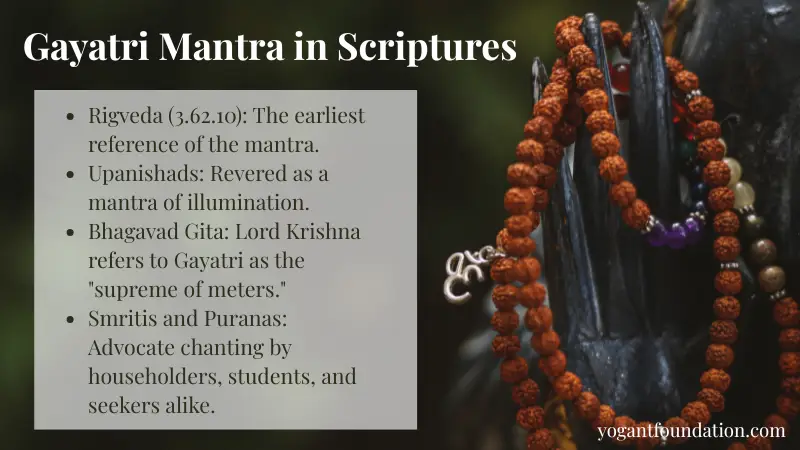
The core Sanskrit verse begins:
Tat Savitur Varenyam
Bhargo Devasya Dhimahi
Dhiyo Yo Nah Prachodayat
Translations vary because Sanskrit terms can carry several shades of meaning. At its heart, however, the mantra is commonly understood as a meditation upon divine or sacred radiance with a prayer that human understanding may be inspired or illuminated. Academic research on the history of the Gayatri identifies the mantra with Rigveda III.62.10 and notes its major role in both historical and contemporary Hindu practice.
Is Gayatri the Same as Every Mantra?
No. “Mantra” is a broad category. The Gayatri Mantra is one specific and historically important example within that category. Think of it this way:
Mantra = category.
Gayatri Mantra = a particular mantra.
Mantra vs Affirmation vs Prayer
| Practice | Main Purpose | Usually Repeated? | Religious Meaning Required? |
|---|---|---|---|
| Mantra | Meditation, contemplation, devotion or sacred practice | Yes | Depends on the mantra |
| Affirmation | Reinforce a chosen belief or mindset | Usually | No |
| Prayer | Communication, worship, gratitude or petition | Not always | Usually |
| Chant | Rhythmic vocal repetition or singing | Often | Not necessarily |
Modern English also uses mantra informally for any phrase or belief that someone repeatedly expresses. Cambridge Dictionary recognizes both the religious/meditative meaning and this broader everyday usage.
Traditional mantra practice, however, should not automatically be reduced to positive self-talk.
How to Practice Mantra Meditation: 7 Simple Steps
1. Choose One Mantra: Start with one rather than collecting ten. A simple sound such as Om may be easier for beginners, while traditional devotional or Vedic mantras may deserve guidance regarding pronunciation and context.
2. Understand What You Are Repeating: If the mantra has linguistic meaning, learn it. Understanding creates intention. You do not need to become a Sanskrit scholar, but knowing whether you are repeating a prayer, sacred name, seed syllable, or contemplative phrase prevents mindless imitation.
3. Sit Comfortably:
- You do not need an impressive yoga posture.
- Sit somewhere reasonably quiet with your spine comfortable and your body stable.
- A chair is perfectly acceptable.
4. Take a Few Natural Breaths:
- Avoid forcing your breathing.
- Let the body settle first.
- Then gently bring attention to the mantra.
5. Repeat the Mantra:
You can repeat it:
- aloud,
- softly or in a whisper,
- or mentally.
Oxford sources describe mantra meaning repetition as occurring aloud, subvocally, or mentally, depending on the practice.
6. Notice When Your Mind Wanders:
- Your mind will wander.
- That does not mean the meditation failed.
- The moment you notice distraction is actually part of the practice.
- Return to the mantra without criticizing yourself.
7. End With Silence: After several minutes, stop repeating. Sit quietly for a short period. Notice your breath, body, attention, and emotional state without trying to produce a particular experience.
Two of the most powerful mantra meaning & examples
The Gayatri Mantra meaning:
The mother of mantras & mantra meaning, this is what many call it. The request isn’t for a brand new car or an improved job. It is an appeal for enlightenment. “Let us look at the divine light fabricated by the Creator.” “Let it illuminate our intellect.” The ultimate gift is the ability to clearly see.
Om (Aum) Mantra Meaning:
The primordial vibration is the one that was heard at the beginning of the Universe. To chant “Om” is to physically feel your connection to everything that ever was and ever will be.
This wisdom traveled. Buddhism embraced it with the profoundly compassionate “Om Mani Padme Hum.” The core idea remained: sound shapes reality, and by shaping the sound within us, we can reshape our inner world.
Practical Tips for Better Mantra Meditation
Keep Your First Sessions Short: Five focused minutes can be more valuable than forcing yourself through thirty distracted minutes. Build consistency before duration.
Use a Natural Pace: Don’t rush thru the mantra meaning. Let the repetition have a comfortable flow.
Pay Attention to Sound: If chanting aloud, listen as carefully as you speak. The practice becomes richer when your attention includes pronunciation, rhythm, resonance, and the subtle repetition and vibration created by your voice.
Learn Traditional Pronunciation Carefully
Sanskrit pronunciation can affect both mantra meaning and sound. For casual meditation, perfection should not become another source of anxiety. However, when practicing a traditional Vedic or lineage-specific mantra, it’s better to learn from a qualified teacher or from a reliable pronunciation source.
Begin with one mantra: There is no familiarity in constant switching. Stay with one practice long enough to discover what happens after the novelty disappears.
A Simple Beginner Rule: Choose one mantra, practice for a few minutes daily, and evaluate the experience after several weeks rather than after one session.
Common Mantra Mistakes to Avoid
1. Treating Mantra as Magic:
- A mantra is not a guaranteed shortcut to money, romance, perfect health, or instant enlightenment.
- Be cautious with anyone promising a specific supernatural result on a fixed schedule.
2. Expecting Your Mind to Become Blank:
- Meditation does not require permanent silence inside your head.
- The training happens through returning.
3. Repeating Without Attention:
- Mechanical repetition can become background noise.
- Whenever possible, bring attention back to the sound, meaning, feeling, or contemplative intention.
4. Changing Mantras Constantly:
- More mantras do not automatically create deeper practice.
- Depth usually comes from sustained attention.
5. Making Unsupported Health Claims:
- Research on meditation is growing, but mantra should not replace professional medical or mental-health care.
- The systematic review of mantra-based meditation found encouraging results while explicitly noting weaknesses in the available evidence.
6. Ignoring Cultural Context:
- Sanskrit mantras come from living spiritual and philosophical traditions.
- Using them respectfully means learning their background instead of treating sacred language as decoration.
Pro Tips and Advanced Mantra Meaning Insights
Once you understand the basic mantra meaning, several deeper ideas become useful.
Sound and Meaning Are Not Always Separate:
A modern affirmation usually depends mainly on semantic meaning:
“I am calm.”
Traditional mantra practice can work differently. The practitioner may attend simultaneously to pronunciation, rhythm, symbolic meaning, devotional association, and repetition. That combination helps explain why translating a mantra into English does not always produce an identical practice.
Repetition Changes Your Relationship With the Words:
The first repetition may feel intellectual. After fifty repetitions, you may stop analyzing every word. The mantra becomes an attentional pattern rather than merely a sentence. This transition from thinking about the mantra to remaining with the mantra is one of the most useful shifts to observe.
Not Every Mantra Should Be Practiced the Same Way:
Some traditional practices are widely accessible. Others belong to specific ritual, initiatory, devotional, or teacher-guided systems. There is no need to fear traditional boundaries. Simply approach unfamiliar practices with curiosity and respect.
A Mantra Meaning Does Not Have to Produce a Dramatic Experience
Calmness is not the only sign of useful practice. Sometimes the most valuable result is simply noticing how restless the mind actually is. Awareness comes before mastery.
The How and Why: The Multifaceted Power of Repetition
So, how does this actually work? The magic is in the repetition and it works on a few different levels that I’ve experienced first hand.
1. The Anchor in the Storm of Thought
When I sit to meditate, my mind is like a browser with 50 tabs open. I’m thinking about an email I need to send, a comment I overheard, what I’m making for dinner. The moment I introduce a mantra—something as simple as “peace” or “I am here”—it gives my busy mind a single job. It’s my anchor. When a wave of anxiety about tomorrow tries to pull me away, I have this rope to hold onto. The mantra doesn’t stop the waves, but it keeps me from drowning in them. It’s a workout for my “attention muscle,” and it’s made me noticeably more focused in my daily life.
2. The Vibrational Tuning Fork
There’s also a physical, sensory component to it. Our bodies are mostly water, and water conducts vibration beautifully. The ancient sages believed that chanting these specific sounds literally recalibrates our internal energy. It’s like hitting a tuning fork and holding it up to your soul. When I chant “Om” aloud, I can feel the vibration in my chest and my skull. It’s a physical sensation that seems to shake loose mental cobwebs. It feels less like thinking and more like being played, like an instrument, and being tuned back to my correct pitch.
3. The Neuropathway Carver
From a modern, less poetic perspective, this is simple brain training. Our thought patterns are like trails in a forest. The paths we walk most often—worry, self-criticism, haste—become deep, well-worn ruts. It’s easy to fall into them without thinking. Using a mantra is the deliberate, conscious work of carving a new path. Every time I say “I can do this” I am stepping one foot in front of the other on a new path of self-belief. The more you repeat it, the more that new, positive path becomes the easy, default route for the brain. Here’s the science that explains why daily affirmations can actually change the way we see ourselves.
Frequently Asked Questions About Mantra Meaning
Q1. What is the simplest mantra meaning?
A mantra is a word, sound or phrase that is repeated in meditation, prayer or spiritual practice to aid concentration and promote contemplation. Many traditional mantras are in Sanskrit, and may be sacred, devotional or philosophical in meaning.
Q2. What is the literal definition of mantra?
The Sanskrit term mantra is commonly interpreted as an “instrument of thought.” It is connected with the Sanskrit verbal root associated with thinking and has long been used for sacred formulas and contemplative recitation.
Q3. What is the Gayatri mantra meaning?
The Gayatri Mantra Meaning, traditionally linked to Savitr, is the celebrated Vedic mantra found in Rigveda 3.62.10. At its center is a reflection on sacred illumination, together with a prayer that human understanding may receive inspiration or guidance.
Q4. What is an example of a mantra?
One of the best-known examples is Om. Some mantra & mantra meaning practices focus on a single sacred syllable, whereas longer mantras can contain multiple Sanskrit words or verses.
Q5. Is a mantra the same as an affirmation?
No way. An affirmation is normally a statement of personal belief or of an attitude that one wishes to develop. In contrast, a traditional mantra may be a sacred syllable, prayer, name, formula, or meditative sound from a particular spiritual tradition.
Q6. Do mantras really work?
They can be used as a useful tool for meditation, attention and contemplative practice. Clinical research on mantra meaning-based meditation has reported promising effects for stress and several mental-health outcomes, but the evidence is not strong enough to treat mantra meditation as a guaranteed medical therapy.
Q7. Do I have to understand Sanskrit to use a mantra?
Not always, but understanding the mantra is valuable. The way of the traditional Sanskrit was to learn the meaning, the pronunciation, the cultural context, to avoid the repeat becoming empty imitation.
Q8. Should a mantra be spoken aloud or silently?
Either can be appropriate. Audible, quiet, and mental repetition are included in traditional descriptions. For beginners, try each method and choose the form that best helps to steady attention.
Q9. How long should I chant a mantra?
There is no one size that fits every length of time. For a beginner, a solid five- or ten-minute practice is often a more realistic goal than trying to slog thru a long one. If the practice is still comfortable and meaningful, increase the time slowly.
Q10. Can mantra meditation reduce stress?
It could help. A systematic review and meta-analysis found small to moderate reductions in a range of mental health symptoms (such as stress and anxiety) for those who practiced mantra-based meditation. However, researchers also highlighted evidence-quality limitations, so these findings should be interpreted cautiously.
Final Thoughts: Mantra Is Repetition With Intention
The deepest mantra meaning cannot be reduced to “a phrase you say repeatedly.” A mantra gives repetition a direction. It can become a meditation focus, sacred chant, prayer, devotional expression, or doorway into deeper awareness. In traditional yoga, sound and attention come together so that repetition becomes a practice rather than mere speech. If you are new to mantra meditation, keep it simple.
- Choose one mantra.
- Learn what it means.
- Repeat it attentively.
- Notice when your mind wanders.
- Return.
You do not need to chase mystical experiences or force yourself into perfect concentration. The practice begins each time attention leaves—and you consciously bring it back. That small act, repeated patiently, is where mantra meditation starts.