
Have you planted an acorn only to ponder if you will be around to see it grow into an oak? Many people find it interesting to ask how long will it take an oak tree to reach its full potential.
Oaks are large trees that belong to the Quercus genus and have many species that are either deciduous or evergreen. Because of how long they last, how they are able to foster ecosystems, and their sturdy wood, they have become well known. It takes most oaks 20 to 30 years to reach maturity and most species can grow anywhere from 1 to 2 feet a year if not more.
Why Oak Trees Matter?
There’s a reason why oak trees have captured human imagination for centuries. In 2004, the U.S. Congress designated the oak as America’s national tree, honoring its strength and symbolic endurance . But these trees offer so much more than symbolism.
Ecological Powerhouses: Oak trees are nature’s ultimate multitaskers. A single oak can support more than 700 insect species, providing essential habitat and food for countless birds, mammals, and fungi . White oaks, in particular, can produce between 2,000 to 7,000 acorns per year, making them a critical food source for wildlife like blue jays, black bears, and wild turkeys .
Economic and Cultural Treasures: The oak’s value extends well beyond the forest floor. Oak wood has been used for centuries to build homes, floors, ships, and even wine barrels . The white oak, in particular, accounts for roughly one-third of the American hardwood resource and is one of the most exported hardwood species in the United States .
The Oak Tree Lifecycle: From Acorn to Ancient Giant
To comprehend the requirements of oak tree trees, we must first recognize the remarkable experience of the tree through its life cycle. The life cycle of an oak tree consists of the following stages:
Stage 1: Seed Stage
An acorn is the fruit of the oak. These seeds are transported away to wait for the ideal environment in which to sprout. Acorns are rich in the nutrients that supply the embryo its initial energy.
Stage 2: Germination and Sprouting
Germination takes place in 2-4 weeks given the correct circumstances and regional ambient temperatures during this period average between 15°C and 25°C (59°F and 77°F). Water is the primary element sought by the growing acorn which has now developed a root. The shoot has now developed and is growing upwards through the soil.
Stage 3: Seedling
When a shoot breaks the earth, it becomes a seedling. This is when the oak is the most vulnerable. The young seedlings can be attacked by various diseases as well as pests and hungry animals. Oak seedlings grow small and delicate shoots with cotyledons and later grow their first true leaves .
💡 Pro Tip: At the end of the first season, oak seedlings typically reach 4 to 12 inches. For best results, transplant before they’re a year old—otherwise, the taproot becomes too long and strong, making transplanting a shock to the young tree .
Stage 4: Sapling
A tree enters the sapling stage when it’s over one meter tall.Saplings have flexible trunks, smooth bark, and cannot still produce flowers or fruit. They are beginning to establish the root system that will support them for centuries.
Stage 5: Maturity
This is when the tree starts producing acorns. For a typical English oak, this happens around 40 years old, peaking between 80 and 120 years. Oaks can remain productive for up to 300 years .
Stage 6: Decay and Legacy
Even in death, an oak gives back. Dead or decaying oaks provide homes for insects and fungi, which become food sources for birds, bats, and other animals. The holes and hollows created in decaying trunks offer shelter, supporting an entire micro-ecosystem .
How Long Does an Oak Tree Take to Grow?
This is the million-dollar question. The answer depends on the species, but here’s what you need to know.
Average Growth Rates
Most oak trees are classified as slow to moderate growers. Under ideal conditions, you can expect:
- Young oaks: Up to 3 feet per year in optimal conditions
- Mature oaks: About 1 to 2 feet (30-60 cm) per year
- Common English Oak: About 50 centimeters (20 inches) per year after the first few decades
Time to Maturity
- 20 to 30 years: The time most oak trees take to reach full maturity under optimal conditions
- About 50 years: For a live oak to become fully mature
- 40+ years: Before most oaks start producing acorns
Species Differences
Not all oak trees grow at the same speed. Here’s how different types compare :
| Oak Type | Mature Height | Spread |
|---|---|---|
| White Oak | 60-100 feet | 50-90 feet |
| Red Oak | 60-70 feet | 40-60 feet |
| Live Oak | 40-60 feet | 60-100 feet |
The Three Hundred Year Rule
Here’s a beautiful old saying about oak trees: “200 years to grow, 200 years to live, and 200 years to die” . While this is more poetry than precise science, it captures the oak’s incredible longevity. On average, oaks live for up to 600 years, with some reaching over 1,000 years old . Oak trees are considered “veterans” at 150 to 300 years old and “ancient” at 400 years and over .
How to Identify an Oak Tree
If you’re wondering whether you have an oak on your property, here are the key identifiers :
Oak Tree Leaves: Oak leaves are usually distinctive—they’re longer than they are wide with five or six deep, rounded lobes and short stalks . The key difference between two common varieties:
Oak Tree Bark: Young oaks have smooth, silvery-brown bark. As the tree ages, the bark becomes rugged, developing finger-shaped platelets with deep fissures . The bark is typically brown or scaly, hard, with deep ridges and grooves .
Oak Tree Silhouette: Oaks have a sturdy, wide silhouette that’s low and spreading, becoming more pronounced with age. The branches have a gnarled look, each one kinked and snaking outward .
Acorns: The oak’s seeds are distinctive: shiny, ovoid fruits held tightly in textured cups. They start green and turn brown as they mature, eventually dropping to the ground in late summer to early autumn .
Expert Oak Tree Care Tips
Based on advice from arborists and agricultural experts, here’s how to keep your oak tree happy and healthy.
The “Leave Me Alone” Rule: Ancient oaks thrive in undisturbed areas where no one has fed, watered, or pruned them. As one arborist wisely put it: “Don’t be a busybody gardener to your oak” .
Watering Do’s and Don’ts: Oaks have very specific water requirements:
The only reason to plant a lawn under your oak is if you want to kill it. Oak bark isn’t adapted to summer moisture, and wet summer roots are prime candidates for deadly diseases. Most oaks die within 10 years if irrigated in summer .
Protect the Root System: Oaks have extensive root systems that extend far beyond the tree’s canopy. Protect the roots from :
- Heavy foot traffic
- Parked cars
- Construction and hardscaping
- Soil compaction
A good rule of thumb: the root protection zone is the area between the trunk and the edge of the canopy. Leave the fallen leaves and apply a layer of mulch—you’re done .
Pruning Best Practices:
- Best time: Winter, outside the active growth cycle
- Avoid: Pruning during oak wilt season (April through November)
- Keep cuts small: Remove as little foliage as possible
- Don’t alter natural shape: If you want something shaped like a palm tree, get one
Feeding Your Oak: Don’t feed your oak. If your oak looks sick, it’s probably due to an environmental problem, not lack of nutrients. Feeding may stimulate excessive leaf growth and encourage pest problems. Improper application can injure roots or burn foliage .
Read Blogs: Spiritual Trees
- Mighty Banyan Tree | More Than Just a Big Tree | बरगद वृक्ष
- Kadam Tree: Symbol of Love, Purity, and Sustainability
- Complete Guide to the Peepal Tree: From Leaves to Roots
5 Common Mistakes to Avoid
1. Planting Too Close to Structures: Oaks need room to grow—they can reach 60 to 100 feet in height with similar spread. Plant with the mature size in mind.
2. Overwatering: Especially in summer. Oaks are adapted to long, wet winters and dry summers . When you water a lawn near an oak, you’re likely harming the tree.
3. Over-Pruning: Pruning should only be done to manage growth and safety, and should be kept to a minimum .
4. Ignoring Signs of Distress: Dead or decaying branches, oozing wounds on the trunk, yellowing foliage, and reduced vigor from one year to the next are telltale signs that your oak needs help .
5. Planting Incompatible Companions: Some landscape plants have incompatible water requirements with oaks. For example, an eastern dogwood near your oak could cause problems due to different water needs .
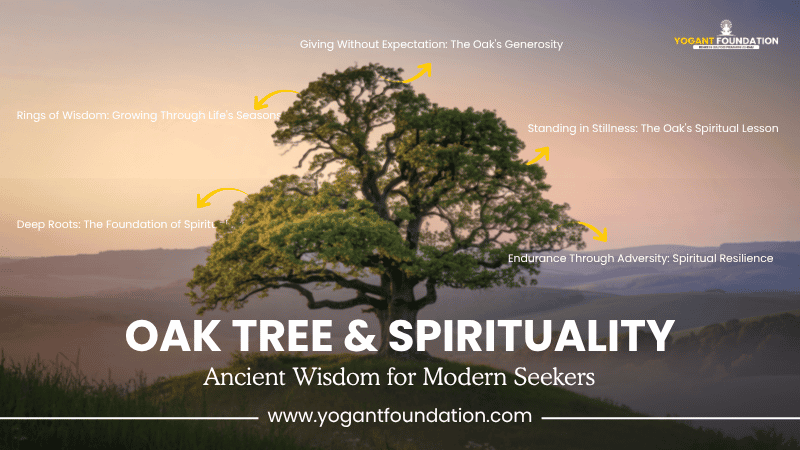
The Oak Tree and the Yogic Path
The oak tree displays the characteristics of yogic wisdom such as patience, grounding, and being present. Yogis are similar to trees in this way. Like yogis, oak trees root themselves deep into the ground, accessing stability beyond what is visible. An oak tree grows slowly with intention, signaling to us the importance of allowing our spiritual journeys to unfold over time, since growth cannot happen quickly.
The rings of an oak tree are a measurement of the seasons it has endured, similar to the self-discovery that we can uncover through meditation. An oak tree does not lose its stability through bending in the strongest of storms, which teaches us a great deal of resilience as we pursue our spiritual journeys.
Oak Tree Problems and Solutions
Common Pests
- Oakworm caterpillars: Feed on new leaves in spring. While they can defoliate a tree, oaks are tougher than you think and will often recover without treatment
- Oak leaf roller, aphids, and caterpillars: Various pests can affect oak health
Diseases to Watch For
- Oak Wilt: A dangerous fungus that blocks water flow inside trees, causing leaf browning, premature leaf drop, and tree decline
- Powdery mildew: White, powdery spots on leaves
- Oak Leaf Blisters: Raised spots scattered on leaves
- Oak Decline: Progressive dieback of crowns in mature red and white oaks
When to Call a Professional
The best person to give your tree a checkup is a licensed arborist with significant oak tree experience. Call for help if you notice :
- Dead or decaying branches
- Oozing wounds on the trunk
- Yellowing foliage
- Reduced vigor from year to year
The Oak Tree Role in Climate and Culture
Oak trees are foundational species that control wildlife populations, community dynamics, and ecosystem processes like carbon balance and water supply . Their deep roots and broad canopies help produce clean, steady streams of water and provide aquatic wildlife habitat .
For indigenous peoples, acorns are an important food source, and oak fibers are used in basketry, regalia, and structures . The cultural and aesthetic values of oaks extend to stately shade trees along boulevards, recreation areas, and spectacular foliage color in fall.
Frequently Asked Questions About Oak Trees
Q1: How long does an oak tree take to grow from an acorn?
From acorn to a mature tree that produces its own acorns takes about 40 years . However, the tree reaches full height and spread in about 20-30 years under optimal conditions . The first year, an oak seedling will only reach 4 to 12 inches .
Q2: Can I speed up my oak tree growth?
While you can’t significantly speed up an oak’s natural growth rate, you can ensure it reaches its maximum potential by planting in well-drained soil, providing full sun, and avoiding overwatering . Never fertilize a sick oak—this can actually harm it .
Q3: Why is my oak tree not producing acorns?
Oak trees typically start producing acorns at about 40 years old, peaking between 80 and 120 years . If your oak is mature but not producing acorns, it could be due to poor pollination, disease, or environmental stress.
Q4: Is an oak tree good for a small yard?
Most oak trees need significant space—they can reach 60-100 feet in height with spreads of 50-90 feet . However, there are smaller oak varieties and shrub-like species for drier habitats . Always research the mature size of the specific oak species before planting.
Q5: How can I tell if my oak tree is healthy?
Check your tree twice yearly—in summer for foliage health and in winter for structure . Signs of good health include full canopy coverage, normal leaf color and size, and absence of dead or decaying branches .
Conclusion: Planting for the Future
When you plant an oak tree, you are an optimistic person. You are thinking about and investing in the future. You are probably using an acorn or sapling, which take 40 and 50 years, respectively, to start producing more acorns and reach full maturity. Even after that, it will stand for a long, long time after with providing a habitat and source of beauty for many people and animals.
These trees are easy to care for, as long as you put them in well-drained soil and a sunny and dry spot, as well as not interfering with them. In return, oak trees give us so many gifts: clean everything, a habitat, and a living past.
First oak or oldest giant, remember that the tree is much more than just a tree, it is a piece if history that you will be taking care if for a long time.