
Om Namah Shivay | ॐ नमः शिवाय
Om Namah Shivay (ॐ नमः शिवाय) means “I bow to Shiva, the auspicious one.” It is the Panchakshara, the five-syllable mantra of Shaivism, and people chant it for calm, steadier focus and a feeling of closeness to Lord Shiva.
The words take a minute to learn. Plenty of people stay with them for decades. This guide explains what the mantra means, where it appears in the Vedas, how to chant it with or without a mala, how many times to repeat it, and what research does and does not say about its effects.
What does Om Namah Shivay mean?
Om Namah Shivay means “I bow to Shiva” or “salutations to the auspicious one.” Each of its three words does a separate job.
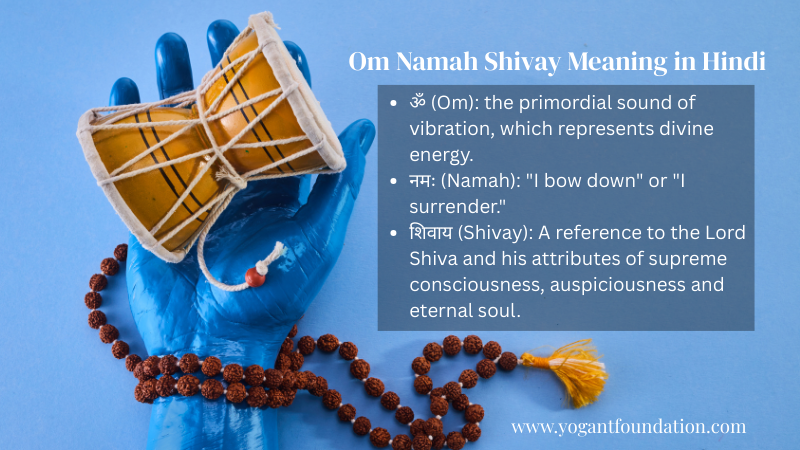
Om (ॐ) is the primal sound in Hindu tradition, the syllable that opens most mantras and prayers. Namah (नमः) means “I bow” or “I offer myself.” Shivay, written Shivaya in Sanskrit transliteration, is the dative form of Shiva, so it means “to Shiva.” The word shiva is itself an adjective meaning auspicious, kind or benign, which explains the translation “the auspicious one.”
Hindi meaning: ॐ नमः शिवाय का अर्थ है “मैं कल्याणकारी भगवान शिव को प्रणाम करता हूँ।” साधक इसे विनम्रता, समर्पण और ईश्वर से जुड़ाव का मंत्र मानते हैं।
Many teachers also read the mantra inward. In that reading, Shiva is the pure awareness present in every person, so bowing to Shiva means bowing to your own deepest self. Elizabeth Gilbert’s memoir Eat, Pray, Love brought this reading to a wide audience, where she wrote that the mantra meant “I honor the divinity within me.” That is a devotional interpretation. The literal translation is the same either way.
Where does the Om Namah Shivay mantra come from?
The mantra goes back to the Vedas. The five syllables without Om first appear in the Shri Rudram, a hymn to Rudra taken from the Taittiriya Samhita of the Krishna Yajurveda (TS 4.5.8.1). The line reads Namah shivaya cha shivataraya cha, which translates as “salutation to the auspicious one and to the more auspicious.” The same verse turns up in the Rudrashtadhyayi of the Shukla Yajurveda, in chapter 16, verse 41.
In that early setting, shiva was still an adjective describing Rudra. Over the centuries the word became a name, and the mantra became the most important chant in Shaivism. The Shiva Purana calls it the five-syllable mantra, or the six-syllable mantra when Om is added. The Tamil hymn collection Tiruvacakam opens with the letters Na, Ma, Shi, Va, Ya, and the Tirumantiram, a Shaiva Siddhanta text, describes those letters as the body of Shiva. Siddha Yoga, founded by Swami Muktananda, later made it the main meditation mantra for many students outside India.
What do the five syllables Na, Ma, Shi, Va, Ya stand for?
In Shaiva Siddhanta, each syllable has a meaning. Na is the Lord’s concealing grace. Ma is the world. Shi stands for Shiva. Va is the revealing grace. Ya is the Atman, the individual soul.
One way to read the sequence is as a path from the veiled world toward Shiva and the soul’s recognition of itself. Another tradition links the syllables to the five elements: earth, water, fire, air and space. Teachers pair them in slightly different ways, so treat these associations as aids for reflection and not as fixed rules.
How is Om Namah Shivay different from other Shiva mantras?
Om Namah Shivay is a salutation, and it asks for nothing. The Mahamrityunjaya mantra, which sits in the same Shri Rudram text, is a prayer for protection and liberation from the fear of death. Om Namo Bhagavate Rudraya, another mantra found in the Rudram, addresses Rudra directly. Devotees often chant these together. Most beginners start with Om Namah Shivay because it is short, easy to pronounce and widely taught.
How do you chant Om Namah Shivay?
Anyone can start chanting Om Namah Shivay today, with no initiation and no equipment. A little structure helps most beginners, so here is a routine that works.
- Choose a clean, quiet spot. An image of Shiva or a Shivalinga in front of you is welcome but not required.
- Sit with a straight spine in Padmasana, Sukhasana or on a chair. Comfort matters more than the name of the posture.
- Close your eyes and take five slow breaths. Some traditions suggest resting attention at the space between the eyebrows, the Ajna chakra.
- Begin with a long Om, then chant Na, Ma, Shi, Va, Ya, giving each syllable the same length. Let the sound hum in the chest and head.
- If you use a rudraksha mala, move one of its 108 beads with each repetition. When you reach the larger head bead, one round is complete. Turn the mala around instead of crossing it.
- When the mind wanders, notice it and return to the sound. That return is the practice.
- Finish with a minute of silence before you open your eyes.
Beginners do well with 5 to 10 minutes a day. Add time slowly. Regular practitioners often sit for 30 minutes to an hour.
What are the types of jaap, and how many times should you chant?
Mantra jaap comes in three forms, each quieter than the last.
- Vachik jaap (वाचिक जाप): chanting aloud.
- Upanshu jaap (उपांशु जाप): whispering so softly that only you hear it.
- Manasik jaap (मानसिक जाप): repeating the mantra silently in the mind.
Many traditions regard manasik jaap as the most powerful form, though beginners usually find it easier to focus when they chant aloud. Start aloud, move to a whisper when you feel settled, and go silent once the mind stays steady.
On counts, 108 is the standard figure for one round of a mala. A common goal is one round a day, and some devotees chant 1,008 repetitions on special occasions. Popular belief attaches outcomes to these numbers, such as peace at 108 and release from karmic debt at 1,008. Those are devotional claims and nobody can measure them. Pick a number you can keep up. Ten calm minutes every day will do more for you than one two-hour session a month.
When is the best time to chant Om Namah Shivay?
Any time works, because the mantra has no strict hour. Tradition favors Brahma Muhurta, the quiet window before sunrise, and the twilight at dusk. Mondays (Somvar) are sacred to Shiva, and many devotees increase their practice on Maha Shivratri and through Shravan month (Sawan).
The mantra also fits ordinary moments. People chant it before sleep, on a train or bus, before a hard conversation, or alongside yoga and pranayama to hold their attention steady.
What are the benefits of chanting Om Namah Shivay?
Devotees describe benefits in three areas: spiritual, emotional and physical. Research supports some of the emotional and physical ones indirectly, and none of the spiritual ones can be measured.
Spiritual benefits are matters of faith and experience. Practitioners describe more humility, a quieter ego and a sense of closeness to Shiva. In Shaivism the mantra is also a path toward moksha, liberation.
Calm and focus come from the structure of the practice. Repeating one phrase gives the mind a single object to come back to, which is the core of most meditation. Many people find it settles racing thoughts at bedtime.
The research needs careful reading, because most lab studies test the syllable Om and not the full mantra. A 2011 pilot fMRI study by NIMHANS in Bangalore, published in the International Journal of Yoga, scanned 12 healthy volunteers. Audible OM chanting was linked to reduced activity in limbic regions, including the right amygdala, compared with rest and with a control “ssss” sound. The authors suggested that the vibration around the ears may stimulate the auricular branch of the vagus nerve (Kalyani et al., 2011). A separate study of heart rate variability found that five minutes of OM chanting may raise parasympathetic activity, the body’s rest response.
Both studies are small. Neither shows that the mantra treats anxiety, depression or high blood pressure. If you live with a medical condition, treat chanting as a companion to your treatment and not a replacement for it.
Common mistakes to avoid
- Rushing the syllables. A mala round finished in four minutes is a race. Let each syllable end before the next begins.
- Forcing a perfect posture. Knee pain pulls attention away from the mantra, so sit on a chair if you need to.
- Chasing results. People who expect visible change in a week often quit by the second.
- Switching methods every few days. Keep one form of jaap for a month before you judge it.
Frequently asked questions
Can anyone chant Om Namah Shivay?
Yes. Most traditions today teach it to anyone, whatever their age, gender or background. A few older texts reserve the six-syllable form with Om for initiated groups, but the five-syllable form is described as open to all.
How many times should I chant it daily?
One mala round of 108 is the usual benchmark. If that feels like too much, begin with 5 to 10 minutes and build up. Regularity matters more than the count.
Is Om Namah Shivay the same as Namah Shivaya?
Yes. Namah Shivaya is the five-syllable form and Om Namah Shivaya is the six-syllable form with Om added. Shivay and Shivaya are two spellings of the same word.
Do I need a guru or initiation?
No. Some lineages offer formal initiation, and many practitioners value a teacher, but chanting the mantra does not require either.
Can I chant without a mala?
Yes. A mala only helps you count. You can chant by the clock instead, setting a timer for 5, 10 or 20 minutes, or count rounds on the finger joints of one hand. The attention you bring matters more than the beads.
Is it better to chant aloud or silently?
Aloud is easier for beginners, because the sound anchors attention. Silent jaap is considered the deeper form. Try each and keep the one that holds your focus.
Can Om Namah Shivay cure anxiety?
No mantra is a cure. Some studies suggest that chanting Om can relax the body, and many people use the mantra to feel calmer. For ongoing anxiety, see a doctor or therapist and treat chanting as a support.
Conclusion
Om Namah Shivay is a small mantra with a long textual history. Its five syllables appear in the Shri Rudram, it carries layered meanings in Shaiva Siddhanta, and it asks for little more than a quiet spot and a few minutes. Try it for ten minutes a day over the next month, notice what changes, and adjust from there. If a teacher or lineage speaks to you, learn from them.
Read Blog: The 7 Mukhi Rudraksha: Meaning, Benefits, and Mantra & 5 Mukhi Rudraksha – Meanings, Prices, Benefits and Mantras