
The importance of yoga is simple: it keeps your body strong and flexible, calms your mind, and helps you handle daily stress better. Yoga is not only exercise. It joins movement (asana), breathing (pranayama), and focus (meditation) in one practice.
You do not need a studio, fancy clothes, or a flexible body to begin. Ten minutes on a mat at home is enough to start feeling the difference.
In this guide, you will learn what yoga is, why it matters in daily life, which benefits have research behind them, five easy poses, a beginner plan, and the mistakes to avoid.
What Is Yoga?
Yoga is an ancient practice from India that connects the body, breath, and mind. The word comes from the Sanskrit root yuj, which means “to join” or “to unite.”
Many people think yoga means twisting into hard shapes. Postures are only one part. Classical yoga, described by the sage Patanjali, has eight limbs. They include ethical living (yama and niyama), postures (asana), breath control (pranayama), and meditation (dhyana).
Today, most people practice three things:
- Asana: physical postures that build strength and flexibility
- Pranayama: slow, controlled breathing
- Dhyana: meditation and quiet focus
Styles like Hatha, Vinyasa, and Iyengar use these tools in different ways. Hatha is slow and gentle. Vinyasa links poses with the breath and moves faster. Iyengar focuses on careful alignment. Since 2015, the world has also marked International Day of Yoga on 21 June.
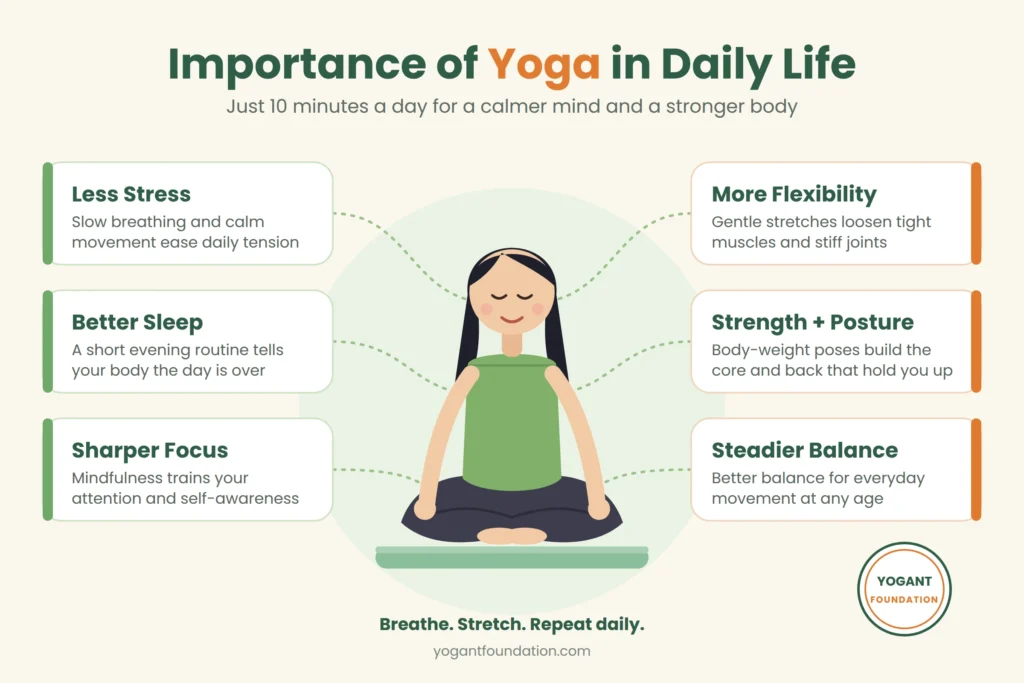
Why Is Yoga Important? Physical Benefits
The importance of yoga for your body is that it trains strength, flexibility, balance, and posture together. It also carries a lower injury risk than high-impact workouts, according to the US National Center for Complementary and Integrative Health (NCCIH).
Here is what regular yoga practice can do for you:
- Better flexibility. Gentle stretching loosens tight muscles and stiff joints, so bending, reaching, and climbing stairs feel easier.
- More strength. Poses like plank, chair pose, and Warrior II use your own body weight to build muscle.
- Better posture. Many of us sit for hours. Yoga strengthens the core and back muscles that hold your spine upright.
- Improved balance. A review of 15 studies found that yoga improved balance in healthy people in most of them, and newer studies point the same way for older adults.
- Relief from neck and back pain. Research suggests yoga can ease neck pain and may give a small benefit for lower back pain, about the same as other exercise.
- Support for a healthy weight. Yoga is not a heavy calorie burner. Still, studies show it can help with gradual weight loss, mostly by building better eating and activity habits.
One honest note: yoga is not a cure for any disease. It works best alongside medical care, good food, and enough sleep.
Mental and Emotional Benefits of Yoga
The mental importance of yoga is that it teaches your body and mind to slow down. When you move with your breath, your mind has one simple job: stay in this moment. That is mindfulness, and it is why many people feel calmer after yoga than after a gym session.
- Less stress. A 2020 review of 12 studies found that yoga lowered perceived stress in healthy adults in every one of them.
- Better mood. Yoga can be a helpful addition to treatment for depression and may ease anxiety symptoms. It does not replace therapy or medicine.
- Better sleep. Studies of older adults, cancer patients, and women with sleep problems found that yoga helped them sleep better. A short evening routine tells your body the day is over.
- Sharper focus. Watching your breath and balance trains your attention, which many people notice at work and in study time.
- More self-awareness. You start to notice tight shoulders, a clenched jaw, or a racing thought before they grow bigger.
The mind-body connection grows with practice. After a few weeks, many people find they react to stress with a pause instead of a snap.
Importance of Yoga for Different People
Importance of yoga bends to fit your life, so you can shape it around your age and routine.
Students. Long study hours bring tired eyes, a stiff neck, and exam nerves. Five minutes of seated breathing before you study helps you settle. Reviews of school yoga programs for ages 5 to 15 show promising results for mental health, though research is still growing.
Office workers. Sitting all day tightens the hips and shoulders. Try neck rolls, a seated twist, and a standing forward fold between meetings.
Women. Yoga can ease stress through different life stages. It may reduce menopause symptoms like hot flashes. For most pregnancies, gentle yoga is considered safe with a doctor’s approval, but hot yoga should be avoided.
Seniors. Gentle and chair yoga improve balance and flexibility. Go slowly, keep a chair or wall nearby, and learn from a trained teacher. Yoga-related injuries are treated in emergency rooms more often after age 65.
Athletes. Yoga loosens tight muscles and builds body control on rest days between hard training sessions.
5 Easy Yoga Poses for Daily Energy
These five poses need no equipment and take about ten minutes together. Breathe slowly through your nose in each one.
- Downward-Facing Dog (Adho Mukha Svanasana). Start on hands and knees, then lift your hips up and back. It stretches your calves, hamstrings, spine, and shoulders. Stay for five breaths.
- Warrior II (Virabhadrasana II). Step your feet wide, bend the front knee, and stretch both arms out. It strengthens your legs, opens your hips and chest, and builds steady focus. Hold five breaths on each side.
- Cobra Pose (Bhujangasana). Lie on your belly with hands under your shoulders. Lift your chest gently while your hips stay on the floor. It wakes up the back muscles and opens the chest, so it suits the morning.
- Sun Salutation (Surya Namaskar). This is a flowing sequence of 12 poses linked with your breath. Three to five rounds warm up the whole body and are a quick way to start the day.
- Child’s Pose (Balasana). Kneel, sit back on your heels, and rest your forehead on the floor. It is a resting pose that releases the lower back and calms your breathing. Use it any time you need a pause.
Pranayama and Meditation: The Quiet Side of Yoga
Poses get the most attention, but breathing and meditation are where yoga calms the mind.
Try this simple breathing exercise. Sit comfortably with a straight back. Breathe in through your nose for a count of four. Breathe out slowly for a count of six. Repeat ten times. A longer exhale helps your body shift into a calmer state.
Two other gentle options for beginners are alternate nostril breathing (Nadi Shodhana) and humming bee breath (Bhramari). Avoid forceful breathing styles until a trained teacher guides you. Centres like Yogant Foundation in Rishikesh teach pranayama along with Hatha yoga and meditation.
For meditation, sit for five minutes and follow your breath. When your mind wanders, gently bring it back. That moment of returning is the practice, so it is not a failure.
How to Start Yoga at Home: A Beginner’s Guide
Starting small is the secret. A short habit you keep beats a long session you skip.
- Begin with 10 to 15 minutes. A small commitment is easy to keep and does not overload you.
- Pick your time. Morning yoga gives energy. Evening yoga helps you unwind. Choose a time you can repeat daily, and wait about two hours after a heavy meal.
- Set up a calm corner. A flat floor, a mat, and loose clothes are enough. A plant or a candle can tell your mind it is time to slow down.
- Follow a simple routine. Try two minutes of slow breathing, three Sun Salutations, Warrior II on each side, Cobra Pose, then Child’s Pose and one minute of rest.
- Learn with a qualified teacher if you can. NCCIH notes that learning alone, without guidance, is linked to a higher risk of injury. For guided practice in Rishikesh, Yogant Foundation runs 3-day and 5-day yoga and meditation retreats with daily Hatha and Ashtanga classes.
- Track your progress. Mark each day on a calendar. Seeing the streak keeps you going.
On low-motivation days, just unroll your mat and stretch for two minutes. Often that is enough to get you moving, and even a short session brings calm and clarity.
Yoga is personal. Try Hatha, Vinyasa, or Iyengar and keep the style that feels right for you.
Common Yoga Mistakes and Safety Tips
Yoga is generally safe for healthy people when done with care. The most common injuries are sprains and strains, mostly in the knee or lower leg. Avoid these mistakes:
- Forcing a stretch. A stretch should feel firm, never sharp. Stop if you feel pain.
- Holding your breath. If you cannot breathe smoothly in a pose, ease out of it.
- Comparing yourself with others. Yoga is not a contest. Your pose will look different from the one on social media, and that is fine.
- Trying advanced poses too early. Beginners should skip headstands, shoulder stands, the lotus position, and forceful breathing.
- Choosing hot yoga without care. It brings a risk of overheating and dehydration.
Talk to your doctor first if you are pregnant, have a knee, hip, or lower spine problem, severe high blood pressure, balance issues, or glaucoma. Do not use yoga to delay seeing a doctor about a health problem.
Frequently Asked Questions About the Importance of Yoga
What is the importance of yoga in daily life?
Yoga builds strength, flexibility, and balance, and it lowers stress through slow breathing and focus. Even ten minutes a day can improve your mood, posture, and sleep.
How many minutes of yoga should I do every day?
Beginners can start with 10 to 15 minutes. As your habit grows, 20 to 30 minutes a day works well for most people.
What is the best time to do yoga?
Morning is great for energy, and evening is great for relaxing. The best time is the one you can keep every day, ideally on an empty stomach.
Can yoga replace the gym?
Not fully. Yoga builds flexibility, balance, and strength, but brisk walking or cycling adds the heart workout. Many people mix both.
Is yoga good for weight loss?
It can help. Studies show gradual weight loss, mostly because yoga improves eating and activity habits. Combine it with healthy food and other exercise.
Which yoga style is best for beginners?
Hatha yoga is a good start because it is slow and gentle. Once you feel confident, you can try Vinyasa or Iyengar.
Can yoga cure diseases?
No. Yoga can support your health and ease some symptoms, but it should not replace medical treatment.
Conclusion: Make Yoga Part of Your Day
The importance of yoga comes down to balance. It gives your body strength and ease, and it gives your mind a place to rest. You do not need to be flexible, fit, or free for an hour. You only need to show up for a few minutes, breathe, and move with care.
Tonight, unroll your mat and try the 10-minute routine above. Small steps, repeated daily, make the biggest change. For guided practice, visit Yogant Foundation in Rishikesh.