
Hatha Yoga: Create a Soothing Sanctuary
What about when you feel like sitting is a torture, because your mind is racing through tomorrow’s list of things to do, but your shoulders are up there by your ears? You’re not alone. The first time I attended a Hatha Yoga Class I found myself exhausted, sceptical and just wanting to stretch my hamstrings.
Here’s what nobody told me: Hatha yoga isn’t about touching your toes or twisting yourself into a human pretzel. It’s about something far more radical—actually being in your body instead of just dragging it around like an overworked Uber driver for your brain.
Whether you’re a complete beginner who can’t tell your Downward Dog from your Upward Dog, or an intermediate practitioner looking to deepen your understanding, this guide will walk you through everything you need to know about Hatha yoga—without the intimidating Sanskrit overload or the pressure to become an Instagram yogi overnight.
Let’s breathe through this together.
What Is Hatha Yoga?
Hatha yoga is a traditional branch of yoga that emphasizes physical postures (asana), breath control (pranayama), and meditation to create balance between body and mind. The Sanskrit word “Hatha” combines “ha” (sun) and “tha” (moon), representing the union of opposing energies—strength and flexibility, effort and ease, masculine and feminine. Unlike faster-paced styles, Hatha classes move deliberately, holding poses longer to build foundational strength, improve alignment, and calm the nervous system.
At its core, Hatha yoga isn’t just one specific style—it’s actually the umbrella term for virtually all physical yoga practices you’ll encounter in Western studios. Think of it like the term “martial arts.” Karate, judo, and taekwondo are all different, but they share common roots. Similarly, Vinyasa, Ashtanga, Iyengar, and even hot yoga all technically fall under the Hatha umbrella.
The foundational text, the Hatha Yoga Pradipika, dates back to the 15th century and outlines that a true Hatha practice only requires three elements: physical poses (asana), breathing techniques (pranayama), and meditation (dhyana). Everything else—the fancy leggings, the heated rooms, the carefully curated playlists—is optional.
Why Hatha Yoga Matters More Than Ever Right Now
We’re living through what researchers politely call “an epidemic of stress.” Your nervous system is constantly toggling between fight-or-flight mode and… well, more fight-or-flight mode. The result? Chronic tension, disrupted sleep, digestive issues, and a brain that feels like it has 47 browser tabs open at all times.
Here’s what recent research tells us about Hatha yoga’s impact:
Measurable stress reduction: A 2025 randomized controlled trial published in Psychoneuroendocrinology found that just eight weeks of Hatha yoga (60 minutes, three times weekly) led to significant reductions in self-reported momentary stress, even though diurnal cortisol patterns remained unchanged. Translation? You genuinely feel better, even if your stress hormones aren’t completely rewired overnight.
Physical fitness improvements: Researchers found that young women who participated in Hatha classes for just ten weeks showed significant gains in core strength, flexibility (measured as the time spent in planks), and balance. This was without having to practice daily.
The “forceful” effect: The word “hatha” literally translates to “force”—not in the sense of forcing your body into poses, but rather the practice’s forceful or powerful effect on moving energy (prana) through your system.
Perhaps most importantly, Hatha yoga offers something increasingly rare in modern life: permission to slow down without feeling guilty about it.
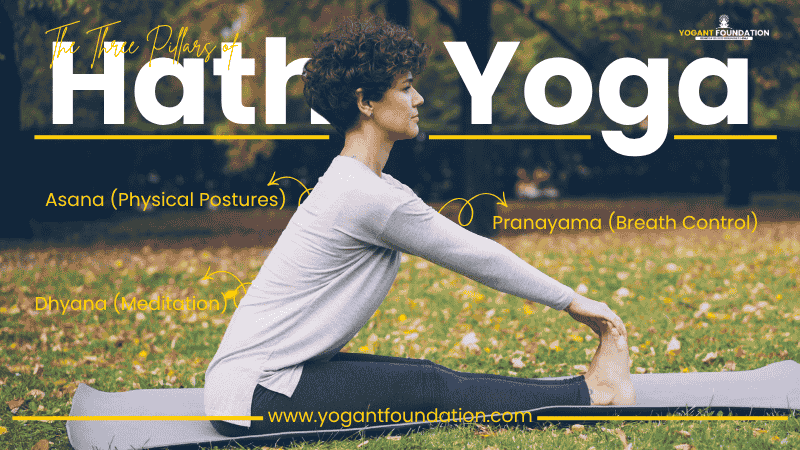
The Three Pillars of Hatha Yoga (And Why Each Matters)
1. Asana (Physical Postures)
This is what most of us picture when we think “yoga”—the poses. But in classical Hatha yoga, asana serves a deeper purpose than just stretching or strengthening. The postures are designed to prepare the body for extended periods of seated meditation by releasing tension, building core stability, and training the spine to remain comfortably erect.
Interestingly, the Hatha Yoga Pradipika only describes 15 asanas in detail . Today’s vast library of poses? That’s largely thanks to T. Krishnamacharya, who pioneered the modernization of Hatha yoga in the early 20th century, creating and documenting hundreds of new postures with detailed notes on their therapeutic effects.
2. Pranayama (Breath Control)
Asanas are the physical body of Hatha-yoga, while pranayama acts as its pulse. It is the combination of Prana (life energy or vitality) and Ayama (extension, control). Through breathing exercises, practitioners are able to control their nervous system and calm down mental chatter. They can also access deep states that science is just beginning to learn about.
The classical texts describe a progression: first equalizing the duration of inhalations and exhalations, then gradually increasing breath retention (kumbhaka), eventually reaching states where breathing becomes so subtle it nearly ceases.
3. Dhyana (Meditation)
Hatha Yoga ultimate goal is not to make you a Warrior II, but rather prepare the practitioner for mediation. The mind will naturally calm down when the body and breath are comfortable. Savasana is a relaxation pose that combines the energetic and physical work done in Hatha.
What Actually Happens in a Hatha Yoga Class: A Step-by-Step Walkthrough
If you’ve never been to a Hatha class (or you’ve been and felt completely lost), here’s exactly what to expect during a typical 60-90 minute session.
Step 1: Centering and Breath Awareness (5-10 minutes)
You’ll typically begin seated—either cross-legged on a bolster or blanket, or kneeling. The teacher guides you to notice your natural breath, often inviting you to close your eyes and arrive fully in the space. This isn’t just a nice ritual; it’s an intentional transition from the external chaos of your day to the internal focus of practice.
What you might hear: “Find a comfortable seat. Allow your eyes to close. Begin to notice the natural rhythm of your breath—not changing anything yet, just observing.”
Step 2: Gentle Warm-Up Movements (10-15 minutes)
Gentle mobilization will be done before you begin standing poses. Consider cat-cows on the hands and legs, wrist circles and neck rolls. This phase helps you prevent injuries by waking up your joints, increasing synovial (your body’s joint lubricant) and waking them up.
Pro tip: Pay attention during warm-ups. This is where you learn crucial alignment cues that will apply to more complex poses later.
Step 3: Standing Poses (20-30 minutes)
This is the “work” portion of class. You’ll move through foundational standing poses like Mountain Pose (Tadasana), Warrior I and II (Virabhadrasana I & II), Triangle (Trikonasana), and Extended Side Angle (Utthita Parsvakonasana). In Hatha, these poses are typically held for 3-5 breaths each—long enough to feel the pose, but not so long that you’re counting ceiling tiles.
Hatha classes follow the “pose-release-reset” method, which is different from Vinyasa classes, in that Vinyasa classes link poses quickly. After a certain pose you’ll take a deep breath and prepare for the next. Hatha is a great way to learn proper alignment because of the deliberate pace.
Step 4: Seated Poses and Forward Folds (10-15 minutes)
After standing work, you’ll come down to the mat for seated postures. This section often includes forward folds like Seated Forward Bend (Paschimottanasana), hip openers like Bound Angle Pose (Baddha Konasana), and gentle twists to release the spine.
Important sequencing note: Experienced teachers save seated forward folds for after the body is thoroughly warmed up. Attempting deep hamstring stretches cold is a recipe for strain.
Step 5: Backbends and Counter-Poses (5-10 minutes)
Backbends are energizing and heart-opening, but they require careful preparation. In Hatha, you’ll typically practice gentle backbends like Bridge Pose (Setu Bandhasana) or Locust Pose (Salabhasana). After each backbend, expect a neutralizing counter-pose—often simply lying on your back with knees bent.
Step 6: Final Relaxation – Savasana (8-15 minutes)
Although you might fall asleep, this is not a nap. Savasana is active, conscious relaxation. While lying flat on the back, your legs and arms are relaxed. Release tensions from all parts of your body. You may have heard it called “the hardest pose,” because the posture requires that you remain completely present and still.
Hatha Yoga vs. Other Popular Styles: What’s Actually Different?
This is where things get confusing, so let me clear it up with a straightforward comparison.
| Aspect | Hatha Yoga | Vinyasa Flow | Ashtanga Yoga |
|---|---|---|---|
| Pace | Slow, deliberate | Moderate to fast, fluid | Vigorous, athletic |
| Pose duration | 3-5 breaths per pose | 1 breath per movement | Set count per pose |
| Structure | Pose-by-pose with resets | Continuous flow between poses | Fixed sequence, same every time |
| Heat generation | Mild to moderate | Moderate to high | High, internally generated |
| Best for | Beginners, stress relief, alignment focus | Creative expression, variety, balanced workout | Discipline, routine, athletic challenge |
| Learning curve | Gentle introduction | Moderate | Steep, requires dedication |
The bottom line: Hatha is your foundation. It’s where you learn how to do yoga—the alignment principles, breath awareness, and body intelligence that make every other style safer and more effective. Many experienced practitioners cycle between styles: Hatha for grounding and refinement, Vinyasa for energy and creativity, Ashtanga for discipline and strength.
Common Hatha Yoga Mistakes That Sabotage Your Practice
Even with the best intentions, these sneaky errors can limit your progress or even lead to injury.
Mistake 1: The Collapsed Spine
Whether seated or standing, a rounded spine compresses your internal organs and restricts breath capacity. In Hatha yoga, the spine should maintain its natural curves—think “tall through the crown of the head” rather than military-stiff.
Fix it: Imagine a string pulling you upward from the crown of your head. Keep your chin parallel to the floor rather than jutting forward or tucking down.
Mistake 2: Forgetting to Breathe
It sounds obvious, but holding your breath during challenging poses is a universal human response. Unfortunately, it increases tension exactly when you need release.
Fix it: When a pose feels intense, consciously soften your exhale. Long, smooth exhales activate the parasympathetic nervous system—your body’s “rest and digest” mode.
Mistake 3: Pushing Into Pain
“Good pain” is a myth in yoga. Discomfort is part of growth; sharp, stabbing, or joint-specific pain is your body’s stop sign.
Fix it: Learn the difference between muscular sensation (dull, widespread, eases with breath) and joint pain (sharp, localized, worsens with continued pressure). Back off immediately from the latter.
Mistake 4: Skipping Savasana
Leaving class early to beat traffic? You’re missing the most physiologically important part of practice. Savasana allows your nervous system to integrate the work you’ve done—it’s when the real transformation occurs.
Fix it: Schedule your class so you can stay for the full practice. Even five minutes of conscious rest is better than none.
5 Practical Tips to Get the Most From Your Hatha Practice
1. Arrive Early, Leave Late
Give yourself at least 10 minutes before class to set up your mat, gather props, and transition mentally. Rushing onto your mat sets a frazzled tone for your entire practice.
2. Embrace Props Without Shame
Blocks, straps, blankets, and bolsters aren’t “cheating”—they’re intelligent tools that help your unique body access poses safely. Many Hatha poses are held long enough that props become essential for comfort and alignment.
3. Focus on Your Own Mat
The person next to you might be casually folding themselves into positions that would send you to the ER. Ignore them. Your practice is about your body, your breath, your present moment. Comparison is the thief of yoga joy.
4. Communicate With Your Teacher
Arrive with injuries, pregnancy, or just feeling “off”? Tell your teacher before class. They can offer modifications and adjustments to keep you safe. A good teacher wants this information.
5. Practice Consistently, Not Perfectly
Research suggests that even once-weekly Hatha practice yields measurable benefits. You don’t need to practice daily to feel the effects. Consistency matters more than intensity or duration.
FAQ: Your Hatha Yoga Questions, Answered Clearly
Q: Is Hatha yoga good for complete beginners?
Hatha style is generally considered beginner friendly. It is easier to understand the foundational positions, learn how to align correctly, and gain body awareness with the slower pace. You can start your yoga journey with a Hatha “beginner’s” class or a “gentle”.
Q: How is Hatha different from Vinyasa yoga?
The primary difference is pacing and structure. Hatha classes move deliberately, holding poses for several breaths with resets between postures. Vinyasa flows continuously, linking one breath to one movement in sequences that feel more like a dance. Hatha emphasizes static strength and alignment; Vinyasa emphasizes cardiovascular conditioning and fluid transitions.
Q: What should I wear to a Hatha class?
Comfortable, stretchy clothing that allows full range of motion. Leggings or loose-fitting athletic pants, a fitted top that won’t fall over your head during forward folds, and bare feet. Avoid overly baggy clothes that might get tangled or reveal more than intended during inversions. Leave jewelry at home—dangling earrings and necklaces become annoyances quickly.
Q: Can Hatha yoga help with back pain?
Many practitioners report significant relief from chronic back pain with consistent Hatha practice. The combination of gentle strengthening (particularly core and back muscles), improved flexibility, and heightened body awareness can address many underlying causes of back discomfort. However, always consult your healthcare provider before starting any new exercise regimen, especially if you have diagnosed spinal conditions.
Q: How often should I practice Hatha yoga to see benefits?
Even once weekly yields noticeable improvements in stress levels, flexibility, and overall well-being. For more significant gains in strength and flexibility, aim for 2-3 sessions per week. The key is sustainability—a consistent weekly practice maintained over months will serve you better than a 30-day challenge followed by burnout.
Q: Do I need to be flexible to do Hatha yoga?
Absolutely not. This is perhaps the most persistent myth about yoga. Flexibility is a result of practice, not a prerequisite. Hatha yoga meets you exactly where you are. Props, modifications, and patient progression allow any body to practice safely and effectively. If you’re breathing, you can do yoga.
The Deeper Why: What Hatha Yoga Offers Beyond the Mat
Here’s something the class descriptions rarely tell you: Hatha yoga is ultimately preparation for sitting still.
In the classical tradition, all those poses, all that breath work, all the sweating and stretching—it’s designed to make your body comfortable enough and your mind calm enough to sit in meditation without distraction. The Hatha Yoga Pradipika devotes only about 10% of its text to asana. The rest covers purification techniques, breath control, energetic locks, and the path toward meditative absorption.
What does this mean for you, a modern practitioner who might never sit for an hour of silent meditation? It means Hatha yoga offers something increasingly precious: the capacity to be present in your own life.
When you learn to stay with discomfort in Warrior II, you’re training for staying with difficult conversations. And You practice softening your breath through challenging poses, you’re building the skill of regulating your nervous system during stressful moments off the mat. When you rest completely in Savasana, you’re reclaiming your birthright to deep, restorative stillness.
The Sanskrit word “yoga” translates to “union”—the joining together of body and mind, effort and ease, sun and moon energy. Hatha yoga doesn’t promise to fix your life. It offers something better: a practice that meets you exactly where you are, again and again, and gently guides you toward balance.
Ready to Begin Your Hatha Yoga Journey?
The hardest part of any yoga practice is showing up the first time. The second hardest is showing up the second time. After that, something shifts—you start to crave the clarity that follows practice, the way your body feels more like home, the surprising peace of simply breathing with intention.
Find a beginner-friendly Hatha class at a local studio, community center, or even online. Wear something comfortable. Bring an open mind and a healthy dose of self-compassion. Leave your expectations at the door.
Your mat is waiting. And so is the version of you that knows how to breathe through anything.
What’s your biggest hesitation about trying Hatha yoga? Drop your questions in the comments below—I’d love to help you take that first step.