
Meditation Techniques Guide for Beginners
Let’s be honest for a moment. If you have ever tried to meditate and ended up feeling more frustrated than relaxed, you are in good company. There is something oddly stressful about being told to “just breathe” when your brain feels like a browser with fifty tabs open. You sit down, close your eyes, and suddenly you are thinking about your grocery list, that awkward thing you said three years ago, and whether or not you remembered to reply to that email. || Meditation Techniques ||
The problem is rarely you. The problem is usually that you haven’t yet found the right meditation techniques for your specific mind. We are often told that meditation is simple—just sit and be still. But for many of us, sitting still is the hardest part. The good news is that there are dozens of techniques in meditation, each designed to work with a different type of brain, a different mood, and a different goal. Think of this as your friendly guide to exploring those options without judgment and without pressure.
What Are Meditation Techniques? | Definition
A meditation techniques is simply a structured way to train your attention. Instead of sitting there hoping your mind will go quiet on its own, you give it a gentle job to do. That job might be watching your breath, repeating a soothing word, slowly moving your body, or even imagining a peaceful scene. Each technique gives your brain something clear to focus on, which makes it easier to stop the endless loop of overthinking.
Why Mastering Different Techniques Matters
Imagine if you only owned one tool in your toolbox. You would try to use a screwdriver for everything—even when what you really needed was a hammer. Meditation is the same. If you only know one way to meditate, you might try to use it when you are exhausted, anxious, or restless, and wonder why it is not working.
When you understand a few different meditation techniques, you gain the ability to choose. Feeling scattered? You might pick a technique that anchors your attention. Feeling heavy with sadness? You might pick a technique that opens your heart. Feeling too tired to sit up? You might pick a technique that lets you lie down and rest deeply. This choice is empowering. It takes meditation from being a chore you “should” do to being a tool you actually want to use.
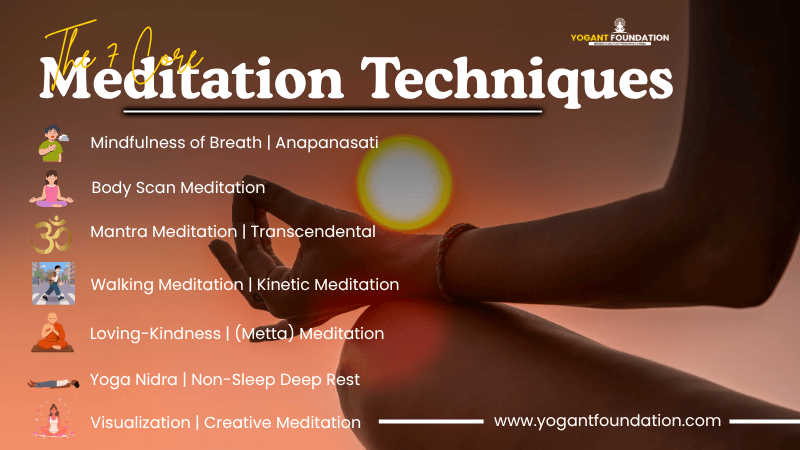
The 7 Core Meditation Techniques | Steps
Let’s walk through seven different approaches. Read them slowly and notice if any of them feel like a “yes” in your body. That sense of ease is usually a good sign that a technique might suit you.
1. Mindfulness of Breath | Anapanasati
This is the one most people think of when they hear the word meditation. It is simple but surprisingly powerful.
- How to do it: Find a comfortable seat. It can be a chair, a couch, or a cushion on the floor. Close your eyes or soften your gaze. Notice where you feel your breath most clearly—maybe it is the rise and fall of your belly, or the gentle movement of your chest. Just rest your attention there.
- What happens: Your mind will wander. This is not a mistake. The moment you notice you have wandered off into thought, you simply come back. Every time you return, you are strengthening your attention like a muscle.
- Why it works: It teaches you that thoughts come and go, and you do not have to follow every single one.
2. Body Scan Meditation
If you carry stress in your shoulders, your jaw, or your stomach, this technique is a wonderful relief. It brings your awareness out of your thinking mind and into your physical body.
- How to do it: Lie down on your back or sit comfortably. Bring your attention to the top of your head. Slowly move your awareness down—to your forehead, your eyes, your jaw, your neck, your shoulders. Do not try to change anything. Just notice. Is there tightness? Tingling? Warmth?
- What happens: Often, simply noticing a tense area allows it to soften on its own.
- Why it works: It interrupts the habit of living entirely in your head and reminds you that you have a body that needs your attention.
3. Mantra Meditation | Transcendental Meditation Style
For people who struggle with silence or have a very busy inner voice, repeating a word or sound can be like giving the mind a gentle lullaby.
- How to do it: Choose a word that feels nice to you. It could be something traditional like “peace” or “calm,” or even a simple sound like “om”. Silently repeat that word to yourself, slowly and gently. When you notice your mind has drifted, just come back to the word.
- What happens: The repetition creates a rhythm that soothes the nervous system.
- Why it works: It gives your mind something to do, so it stops creating its own distractions.
4. Walking Meditation | Kinetic Meditation
If sitting still makes you antsy, this is a beautiful alternative. You can do it indoors in a hallway or outside in nature.
- How to do it: Stand still for a moment. Feel your feet on the ground. Start walking very slowly—much slower than usual. Notice the sensation of lifting one foot, moving it forward, and placing it down. You can coordinate this with your breath if you like.
- What happens: You have a full awareness of your surroundings and your own body.
- Why it works: It proves that meditation does not require stillness. Movement can be just as meditative.
5. Loving-Kindness | (Metta) Meditation
This technique is for the heart. It is especially helpful if you struggle with self-criticism, anger toward others, or a general sense of disconnection.
- How to do it: Sit comfortably and bring to mind someone you care about easily—a friend, a family member, or even a pet. Repeat phrases such as “May you always be happy” in a low voice. You will be in safety. “May you feel at ease.” Try directing these phrases to yourself after a few moments.
- What happens: Over time, this practice softens harsh inner voices and builds genuine warmth.
- Why it works: It activates the parts of your brain associated with empathy and connection.
6. Yoga Nidra | Non-Sleep Deep Rest
Sometimes you do not need to “work” at meditation. You just need to rest. This technique is often guided by a recording or a teacher.
- How to do it: In a position that is comfortable, lie down. You can cover up with a quilt if you get cold easily. You will hear a voice guide you in a relaxing journey, moving from one part of the body to another and encouraging each area to release tension.
- What happens: You enter a state between wakefulness and sleep. It is deeply healing for exhaustion and burnout.
- Why it works: It allows your nervous system to reset without you having to do anything.
7. Visualization | Creative Meditation
This technique is playful and creative. It is used by athletes, artists, and anyone who wants to cultivate a sense of calm or confidence.
- How to do it: You can close your eyes, and then take some deep breaths. Imagine being in an environment where you are completely at ease and safe. You can imagine a place, or it could be a real one. Explore the area with all your senses. What can you see, what can you smell and how do it make feel? Spend a few moments in the place.
- What happens: Your body often relaxes as if you were actually in that safe place.
- Why it works: You brain doesn’t always distinguish between a vividly imagining experience or a true one. Visualization creates real calm.
Meditation Techniques | Practical Tips & Expert Strategies
To rank well and actually help readers, we need to move beyond the basics. Here is how experts optimize their practice:
Technique Rotation: Just as athletes cross-train, meditators should cross-train. Use Mindfulness for focus during work hours, Loving-Kindness if you feel irritable, and Yoga Nidra for sleep recovery.
The “2-Minute” Rule: Don’t set a goal to meditate for 20 minutes. Set a goal to simply start. Often, the resistance is to the beginning, not the practice itself. Commit to just 2 minutes of your chosen meditation techniques once you start, you’ll likely want to continue.
Stack Your Habits: Attach your practice to an existing habit. “After I brush my teeth, I will meditate for 3 minutes.” This leverages the existing neural pathway of the habit.
Meditation Techniques | Common Mistakes to Avoid
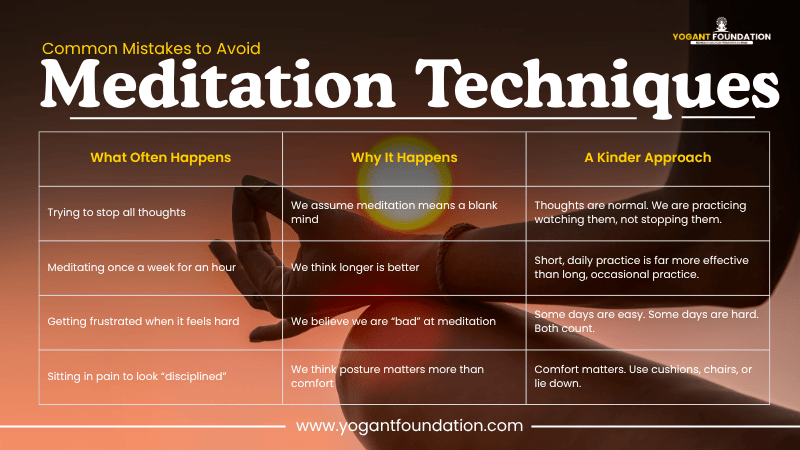
Even well-meaning meditation techniques often fall into these traps. Recognizing them can save you a lot of frustration.
| What Often Happens | Why It Happens | A Kinder Approach |
|---|---|---|
| Trying to stop all thoughts | We assume meditation means a blank mind | Thoughts are normal. We are practicing watching them, not stopping them. |
| Meditating once a week for an hour | We think longer is better | Short, daily practice is far more effective than long, occasional practice. |
| Getting frustrated when it feels hard | We believe we are “bad” at meditation | Some days are easy. Some days are hard. Both count. |
| Sitting in pain to look “disciplined” | We think posture matters more than comfort | Comfort matters. Use cushions, chairs, or lie down. |
Choosing the Right Meditation Techniques for You | Comparison Table
Choosing the right meditation techniques depends entirely on your current state and goals. Use this table as a quick reference guide.
| Technique | Primary Goal | Best For | Difficulty Level |
|---|---|---|---|
| Mindfulness of Breath | Focus & Awareness | Beginners, ADHD | Easy |
| Body Scan | Somatic Release | Insomnia, Chronic Pain | Easy |
| Mantra | Calming the “Monkey Mind” | Anxiety, Overthinking | Easy/Medium |
| Walking | Grounding | Restlessness, Nature lovers | Easy |
| Loving-Kindness | Emotional Regulation | Anger, Social Anxiety, Burnout | Medium |
| Yoga Nidra | Deep Restoration | Trauma, Fatigue, PTSD | Easy (Requires guide) |
| Visualization | Goal Setting & Confidence | Athletes, Performance anxiety | Medium |
Meditation Techniques | Pro Tips & Advanced Insights
Once you feel comfortable with the basics, you might notice that your relationship with meditation begins to shift. Here are a few insights that often come with time:
- You stop fighting distractions. Instead of getting annoyed when the dog barks or your mind races, you begin to welcome those moments as opportunities to practice coming back.
- You notice the gap. You start to notice that there is a small space between a feeling arising and you reacting to it. That space is freedom.
- Meditation leaves the cushion. You find yourself taking a deep breath before answering a difficult email. You find yourself pausing to notice the texture of the grass under your feet. The practice seeps into your daily life.
Frequently Asked Questions
Q1: What is the best meditation techniques for a beginner?
Try a different technique. If you tried sitting still and watching your breath, try walking meditation or repeating a mantra. Often, giving up means the technique did not suit your temperament, not that you are incapable of meditating.
2. How long do I need to meditate to feel calmer?
You can feel calmer after just a few minutes. Even three minutes of conscious breathing signals your nervous system to shift out of fight-or-flight mode. Consistency matters more than duration.
3. Is it okay to meditate lying down?
Yes, absolutely. The only caution is that if you are very tired, you might fall asleep. If you want to stay awake, sitting up helps. But if sleep is what you need, there is nothing wrong with sleeping.
4. Can I practice more than one type of meditation techniques?
Yes. Many people use different techniques for different times of day. A mantra in the morning to start the day calmly, a body scan in the afternoon to release tension, and deep rest in the evening to wind down.
5. What if I feel worse when I meditate?
Sometimes when we sit still, emotions we have been avoiding bubble up. This is normal, but it can feel unsettling. If this happens, try a more active technique like walking meditation, or consider practicing with a teacher or therapist who can support you.
Conclusion: Your Journey Starts with a Single Breath
You have read about many different meditation techniques, and maybe one of them felt like a quiet “yes.” That is your intuition guiding you. You do not need to master all of them. Do not need to do it perfectly. You just need to start somewhere small.
Close this page for a moment if you like, and try one technique for just two minutes. Notice how it feels. Not good or bad—just notice. That simple act of noticing is the beginning of a relationship with your own mind that can grow deeper over time.
Your mind is not broken. It is just untrained, like a puppy that needs gentle guidance. Every time you sit, every time you return your attention, you are training it with kindness. And over time, that kindness becomes your natural way of being.