
Balkuwari Temple is a hilltop shrine to the goddess Shakti, worshipped here as Maa Balkuwari. It sits on the Neelkanth road in the Pauri Garhwal hills, roughly 23 to 25 km from Rishikesh, and you reach it by climbing about 400 stone steps from the road. Most people give it two to three hours. Pair it with the Patna Waterfall hike and it becomes a comfortable half-day.
This guide covers what the temple is, the legends around it, the exact route from Rishikesh, how hard the climb really is, when to go, and what to pair it with. I’ve also been upfront about what I couldn’t confirm, because a lot of pages on this temple repeat each other without checking.
What is Balkuwari Temple, and who is Maa Balkuwari?
It’s a small, quiet Devi temple on a ridge above the Neelkanth road, dedicated to Shakti, the divine feminine. Maa Balkuwari is understood as a form of the Mother Goddess, and local belief links her with Goddess Parvati. Local sources call the place a Siddh Peeth, which in everyday use means a spot where devotees feel prayers are answered.
Parents are among the most regular visitors. Travel writers who cover the temple note that families come to ask for a child’s health and success in studies.
You’ll see the name written many ways: Balkuwari, Balkunwari, Balkumari, Bal Kunwari, Balkuwari Mata Mandir. They all point to the same Rishikesh shrine. One small trap: there’s a famous Balkumari Temple in Bhaktapur and Patan in Nepal. Different place, different tradition. If you’re searching online, add “Rishikesh” or “Neelkanth.”
Where exactly is Balkuwari Temple located?
It’s in the hills of Pauri Garhwal district, Uttarakhand, on the road that climbs from Rishikesh towards Neelkanth Mahadev Temple. Local guides place it about 25 km from Rishikesh’s main market and about 23 km from Laxman Jhula, a little past Garud Chatti, near the Pipalkoti diversion on the Yamkeshwar road.
| Detail | What sources say |
|---|---|
| District | Pauri Garhwal, Uttarakhand |
| Distance from Rishikesh market | About 25 km |
| Distance from Laxman Jhula | About 23 km |
| Nearest road landmark | Pipalkoti / Neelkanth diversion, past Garud Chatti |
| Distance to Neelkanth Mahadev | Roughly 5 to 8 km (sources disagree) |
| Climb from the road | About 400 stone steps |
| Elevation | About 1,300 m, per one local guide’s blog |
The elevation figure comes from a single local source, so treat it as approximate. Neelkanth Mahadev itself is listed by the Pauri Garhwal district administration at 32 km from Rishikesh by road via the barrage, or 22 km via Ram Jhula. Once you’re on the Neelkanth road, Balkuwari comes before the main temple.
From the top, you look down on Amdi and Gyoth villages on either side, and across the valley towards the Yamkeshwar block and the Hanwal river.
What is the story behind the temple?
There isn’t one agreed, documented history. What exists is local legend, and it’s worth treating it as exactly that.
The most repeated story says Goddess Parvati chose this quiet ridge for her penance. A second tradition links the site to the Pandavas of the Mahabharata. Neither is backed by an archaeological record that I could find. Neither needs to be, for a devotee. But if you’re writing a school project or planning a talk, call them local beliefs, not established history.
For comparison, the nearby Neelkanth Mahadev has a documented legend (the Samudra Manthan story, where Shiva drank the poison that came out of the churning of the ocean) and a recorded renovation history. Balkuwari doesn’t have that paper trail, and that’s part of why it feels like a village shrine rather than a monument.
Is Balkuwari Temple a Shakti Peeth?
Not in the traditional sense, as far as I can tell. The classical Shakti Peeths are the 51 sites (sometimes counted differently) where, in the Sati legend, parts of the goddess’s body fell. Uttarakhand has a few places that carry the Siddh Peeth label, and Surkanda Devi near Dhanaulti is often listed among the Shakti Peeths.
Balkuwari is described locally as a Siddhpeeth, and one yoga-school blog even prints “Jai Maa Balkunwari Siddhpeeth” at the top. I couldn’t find it on a standard list of the 51 Shakti Peeths. So the honest wording is: a Shakti shrine, locally revered as a Siddh Peeth.
How do you reach Balkuwari Temple from Rishikesh?
Go by taxi or your own vehicle along the Neelkanth road towards Pipalkoti, then walk the last stretch. It’s roughly an hour’s drive, winding but scenic, with the Ganga and the forested valley alongside you at stages.
Step by step:
- Leave Rishikesh (Laxman Jhula or Tapovan side) and head for the Neelkanth road via Garud Chatti.
- Continue to the Pipalkoti diversion and follow the Yamkeshwar road.
- Look for the temple on the hill to your left. Local guides say it’s visible from the road.
- About half a kilometre along the Pipalkoti to Yamkeshwar road, a footpath leads off near the small village of Idiya. Expect a walk of roughly a kilometre in total, with the main gate coming into view after the first few hundred metres.
- Climb the roughly 400 steps to the shrine.
Can you go by bus or shared transport?
Local blogs mention buses and shared options along the Neelkanth route, but timetables change and I couldn’t verify a fixed schedule. A hired taxi for a few hours is the simplest option, and it lets you add Patna Waterfall and Neelkanth on the same run.
How do visitors from the US or UK get there?
Fly to Delhi (DEL), then continue to Rishikesh by road or by train to Haridwar or Rishikesh and onward by taxi. Dehradun’s Jolly Grant airport is the closest airport to Rishikesh. From your Rishikesh hotel, the temple is a half-day outing. Book the taxi through your stay a day ahead, and agree the waiting time before you set off.
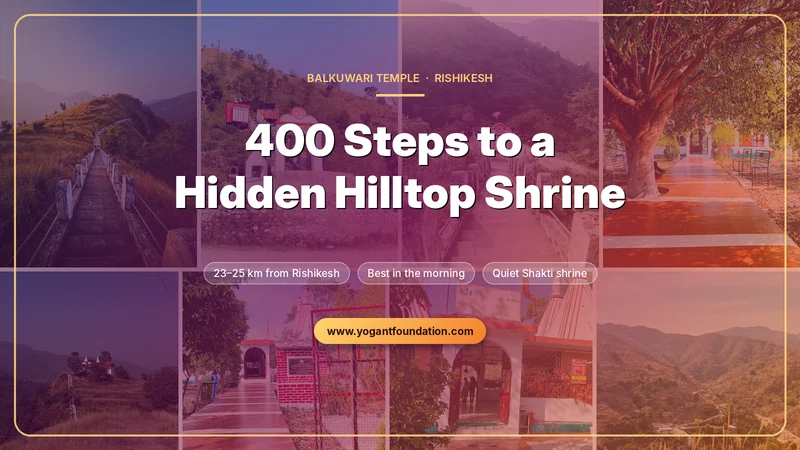
How hard is the climb up the 400 steps?
For most healthy adults it’s manageable: a steady 15 to 30 minutes up with a few rests, depending on fitness and heat. It’s not technical, just a lot of stairs. The guided tour listings for this hike mention moderate fitness as a requirement and don’t recommend it for travellers with poor cardiovascular health.
Some practical points:
- Go slowly on the first fifty steps. Everybody starts too fast.
- Carry water. There may be little to buy near the steps, so don’t count on it.
- Wear shoes with grip. Stone steps get slippery when damp.
- Remember you’ll be going back down, which tires the knees in a different way.
What are the temple timings and is there an entry fee?
I couldn’t find a reliable published timing or fee for Balkuwari Temple. Tour operators bundle “admission included” into their packages, which suggests visiting is free or very low cost, but that isn’t the same as an official statement.
What to do: ask your driver or guesthouse the day before, aim for morning, and treat late afternoon as risky because of the stairs and fading light. For Neelkanth, listings show regular aarti times, but those don’t apply to Balkuwari.
When is the best time to visit Balkuwari Temple?
Morning, and outside peak monsoon. Early starts mean cooler stairs, softer light for photographs, and fewer people. October to March is generally pleasant in the Rishikesh foothills; summers get hot on those steps.
The monsoon (roughly July to September) is the one to be careful with. Temple-listing sites warn that the Neelkanth region is landslide-prone in that season, so check road conditions before you leave.
If you’re thinking about sunrise or sunset: a hill with open valley views rewards both, but there are no published sunrise-ritual timings that I could verify. Sunset means descending 400 stone steps in fading light, so if you choose that, bring a torch and leave a margin.
What can you do around the temple?
The big one is the Patna Waterfall, and then the Neelkanth Mahadev temple further up the road. Many visitors do all in one trip.
How do you combine Balkuwari Temple and the Patna Waterfall in one day?
Do the temple first, while you’re fresh, then the waterfall. Day-tour operators sell exactly this as a 5 to 6 hour private outing from Rishikesh, with prices starting at around US$35 per person on international booking sites. Prices vary by group size, so treat that as a guide, not a quote.
About the waterfall itself:
- It’s about 6.5 km from Laxman Jhula on the Neelkanth road.
- The trailhead is opposite a roadside “Sidh Bali Temple” pin on maps, with no clear sign.
- The hike is roughly 3 km round trip and takes about two hours with time at the falls. It’s easy.
- The flow is gentle. In summer it can dry up; in monsoon the trail gets muddy.
- It sits in forest on the edge of Rajaji National Park, so stay on the path and avoid hiking in low light.
Should you continue to Neelkanth Mahadev afterwards?
If you have the time, yes. It’s the main Shiva shrine of the area, in Pauri Garhwal, and it makes sense as a second stop. Note that road distances differ by route, from 22 km via Ram Jhula to 32 km via the barrage.
How does Balkuwari Temple compare with Kunjapuri?
Both are hilltop Devi temples near Rishikesh. Kunjapuri is better known and easier to reach; Balkuwari is quieter and asks more of your legs.
| Balkuwari Temple | Kunjapuri Temple | |
|---|---|---|
| Direction from Rishikesh | Neelkanth road | Tapovan / Narendranagar side |
| Steps from road | About 400 | About 80 (per trek operators) |
| Altitude | About 1,300 m (one local source) | About 1,676 m (trek operators) |
| Crowds | Usually quieter | Busier, especially at sunrise and Navratri |
| Best for | Calm, short pilgrimage, pairing with Patna Waterfall | Sunrise views, easier access |
If you only have time for one and want sunrise mountain views, Kunjapuri is the classic. If you want fewer people and a bit of effort, Balkuwari suits you better.
What mistakes do visitors usually make at Balkuwari Temple?
- Going too late in the day. The stairs are the problem, not the temple.
- Assuming the Nepal temple is the same. It isn’t.
- Skipping water. People underestimate 400 steps.
- Trusting one source on distances. Figures differ, so confirm with your driver.
- Expecting facilities. This is a village hill shrine, not a developed tourist site.
- Visiting in heavy monsoon. Roads and trails turn slippery and risky.
- Treating legends as documented facts in articles or talks.
Who should take extra care before visiting?
Anyone with heart or breathing problems, bad knees, or trouble with long stair climbs should think twice, or ask their doctor first. Tour listings specifically advise against it for people with poor cardiovascular health. Young children and older relatives can still go, but plan rests, and consider whether someone could wait at the bottom. Don’t push through chest pain or dizziness. Come back down.
Please also dress modestly, keep shoes off at the sanctum, and ask before photographing people or the deity.
Can you meditate or do yoga at Balkuwari Temple?
Yes, in the sense that the courtyard is calm and open, and local guides describe it as a good place for quiet sitting and breathing practice. Keep it low-key: sit at the edge, don’t block the path, and don’t set up a group session without asking the people who look after the shrine.
A simple five-minute routine works well after the climb: stand and let your heart rate settle, take ten slow breaths with a longer exhale, then sit and watch the valley. It resets you before the walk down.
Which questions do visitors ask most about Balkuwari Temple?
Is Balkuwari Temple the same as Balkumari Temple?
In Rishikesh, yes. Balkuwari, Balkunwari and Balkumari are spelling variants of one shrine. The Balkumari temple in Nepal’s Kathmandu valley is a separate place.
How far is the temple from Neelkanth Mahadev?
Sources give roughly 5 to 8 km, with the temple lying on the way. Ask your driver for the exact stretch on the day.
How long does the whole visit take?
Plan 2 to 3 hours for the temple including the drive stops and climb. With Patna Waterfall, tour operators quote 5 to 6 hours from a Rishikesh hotel.
Do you need a guide?
Not strictly. The route is straightforward with a driver. A guide helps if you want the local stories and a smooth waterfall trail.
Is it safe for solo women travellers?
It’s a regularly visited shrine, but remote roads are quieter in the late afternoon. Go in the morning, tell your stay where you’re going, and arrange return transport before you start.
Can children and older adults make the climb?
Many do, with rests. Judge by the person, not the age. The stairs are the challenge, so keep your pace to the slowest member.
What should you carry?
Water, a light snack, sun protection, grip shoes, a small cloth or scarf, some cash in small notes for offerings, and a torch if you’ll be late.
So, is Balkuwari Temple worth the trip?
Yes, if you like quiet places and don’t mind stairs. Balkuwari Temple gives you a calm Shakti shrine, valley views, a short Himalayan-foothill drive, and an easy add-on at Patna Waterfall. It isn’t a grand monument, and it doesn’t pretend to be.
The short version: roughly 23 to 25 km from Rishikesh, about 400 steps, go in the morning, avoid heavy monsoon, and confirm timings locally. If you’re staying in Rishikesh for yoga or retreat, a morning here is a simple way to see the hills around you. If you’d like to build a retreat around days like this, you can look at the programmes at Yogant Foundation.