
Bhojan Mantra | How to Practice Before Meals
I still remember the first time my grandmother gently placed her hand on mine, stopping me from grabbing my plate of steaming dal and rice. Bhojan Mantra
“Wait,” she said softly. “We eat with gratitude, not just hunger.”
Then she closed her eyes, and in a whisper that seemed to hold centuries, she recited what I’d later learn was the bhojan mantra. I was maybe seven years old, impatient, and definitely more interested in the aloo paratha on my plate than in any Sanskrit words. But something about that moment stuck with me.
Years later, sitting alone in a cramped apartment in New Jersey, staring at a takeout container, I found myself repeating those same words. And I understood for the first time why my grandmother insisted on them.
That tiny pause. That moment of acknowledgment. It changes everything about how you eat.
What Is the Bhojan Mantra, Really?
If you grew up in an Indian household, you’ve probably heard it. The bhojan mantra is simply a prayer or chant recited before eating. But calling it “just a prayer” misses the point entirely.
In Sanskrit, bhojan means food, and mantra means a tool for the mind. Put them together, and you have something quite practical: a tool to shift your mind before you nourish your body.
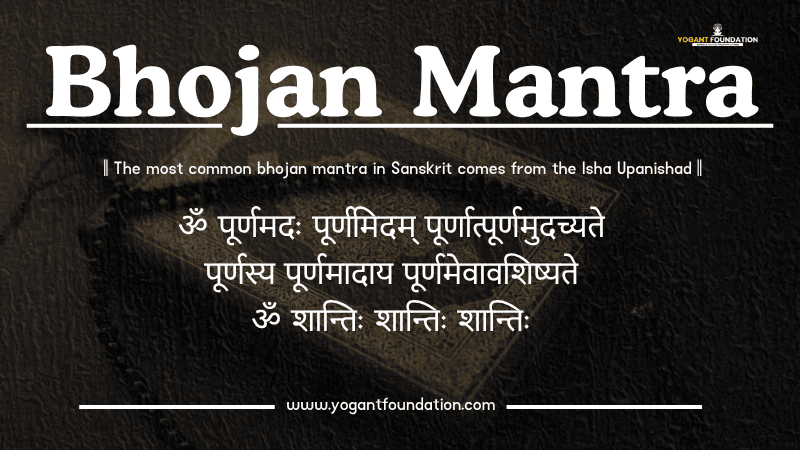
The most common bhojan mantra in Sanskrit comes from the Isha Upanishad:
ॐ पूर्णमदः पूर्णमिदम् पूर्णात्पूर्णमुदच्यते
पूर्णस्य पूर्णमादाय पूर्णमेवावशिष्यते
ॐ शान्तिः शान्तिः शान्तिः
But here’s the thing—you don’t need to be a Sanskrit scholar to get the point. You don’t even need to recite it perfectly. What matters is the intention behind it.
Why I Started Saying It Again | Why You Might Want To
Look, I’ll be honest. For most of my twenties, I dropped the habit entirely. I was busy. I was “modern.” I thought it was just something my grandparents did out of superstition.
But here’s what happened: I developed the worst relationship with food.
I ate while scrolling through Instagram & answering work emails. I ate standing at the kitchen counter, barely tasting anything. Food became fuel at best, and at worst, something I felt guilty about.
Then one day, my mom visited me in the US. She brought some homemade thepla and—you guessed it—recited the bhojan mantra in Hindi before we ate:
ॐ अन्नपूर्णे सदापूर्णे शङ्करप्राणवल्लभे ।
ज्ञान वैराग्य सिद्ध्यर्थं भिक्षां देहि च पार्वति ॥
I laughed at first. But I sat with her. And I noticed something strange: the food tasted better. Not because she’d done anything different with the spices, but because for those few minutes, I was actually present.
The Science Behind the Sanskrit
This isn’t just feel-good philosophy. There’s real science here.
When you take a moment before eating—whether through a bhojan mantra or any mindful practice—you activate your parasympathetic nervous system. That’s the “rest and digest” mode. Your body shifts from fight-or-flight to a state where it can actually absorb nutrients properly.
Here’s what actually happens:
- Your digestion improves because you’re relaxed
- You eat slower, giving your brain time to register fullness
- You make better food choices because you’re not eating on autopilot
- Your stress levels drop, which literally changes how your body processes food
And that’s just the physical side.
The Bhojan Mantra in Hindi vs Sanskrit | Which One Should You Use?
One question I get asked a lot: “Do I need to use the Sanskrit version, or can I say it in Hindi?”
The short answer: whichever one actually makes you feel something.
If Sanskrit feels like a foreign language you’re just parroting without understanding, it’s probably not going to do much for you. The point isn’t the language—it’s the shift in consciousness.
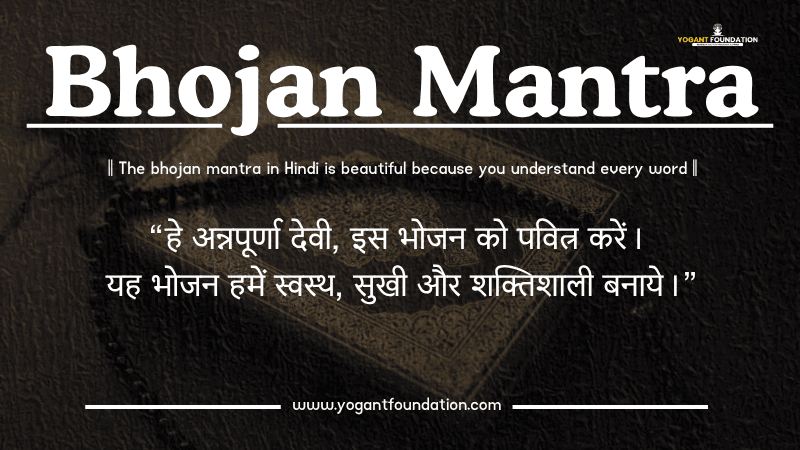
The bhojan mantra in Hindi is beautiful because you understand every word. A simple one goes:
“हे अन्नपूर्णा देवी, इस भोजन को पवित्र करें। यह भोजन हमें स्वस्थ, सुखी और शक्तिशाली बनाये।”
Translation: “Goddess Annapoorna, sanctify this food. May this food make us healthy, happy, and strong.”
But you don’t even need a formal mantra. My grandfather’s “mantra” was just a quiet “Thank you for this meal” in his mother tongue. It counted.
How to Actually Practice It | Without Feeling Awkward
If you’re new to this, or if you’re trying to bring it back into your life, here’s my advice from someone who fumbled through the awkward phase:
Start with just three seconds.
That’s it. Before you take your first bite, pause. Close your eyes if you can. Take one breath. Acknowledge the food in front of you.
If you want to add words, keep it simple:
- “I’m grateful for this meal.”
- “Thank you to everyone who made this possible.”
- “May this food nourish me.”
The bhojan mantra in whatever language you choose is just scaffolding for that moment of awareness.
What if you’re eating alone? I do it anyway. Honestly, that’s when I need it most. Eating alone in a foreign country, far from family, the mantra became my way of feeling connected to something larger than my loneliness.
What if you’re eating with non-Indian friends? I’ve done this plenty of times. A simple pause before eating is respected in almost every culture. You don’t have to chant loudly. A quiet moment of thanks is universal.
The Deeper Meaning Nobody Talks About
Here’s what I’ve come to understand after years of practicing this.
The bhojan mantra isn’t really about the food. It’s about remembering that we are part of something larger.
Every meal represents hundreds of hands:
- The farmer who grew the grain
- The worker who harvested it
- The truck driver who transported it
- The shopkeeper who stocked it
- The person who cooked it (even if that person is you)
When you recite the mantra, you’re acknowledging that no meal is truly self-made. It’s a humbling practice in a world that constantly tells us we’re independent and self-sufficient.
I noticed this shift in myself & stopped complaining about food. I stopped wasting it carelessly. I started understanding what my grandmother meant when she said, “Anna daata sukhī bhava”—may the giver of food be happy.
Adapting the Practice for Modern Life
Let’s be practical. We don’t all live in joint families with time for elaborate rituals. Here’s how I’ve adapted it for my chaotic life:
For the work-from-home lunch crowd: Set your fork down. Take three breaths. Say your bhojan mantra in Hindi or Sanskrit or English. Then eat away from your keyboard. Even 5 minutes without screens changes everything.
For the family dinner chaos: Get everyone to hold hands for a moment before serving. A simple “Let’s take a moment” can be the mantra. Kids might roll their eyes at first. Mine did. Now they remind me.
For eating out: I do a silent version. No one even notices. But I notice. My digestion is better, I order less, and I actually enjoy what I eat instead of inhaling it.
For when you’re stressed about food: This one is important. If you struggle with food guilt or disordered eating, the mantra can actually help. It shifts the focus from “this is bad for me” to “this nourishes me.” It creates space between the anxiety and the action.
A Simple Bhojan Mantra for Beginners
If you want to start today, here’s the easiest version I know. You can say it in whatever language feels right:
“I receive this food with gratitude.
May it nourish my body,
Calm my mind,
And strengthen my spirit.
I am grateful for all who made this meal possible.”
That’s it. No pressure to get Sanskrit pronunciation perfect. No need to memorize anything complex.
If you do want to learn a traditional bhojan mantra in Sanskrit, the one from the Bhagavad Gita is simple and widely used:
“ब्रह्मार्पणं ब्रह्म हविः
ब्रह्माग्नौ ब्रह्मणा हुतम्
ब्रह्मैव तेन गन्तव्यं
ब्रह्मकर्मसमाधिना”
It essentially reminds us that the food, the eater, and the act of eating are all one. Pretty profound for something that takes ten seconds to say.
Frequently Asked Questions
What is the bhojan mantra?
The bhojan chant, or mantra, is a Hindu prayer or chant recited in front of meals. The bhojan mantra is used to show gratitude and acknowledgment of the connection between everything involved in food’s preparation.
What is the bhojan mantra in Hindi?
A simple one in Hindi goes like this: “हे अन्नपूर्णा देवी, इस भोजन को पवित्र करें। यह भोजन हमें स्वस्थ, सुखी और शक्तिशाली बनाये।” It’s asking Mother Annapoorna to bless the food so it actually does what food is supposed to do—make us healthy, happy, and strong. Nothing complicated. Just a little gratitude before you eat.
What is the bhojan mantra in Sanskrit?
The most common bhojan mantra in Sanskrit comes from the Isha Upanishad: “हे अन्नपूर्णा देवी, इस भोजन को पवित्र करें। यह भोजन हमें स्वस्थ, सुखी और शक्तिशाली बनाये।” which speaks about the wholeness and completeness of existence.
Can non-Hindus say the bhojan mantra?
Absolutely. This mantra emphasizes gratitude and mindfulness. These are values that all humans share. The mantra can be adapted to your language, whether it’s the Sanskrit or Hindi versions. It is important to practice pausing, and giving thanks.
Do I need to say it out loud?
No. Practice is internal. The goal is to create a moment’s awareness just before eating. Whether you think, speak, or whisper the words, they have the same impact.
What if I forget to say it before eating?
Then just pause mid-meal. There’s no rule that says it has to be before the first bite. The intention is what matters. I’ve stopped halfway through a sandwich, put it down, and taken a breath. It still counts.
Here’s What I Want You to Take Away
You don’t have to be religious to benefit from this. You don’t need to know Sanskrit. Don’t need to be Indian. You don’t need to sit cross-legged on a meditation cushion.
You just need to pause.
In a world that wants you to eat faster, multitask through every meal, and treat food like just another item on your to-do list, the bhojan mantra is a small rebellion. It’s three seconds of saying, “This matters. I matter. The food I eat matters.”
My grandmother passed away a few years ago. But every time I pause before a meal—whether it’s a simple roti-sabzi or a sad desk salad—I feel her hand on mine again.
“Wait,” she seems to say. “Eat with gratitude.”
And I do.
So here’s my challenge to you: try it for one week. Just one meal a day. Pause for three seconds. Say something—anything—that expresses thanks. And notice what shifts.
Not because it’s a ritual you should do. But because you deserve to eat with presence, with peace, and with a full heart.
The food will still be there. But you’ll arrive at it differently.
Annadata sukhī bhava. May the giver of food be happy. And today, that giver includes you.