
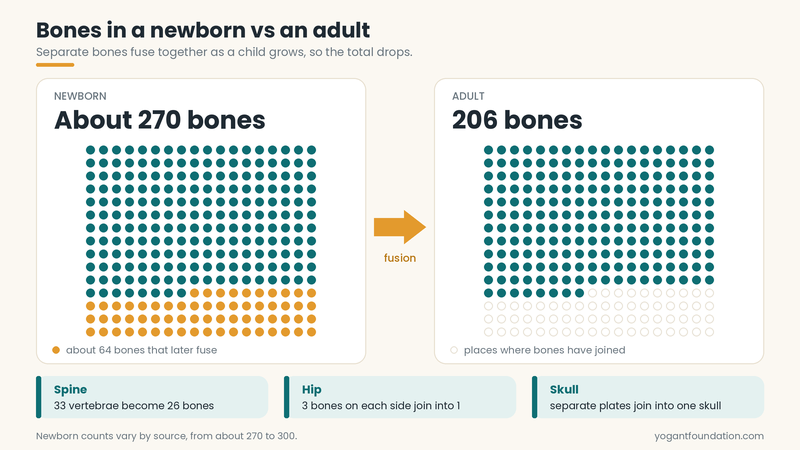
An adult has 206 bones in human body. A newborn has more, usually around 270 and sometimes close to 300, because many small bones fuse together as a child grows.
That number is what most people search for, and it usually leads to the next questions. Which bone is the longest? Which is the smallest? How are the bones grouped? This guide answers all of them. It covers how many bones are in the human body at each stage of life, the names of the main bones in the human skeleton, a region-by-region count that adds up to 206, and the jobs bones do besides holding you upright.
The facts come from established anatomy references, and where sources disagree the article says so. Measurements are given in centimetres and inches, so the numbers are easy to use whether you are reading from India, the US, Indonesia, the UK or anywhere else.
Quick Answers: Bones in Human Body at a Glance
- Total bones in an adult: 206 (the standard textbook figure).
- Bones in a newborn: about 270, sometimes quoted as up to 300.
- Longest and largest bone: the femur (thigh bone).
- Smallest bone: the stapes, deep inside the middle ear.
- Share in the hands and feet: 106 of the 206 bones, more than half.
- Bones in men versus women: the same count.
How Many Bones Are in the Human Body?
A fully grown adult has 206 bones. This is the total bones in human body figure used in school biology and most anatomy textbooks, and it describes a typical skeleton after growth has finished and the separate pieces of some bones have joined.
Some sources give a range instead. Cleveland Clinic says adults have between 206 and 213 bones. Normal variation explains the gap, since a few people carry extra small bones, such as an additional rib or small sesamoid bones in the hands and feet. Treat 206 as the standard answer and expect small differences from person to person.
Do men and women have the same number of bones?
Yes. Men and women both have 206 bones in the typical adult skeleton. The shapes differ in places, for example the female pelvis is usually wider, but the count does not change.
Do teeth count as bones?
No. Teeth are hard and high in calcium, but they consist of different tissues than bone: enamel and dentin. They are left out of the 206.
How Many Bones Are in a Baby?
A newborn has about 270 bones, according to Cleveland Clinic, while other references quote closer to 300. The totals differ because parts of a baby’s skeleton are still soft cartilage, so the number depends on what is counted as a separate bone.
Either way, a baby has more bones than an adult. Nothing disappears as a child grows. Separate pieces join together, and that is why the count drops to 206.
Why do babies have more bones than adults?
Many bones start life as several smaller pieces joined by cartilage. Three examples show how this works:
- Skull: a baby’s skull is made of plates with soft gaps between them. The gaps let the head pass through the birth canal and give the brain room to grow, and they close over the first couple of years.
- Spine: infants typically have 33 separate vertebrae. In adults the lower nine fuse into the sacrum (5) and the tailbone, or coccyx (4), which leaves 24 movable vertebrae.
- Hip: each hip bone begins as three bones, the ilium, ischium and pubis, which fuse by the late teens.
Long bones such as the thigh bone also have growth plates near each end, areas of cartilage where the bone lengthens. These plates harden and close in the late teens, and a few bones keep fusing until around the mid-20s.
How do a baby’s bones change with age?
| Stage | What changes |
|---|---|
| Birth | About 270 bones. Skull plates are separate, and much of the skeleton is cartilage. |
| First two years | Soft spots on the skull close. Cartilage keeps turning into bone. |
| Childhood | Long bones lengthen at the growth plates. |
| Teenage years | Hip bone pieces fuse. Growth plates begin to close. |
| Early to mid-20s | The last fusing finishes and the skeleton settles at 206 bones. |
How Many Bones Are in Each Part of the Human Skeleton?
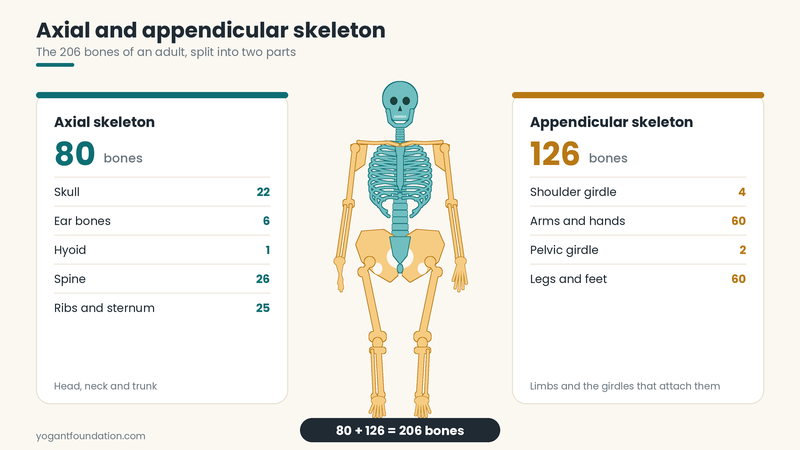
The human skeleton is split into two divisions. The axial skeleton has 80 bones and forms the central line of the body: the skull, spine, ribs and breastbone. The appendicular skeleton has 126 bones and includes the arms, legs and the girdles that attach them to the axial skeleton.
| Division | Region | Bones | What it includes |
|---|---|---|---|
| Axial | Skull | 22 | 8 cranial bones and 14 facial bones |
| Axial | Ear bones | 6 | Malleus, incus and stapes in each ear |
| Axial | Hyoid | 1 | A U-shaped bone in the neck |
| Axial | Spine | 26 | 24 vertebrae, the sacrum and the coccyx |
| Axial | Ribs and sternum | 25 | 24 ribs (12 pairs) and the breastbone |
| Appendicular | Shoulder girdle | 4 | 2 collarbones and 2 shoulder blades |
| Appendicular | Arms and hands | 60 | 30 per side, wrist and finger bones included |
| Appendicular | Pelvic girdle | 2 | The 2 hip bones |
| Appendicular | Legs and feet | 60 | 30 per side, ankle and toe bones included |
| Total | 206 | 80 axial plus 126 appendicular |
Why do the hands and feet have so many bones?
Each hand has 27 bones and each foot has 26, so the hands and feet hold 106 of the 206 bones. The wrist alone has 8 small carpal bones, and the ankle has 7 tarsal bones. Many small bones moving against each other allow fine finger control and let the foot adjust to uneven ground.
What are the common names of the main bones?
Medical names can be confusing, so here are the everyday names beside them:
- Collarbone: clavicle
- Shoulder blade: scapula
- Breastbone: sternum
- Upper arm bone: humerus
- Forearm bones: radius and ulna
- Thigh bone: femur
- Kneecap: patella
- Shin bone: tibia
- Outer lower leg bone: fibula
- Jaw bone: mandible
Which Is the Longest and Largest Bone in the Human Body?
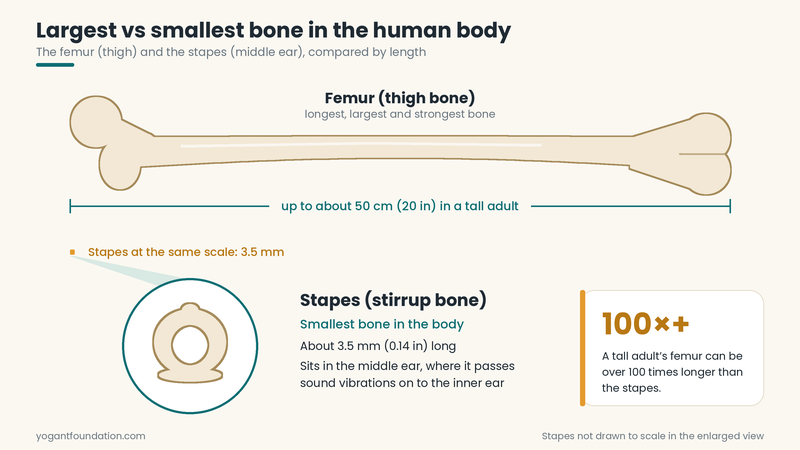
The femur, or thigh bone, is both the longest and the largest bone in the human body. Cleveland Clinic also lists it as the strongest. It runs from the hip to the knee and carries much of the body’s weight when you stand, walk or run.
Length depends on height. A Live Science report quotes a physician describing the femur as nearly 50 cm (20 inches) long in adults, which fits a tall person. In a shorter adult it will be less.
The word “largest” can mean different things, so a few other record holders are worth knowing. The hip bone is the largest flat bone, the mandible (jaw bone) is the largest facial bone, and the kneecap is the largest sesamoid bone, which means a bone that sits inside a tendon.
Which Is the Smallest Bone in the Human Body?
The stapes is the smallest bone in the human body. It sits in the middle ear and is shaped like a stirrup, which is what its name means in Latin. Cleveland Clinic gives its length as about 3.5 mm, roughly one-tenth of an inch.
The stapes is one of three tiny ear bones, called ossicles. The other two are the malleus (hammer) and the incus (anvil). Together they pass sound vibrations from the eardrum to the inner ear. Each ear has three, which is why the 206 count includes 6 ear bones.
Bone records at a glance
| Bone | Location | What makes it notable |
|---|---|---|
| Femur | Thigh | Longest, largest and strongest bone |
| Humerus | Upper arm | Longest bone in the arm |
| Hip bone | Pelvis | Largest flat bone |
| Mandible | Jaw | Largest facial bone |
| Patella | Knee | Largest sesamoid bone |
| Stapes | Middle ear | Smallest bone, about 3.5 mm |
What Are the Main Types of Bones?
Anatomists sort bones into five types by shape. The shape of a bone usually tells you what it does.
| Type | Examples | Main job |
|---|---|---|
| Long | Femur, humerus, tibia | Act as levers for walking, lifting and reaching |
| Short | Wrist (carpal) and ankle (tarsal) bones | Give stability with small, controlled movement |
| Flat | Skull bones, ribs, breastbone, shoulder blade | Protect organs and give muscles wide surfaces to attach to |
| Irregular | Vertebrae, some facial bones | Fit complex roles, such as shielding the spinal cord |
| Sesamoid | Kneecap | Sit inside tendons and improve the leverage of a muscle |
What Do the Bones in the Human Body Do?
The human skeleton does five main jobs, and only the first is the one most people think of.
- Support: The skeleton is the framework that gives the body shape and helps hold you up.
- Protection: Your skull protects your brain heart and lungs are protected by ribs vertebrae surround spinal cord.
- Movement: Muscles pull on bones across joints: You have movement The force comes from the muscles, and leverage comes from the bones.
- Blood cell production: Red bone marrow (this is located in the centre of a large bone such as the hip bones and pelvis and femur) produces blood.
- Mineral storage: Bone tissue stores most of the calcium in our bodies and can release it into blood when other tissues are in need.
Bone is also living tissue. It has a hard outer layer and a lighter, spongy interior, and it keeps renewing itself throughout life. Old bone is broken down and new bone is laid down in its place, which is how a broken bone is able to heal.
Why Do Some People Have More or Fewer Than 206 Bones?
The 206 count describes the typical adult. Real skeletons vary a little, and these are the usual reasons:
- Extra sesamoid bones: small, pea-shaped bones in tendons of the hands and feet, which the standard count leaves out.
- A cervical rib: an extra rib that grows above the first normal rib.
- Extra or missing fingers and toes, which change the count of hand and foot bones.
- Small bones along the joints of the skull, which some people have and others do not.
- Bones that fused differently, for example at the base of the spine.
These differences are usually harmless and are often found by chance on an X-ray. Talk to a doctor only if there is pain, swelling or a change in how a limb moves.
How Can You Keep the Bones in Your Body Strong?
Bone mass generally peaks in early adulthood and declines slowly afterward, so habits you build early pay off later. The basics are simple:
- Get enough calcium. The NIH Office of Dietary Supplements lists 1,000 mg a day for adults aged 19 to 50 and 1,200 mg a day for older adults. Milk, curd, paneer, ragi, tofu, leafy greens and canned fish with soft bones are all sources.
- Look after your vitamin D. Vitamin D helps the body absorb calcium. Ask a doctor before taking a supplement, because the right dose depends on your blood levels.
- Do weight-bearing exercise. Walking, jogging, climbing stairs, strength training and standing yoga poses all make bones work against gravity.
- Avoid smoking and heavy drinking, both of which are linked with weaker bones.
- Get checked when risk is higher. A family history of osteoporosis, early menopause or long-term steroid use are reasons to ask about a bone density test.
This section is general information. It does not replace advice from a doctor who knows your health history.
Common Mistakes When Learning About the Skeleton
Students and parents tend to trip over the same few points:
- Using 206 for every age. That figure is for adults. A baby’s count is higher.
- Counting teeth. They are not bones and are not part of the 206.
- Mixing up the leg bones. The femur is the thigh bone, the tibia is the shin and the fibula is the thinner bone beside it.
- Memorising the total with no structure. It is easier to remember 80 axial plus 126 appendicular bones, then the regions in the table above.
- Treating bone as dead material. Bone is living tissue that keeps rebuilding itself.
- Worrying about small differences. A person with an extra rib or a few extra small bones is usually healthy.
Frequently Asked Questions About Bones in the Human Body
How many bones are in the human body?
An adult has 206 bones. A newborn has about 270, and the number falls as separate bones fuse during growth.
Which is the largest bone in the human body?
The femur, or thigh bone. It is also the longest and strongest bone in the body.
What is the smallest bone in the human body?
The stapes, a stirrup-shaped bone in the middle ear. Cleveland Clinic gives its length as about 3.5 mm.
Which part of the body has the most bones?
The hands and feet. The two hands have 54 bones between them and the two feet have 52, which makes 106 of the 206.
How many ribs do humans have?
Facts 12: Almost everyone has 24 ribsWomen have the same number of ribs as men; we all have a total of 24. However, seven pairs connected directly with the breastbone, while three pairs connect through cartilage and two other pairs, known as floating ribs do not attach to the front.
How many bones are in the human skull?
The skull consists of 22 bones: 8 in the cranium which forms a protective case around the brain, and another 14 that make up the face. If we break them down into types of bones, there are 6 ear bones because each ear has all three tiny bones in separate count.
Does the number of bones change in adulthood?
Not in a typical adult. The count stays at 206 once growth is finished, although bone density can fall with age. Broken bones heal because the body keeps rebuilding bone tissue.
Conclusion
The bones in the human body number 206 in an adult and about 270 in a newborn, with the drop coming from bones that fuse during childhood and the teenage years. The femur is the longest and largest bone, the stapes in the ear is the smallest, and more than half of all bones sit in the hands and feet. Bones also protect organs, make blood cells and store calcium, so they are worth looking after with a calcium-rich diet, regular weight-bearing exercise and a check-up if you are at higher risk.
If you want a guided way to build a regular movement habit, Yogant Foundation offers yoga and meditation programs in Rishikesh, India. You can read about the programs on the website.