
Elaichi is the Hindi and Urdu name for cardamom, a fragrant spice made from the seed pods of a plant related to ginger. The small green kind (choti elaichi, or hari elaichi) goes into masala chai, kheer and biryani. The large dark kind (badi elaichi) is smoky and goes into savoury dishes and garam masala.
Most people know elaichi by its smell long before they know anything about it. This guide covers the types, what research honestly says about its benefits, how much is sensible to use, and a few simple ways to bring it into your day. Where the evidence is thin, we’ll say so.
What is elaichi, exactly?
Elaichi is cardamom. The green version comes from a plant called Elettaria cardamomum, which belongs to the ginger family (Zingiberaceae). The part we use is the dried pod and the tiny black seeds inside it.
Green cardamom is native to southern India and is now also grown in places like Sri Lanka and Guatemala. It has a long history in Ayurveda, where it’s called ela. It’s also one of the priciest spices by weight, usually ranked just behind saffron and vanilla, because the pods are picked by hand and need careful drying.
In English you’ll see it called green cardamom, true cardamom or cardamom pods. In Urdu it’s written الائچی, and Pakistani kitchens use the same word, elaichi (sometimes spelt ilaichi or elachi).
What are the different types of elaichi?
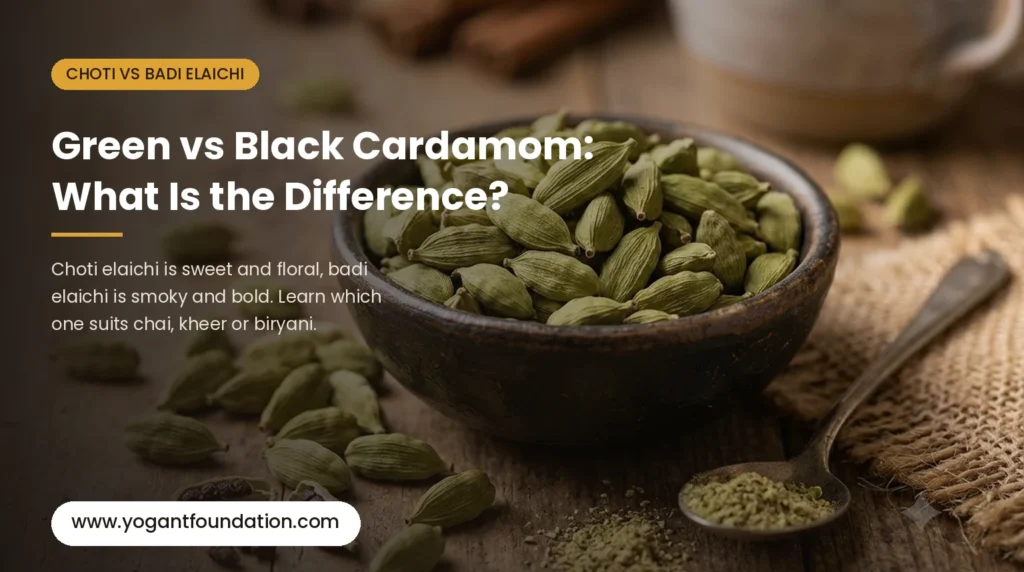
There are two main types: green (choti) and black (badi). They come from different plants and taste quite different.
| Green elaichi (choti / hari) | Black elaichi (badi / moti) | |
|---|---|---|
| Botanical name | Elettaria cardamomum | Amomum subulatum |
| Size and colour | Small, pale green pod | Large, dark brown, wrinkled pod |
| Flavour | Sweet, floral, slightly citrusy | Smoky, earthy, camphor-like |
| Native area | Southern India | Eastern Himalayas (Sikkim, eastern Nepal, parts of West Bengal) |
| Typical use | Chai, kheer, halwa, sweets, rice | Biryani, dal, curries, garam masala |
There’s also white elaichi. It’s simply green cardamom that has been bleached, and it has a milder flavour. Most home cooks never need it.
What is the difference between choti elaichi and badi elaichi?
The short answer: choti elaichi is sweet and aromatic, badi elaichi is smoky and strong. You can’t swap one for the other without changing the dish.
If you put badi elaichi in a cup of chai, it’ll taste like a campfire. If you drop choti elaichi into a heavy mutton curry, the flavour mostly disappears. Use green for sweets and drinks, black for slow-cooked savoury food.
Why does elaichi smell and taste the way it does?
The aroma comes from essential oils in the seeds. One of the main compounds is 1,8-cineole (also called eucalyptol), which gives the cool, fresh note you notice when you crack a pod. Another is alpha-terpinyl acetate, which adds the sweet, floral part.
The exact mix changes with where the cardamom is grown and how it’s stored, which is why pods from different farms smell slightly different. It also explains why old, dried-out pods taste flat: the oils have evaporated.
What are the benefits of elaichi?
It has a lot of traditional uses and a growing pile of early research. But most of that research is on animals or cells in a lab, and the human studies are small. So treat these as possible benefits, not guaranteed results.
Here’s where things stand:
- Digestion and bloating. It has long been chewed after meals in India for exactly this reason. Some lab and animal studies suggest it may help with gut spasms and nausea, but large human trials are lacking.
- Fresh breath. This one is easy to believe. The strong oils mask odour, and some lab studies show cardamom extract acting against bacteria linked to gum problems. A pod after a meal won’t replace brushing, though.
- Inflammation and antioxidants. Cardamom contains plant compounds with antioxidant activity. A review of studies found that cardamom supplements lowered some inflammation markers in the blood, though that doesn’t tell us what happens to long-term health.
- Blood pressure and blood sugar. Some small studies hint at an effect. Researchers say more work is needed before anyone can claim elaichi treats high blood pressure or diabetes.
- Stomach lining. A 2024 rat study found cardamom essential oil protected against alcohol-induced stomach ulcers. Rats aren’t people, so this is a lead for researchers, not advice for you.
What you’ll also see online, and should take with a pinch of salt: claims that it melts belly fat, cures depression or prevents cancer. The evidence in humans isn’t there for any of these.
Does elaichi help with digestion?
It may, and it has a long tradition behind it, but the proof in humans is limited. In Ayurveda, ela is used to ease heaviness and gas after meals, and many families still chew one or two seeds after a big lunch.
A practical way to try it: crush one pod, chew the seeds slowly after eating, and see how you feel. If it works for you, wonderful. If you have constant bloating, pain or acidity, that deserves a proper check-up and not another spice.
Is it okay to eat elaichi every day?
Yes, for most people, in the small amounts used in food. Cardamom is generally recognised as safe as a food ingredient, and a medical review site notes that there are no known side effects from using it as a spice and that allergies are rare.
Supplements are a different story. Capsules and extracts deliver a much larger dose than a pinch in your chai, and there’s no official recommended dose. One study in people with prediabetes used 3 grams of cardamom a day, but that’s a research setting, not a guideline to copy at home.
A sensible everyday range for cooking and tea is 1 to 3 pods. That’s a common-sense kitchen number, not a medical dose.
How can you use elaichi at home?
The easiest way is to crush the pod just before using it. The seeds release their oil only when broken, and pre-ground powder loses punch fast.
Simple ways to use it:
- In chai. Lightly crush 2 pods and add them to the water along with the tea leaves and ginger. Boil for a couple of minutes before adding milk.
- In kheer and halwa. Add the ground seeds from 3 or 4 pods at the end of cooking so the aroma stays bright.
- In rice. Drop in 2 whole pods when you start cooking plain rice or pulao.
- As a mouth freshener. Chew one pod slowly after a meal and discard the husk.
- In warm water. Soak 1 crushed pod in a cup of hot water for 5 minutes. Some people drink this in the morning for digestion, and it’s gentle enough to try.
- In coffee. A crushed pod in the pot is a classic in Arabic coffee (qahwa).
How do you make elaichi tea step by step?
Elaichi tea takes about five minutes. Here’s the basic version:
- Crush 2 green cardamom pods with the back of a spoon.
- Boil 1 cup of water with the crushed pods for 2 minutes.
- Add 1 teaspoon of tea leaves, simmer for another minute.
- Add half a cup of milk if you like, bring it to a gentle boil, then strain.
- Sweeten lightly, or not at all.
For a caffeine-free evening version, skip the tea leaves and simmer just the pods with a slice of ginger. It’s a nice thing to sip before bed or after practice.
How should you buy and store elaichi?
Buy whole pods, not powder. Look for pods that are plump, pale to bright green and strongly scented when you squeeze one. Dull, shrivelled, pale-brown pods are old.
Store them in an airtight jar, away from sunlight and heat. Whole pods keep their flavour for many months this way; ground cardamom fades much quicker, so grind small amounts at a time.
Where to find it:
- India: Any kirana store or spice market sells it. Prices vary a lot by grade, with larger, greener pods costing more.
- Pakistan: Available at general stores and spice sellers under the same name, elaichi (or ilaichi).
- US: Look for “green cardamom pods” in the spice aisle of large supermarkets, or at Indian, Pakistani and Middle Eastern grocers, where it’s usually cheaper and fresher.
How is elaichi used in Indian and Pakistani cooking?
It runs through both cuisines. Masala chai, kheer, gulab jamun syrup, halwa, shahi tukda, zarda and many biryanis all rely on it. Garam masala blends often include both green and black cardamom.
In Pakistani homes, It also shows up in kehwa (green tea with cardamom) and in sweet rice dishes served at celebrations. In both countries, a pod or two is often offered after a meal, which tells you how closely it’s tied to digestion in everyday habit.
Is badi elaichi healthier than choti elaichi?
Not clearly. A few pages say black cardamom works better for heart health, but that claim comes from limited research, and nobody has shown that one is simply “better”.
They’re different spices for different jobs. Pick by flavour and recipe. For daily tea and sweets, choti elaichi is the natural choice.
What are the side effects of elaichi?
At food amounts, side effects are rare. People in studies have reported mild things like diarrhoea, constipation or a sore tongue, usually at higher doses.
Take extra care if:
- You’re pregnant or breastfeeding. Normal cooking amounts are fine for most people, but ask your doctor before using supplements or concentrated extracts.
- You take blood thinners, blood pressure or diabetes medicines. Cardamom has shown effects on blood pressure, blood sugar and platelets in early studies, so supplements could in theory add to your medicine. Check with your doctor first.
- You have gallstones. People with gallstones are commonly advised to ask a doctor before taking large amounts.
- You’re allergic to spices in the ginger family. Cardamom allergy is uncommon, but it exists. Stop if you get a rash, itching or swelling.
What common mistakes do people make with elaichi?
- Using pre-ground powder that has been sitting for months.
- Treating it as a medicine. Elaichi water won’t cure diabetes or melt fat.
- Swapping badi for choti (or the other way round) in a recipe.
- Boiling it too long in delicate sweets, which can turn the flavour bitter.
- Taking supplements without checking with a doctor.
- Storing pods in a warm, bright spot above the stove.
Can elaichi fit into a calm, mindful routine?
It can, as a small ritual rather than a cure. The smell alone slows many people down. A cup of elaichi tea after practice, taken without a screen in your hand, is a simple way to close the session.
No one has proven that elaichi tea treats stress or depression, so don’t expect it to do that. But a warm, fragrant drink taken slowly is a decent anchor for a quiet five minutes, and that part needs no research paper.
What else do people ask about elaichi?
What is elaichi called in English?
Elaichi is called cardamom in English. The small green one is green cardamom (or true cardamom) and the large dark one is black cardamom.
Is elaichi the same as cardamom?
Yes. Elaichi is the Hindi and Urdu word for cardamom. When someone just says elaichi they usually mean the small green pods.
Can I chew elaichi on an empty stomach?
Most people can in small amounts, one pod at most. If it makes you feel acidic or uncomfortable, have it after food instead.
Is elaichi water good for weight loss?
There’s no solid human evidence that it burns fat. It can be a pleasant zero-calorie drink in place of a sugary one, and that swap may help, but the water itself isn’t a weight-loss tool.
How many elaichi can I eat in a day?
For food and tea, 1 to 3 pods is a common-sense amount. No official daily dose exists, so keep it modest and avoid high-dose supplements unless a doctor agrees.
How long does elaichi last?
Whole pods kept airtight in a cool, dark place stay flavourful for many months. Ground powder loses its aroma much sooner, so buy it in small amounts.
Is elaichi safe during pregnancy?
Normal cooking amounts are generally considered fine, but supplements and concentrated extracts are best avoided unless your doctor says otherwise.
Is elaichi worth keeping in your kitchen?
Yes. Elaichi is a good everyday spice, with a lovely aroma, a long history in Indian and Pakistani cooking, and some promising early research behind it. Treat it as a flavour and a small daily habit, not a cure, and buy whole green pods so you get the most from them.
If you enjoy the idea of building calm, simple routines around food, breath and movement, you’re welcome to explore how we teach yoga and mindful living at Yogant Foundation in Rishikesh. No pressure at all; a cup of elaichi chai and a few slow breaths is a fine place to start.