
My Journey with the Sri Yantra
I still remember the first time I saw a Sri Yantra. It was sitting on my aunt’s altar—a small, intricate piece of copper, glowing softly in the morning sunlight that streamed through her window. I was maybe twelve years old, and to me, it looked like a puzzle. Triangles upon triangles, circles, petals, all converging into a tiny dot at the center. I asked her, “What is that thing?” She smiled and said something I’ll never forget: “It’s the universe, beta. And it’s also you.”
I didn’t understand then. Honestly, for years, I thought it was just a pretty piece of metal. Something for “spiritual people” who chanted in Sanskrit and woke up at 4 AM. But life has a way of humbling you. When I hit a rough patch a few years ago—financial stress, constant arguments at home, a mind that wouldn’t stop racing—I found myself standing in front of that same copper yantra again. Only this time, I was ready to listen.
What I discovered changed not just my home, but the way I see energy, intention, and even myself. Today, I want to share what I’ve learned about the Sri Chakra Yantra—not as a scholar or a priest, but as someone who has walked the path from skepticism to genuine, life-changing practice.
What is the Sri Yantra? | Snippet Definition
Let’s begin with the fundamentals, as I understand how perplexing this can seem at first.
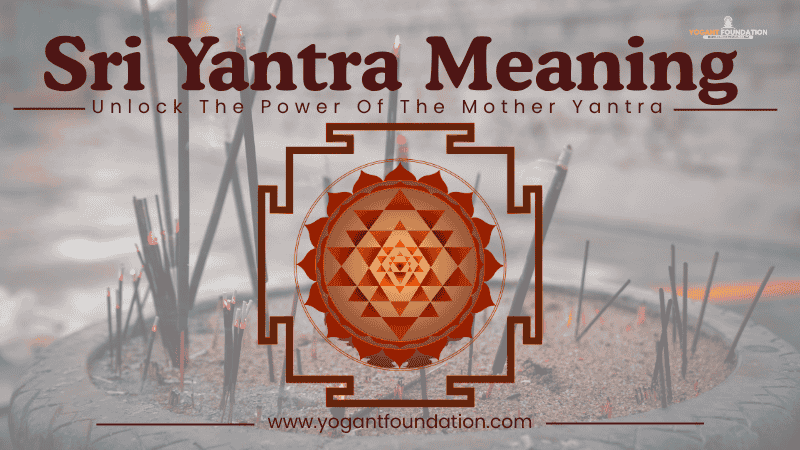
The Sri Yantra, also known as the Sri Chakra Yantra, is a significant geometric symbol with a long history, rooted in the Vedic tradition. This yantra is made up of nine triangles. Four of these triangles point up, while five point down, and they are all carefully interwoven. Surrounding these triangles are lotus petals and a square frame.
But here’s the thing: it’s not just a symbol. It’s not a logo or a piece of art.
In the spiritual world, it’s considered a living tool. Think of it like a battery. When you place it correctly, treat it with respect, and give it your attention, it starts to hum with energy. That energy doesn’t just sit there—it radiates outward, influencing your space, your mood, and even your circumstances.
If you’ve ever walked into a room and immediately felt “off” without knowing why, you’ve experienced what happens when a space lacks harmonious energy. The Sri Vastu Yantra is often used specifically to fix that. It’s like a tuning fork for your home—bringing everything back into alignment.
The First Time I Placed Sri Yantra Wrong | What I Learned
I have to be honest with you. My first attempt with the Sri Yantra was a disaster. I bought a beautiful, laser-engraved one from an online store. It arrived in a velvet pouch, and I was so excited that I immediately hung it on the first empty wall I saw—which happened to be in my bedroom, right above my desk.
Nothing happened. For weeks, I felt the same stress, the same financial pressure, the same tension at home. And I started thinking, “This is all nonsense.” It wasn’t until I spoke with my aunt again that I realized my mistake. She asked me two simple questions: “Where did you put it? And did you even say hello to it?”
I hadn’t. I had treated it like a decoration.
Here’s what I learned the hard way: placement matters. Not because the universe is picky, but because energy flows in specific ways. The Sri Yantra is designed to work with the natural currents of your home—what Vastu Shastra calls the energy grid.
- Ideal placement: East or North wall of your living room, pooja room, or office.
- Direction matters: The tip of the central triangle should point East (toward the sunrise).
- What to avoid: Never place it on the floor, in a bedroom, near a bathroom, or in a cluttered, dusty corner.
Once I moved mine to the northeast corner of my living room, placed it on a clean red cloth, and started lighting a small lamp near it every Friday… something shifted. It wasn’t overnight. But slowly, the heavy feeling in my chest started to lift. Conversations at home became calmer. Opportunities I had been praying for started appearing.
Coincidence? Maybe. But I’ve learned to trust the quiet changes.
The Heart of Sri Yantra: What the Triangles Really Mean
I used to think the triangles were just a beautiful design. But when you sit with the Yantra long enough, you start to feel what they represent. In the Sri Chakra Yantra, the triangles are not random.
The Triangles: Shiva and Shakti
The four triangles pointing upward represent Shiva—consciousness, stillness, the sky, the masculine energy that holds space.
The five triangles pointing downward represent Shakti—energy, movement, the earth, the feminine power that creates and nourishes.
The Bindu: The Point of Creation
When they interlock, they form 43 smaller triangles, each one a portal to a different energy. At the very center is the Bindu—that tiny dot you see. That’s the seed of creation. The starting point of everything. I remember the first time I meditated on the Bindu. Sat cross-legged, feeling frustrated, with my mind racing about bills and deadlines. I just stared at that dot. And stared. And after about ten minutes, something strange happened: my thoughts didn’t stop, but they slowed down. It was like watching a river that had been raging suddenly calm into a gentle stream.
The Enclosure: The Temple of Life
Enclosing the triangles are two circles of lotus petals—one with eight, the other with sixteen—along with an outer square, the Bhupura, punctuated by four gates. This configuration symbolizes the physical realm and the limits of our experience. Frequently called a “temple with four doors,” it opens outward to the cosmos, a reminder that the spiritual path starts right here, in the world we inhabit.
That’s the magic of the Yantra. It gives your mind somewhere to rest. When the mind is at peace, the heart becomes more open.
Step-by-Step Guide: How to Install and Energize Your Sri Chakra Yantra
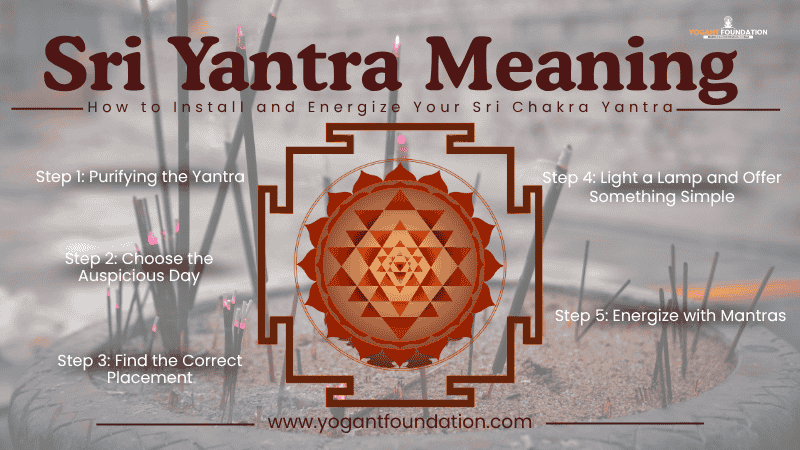
For your Sri Vastu Yantra to truly work, proper installation (Sthapana) and energization (Pran Pratishtha) are essential. Here’s a straightforward guide to help you through the process.
Step 1: Purifying the Yantra
The yantra was carefully cleansed using water that had a small amount of salt mixed in. Salt absorbs old energy. If you have a copper or crystal yantra, you can even leave it in salted water overnight once in a while to refresh it.
Step 1: Choose the Auspicious Day
I was told Fridays are best—they’re ruled by Venus, the planet of beauty, love, and prosperity. But honestly, any day that you can give a few quiet minutes works. The energy you bring matters more than the calendar.
Step 3: Find the Correct Placement | (Vastu)
I cleared a small shelf in my living room, placed a clean yellow cloth down, and set the yantra on it. I made sure it faced East, because that’s the direction of new beginnings.
Step 4: Light a Lamp and Offer Something Simple
I light a small ghee lamp or a tea light. Sometimes I offer a flower. Sometimes just my presence. I don’t stress about elaborate offerings. It’s the act of showing up that counts.
Step 5: Energize with Mantras
This was the hardest part for me. I don’t chant perfectly. But I learned a simple mantra: Om Shreem Hreem Shreem Mahalaxmaye Namah. I repeat it 108 times using a rudraksha mala, but in the beginning, I just repeated it 11 times with my eyes closed, visualizing the yantra glowing.
If chanting feels foreign to you, that’s okay. You can just sit quietly, looking at the Bindu, and then set your intention. Perhaps something like, “Let this space be filled with peace. Guide me toward abundance.“
The Yantra listens to your heart, not your Sanskrit pronunciation.
What Changed When I Started Taking Sri Yantra Seriously
I don’t want to sound like I’m promising miracles. I’m not.
But I do want to share what happened in my life over the months after I started working with the Sri Vastu Yantra with consistency.
- My home felt lighter. My partner and I used to argue about small things constantly. The tension in the air was thick. After placing the yantra in the northeast corner and lighting a lamp every Friday, the fights didn’t vanish, but they lost their sharpness. We started giving each other more grace.
- My focus improved. I’m a writer, and I was struggling with deadlines. Sitting with the yantra for just ten minutes before work helped me settle my scattered thoughts. It’s like the geometry gently organizes your mental chaos.
- Financial flow shifted. This one surprised me. I had been struggling with irregular income for over a year. After a few months of regular effort, two projects I hadn’t anticipated came my way, and a payment I’d been waiting on for ages finally showed up. Could it have been the yantra? I think it probably helped me align my energy with the opportunities that presented themselves.
- I felt less anxious. This was the biggest gift. The constant hum of worry in my chest quieted down. I started sleeping better. I started trusting life again.
I’m not saying the yantra is a magic wand. But I am saying it’s a tool—a powerful one—that helps you remember who you are beneath the stress and the noise.
The Mistake Almost Everyone Makes | Including Me
If I could go back and give my beginner self one piece of advice, it would be this: don’t treat the yantra like a lucky charm.
When I first bought mine, I secretly thought it would fix everything without me having to change anything. I thought I could hang it on the wall and go back to my old habits—worrying, complaining, staying stuck.
But the Yantra doesn’t work that way.
It’s a mirror. It reflects back to you what you’re putting out. If you place it with reverence and then continue to fill your home with negativity, clutter, and chaos, it can’t do its job. You have to meet it halfway.
Another common mistake? Forgetting to clean it. Dust settles on the Yantra, and with it, stagnant energy. I make it a habit to gently wipe mine with a clean cloth every morning. It takes ten seconds, but it keeps the energy fresh.
And please—if you have a damaged Yantra (a crack, a broken corner), don’t keep it. It’s believed that a broken Yantra emits fragmented energy. You can respectfully immerse it in a river or bury it in the earth, and get a new one when you’re ready.
Sri Yantra vs. Sri Meru: Understanding the Difference
Often, people confuse the flat Yantra with the 3D form. Here is a quick comparison to help you decide which is right for you.
| Feature | Sri Chakra Yantra (2D) | Sri Meru (3D) |
|---|---|---|
| Form | Flat diagram (copper, paper, silver) | Three-dimensional pyramid-like structure |
| Energy | Radiates energy outwards; good for Vastu corrections and general blessings | Generates and stores immense energy; used for intense meditation and deep spiritual practices |
| Placement | Placed on walls or altars; directional guidelines apply | Placed on the ground or altar; requires more sacred handling; often placed beside a Shiva Lingam |
| Best For | Homes, offices, cash counters | Temples, advanced practitioners, dedicated meditation spaces |
Pro Tips for Advanced Practitioners of Sri Yantra
Some days, I don’t touch my Sri Yantra. Life gets loud. The kids are screaming, emails are piling up, and by the time I collapse into bed, I realize the lamp never got lit. The Yantra sits there. Silent. Waiting.
Here’s what I’ve learned: it doesn’t get mad. It doesn’t judge. It’s not keeping score. The Sri Yantra isn’t a task on your to-do list. It’s a presence. A quiet anchor that waits for you to remember. And when you do—even if it’s been weeks—it welcomes you back without a word.
“There has to be more than just lighting a lamp and sitting here.”
Nava Chakra Meditation
Here’s something I didn’t know for years: the Sri Yantra isn’t one design. It’s nine layers stacked inside each other, like an onion. They call it the Nava Chakra—nine circles of energy.
When I first heard this, I sat with my Yantra and started tracing it with my eyes. From the outer square (the Bhupura, the physical world) all the way inward to the tiny dot at the center (the Bindu, where everything begins).
The practice is simple:
- Spend a few days or weeks with just one layer.
- Don’t rush to the center.
- Let each layer teach you something about where you are in life.
The Khadgamala Mantra
Okay, I’ll be honest. When someone first mentioned the Devi Khadgamala Mantra to me, I panicked. “A thousand syllables? I can barely chant three without messing up.” But here’s what I learned: this mantra isn’t about performance. It’s a map.
Think of it like this: every triangle, every petal, every layer of the Sri Yantra is home to a specific energy. The Khadgamala Mantra simply names them, one by one, as you move from the outside in.
Combine with Visualization
For years, I treated my Sri Yantra like a focal point. I stared at it and analyzed the triangles. I counted the petals. And while that’s useful, it kept me on the outside looking in.
One day, an older practitioner told me: “Stop looking at the Yantra. Start looking through it.”
I didn’t understand at first. But then I tried something new. Instead of gazing at the Bindu, I imagined it glowing—soft at first, then brighter. I pictured that light expanding outward, filling the first set of triangles, then the next, then the lotus petals, then the outer square, until the whole Yantra was radiating like a sun.
Then I imagined that light leaving the Yantra. Filling my room. Touching my chest. Spreading through my whole body. Dissolving the tension in my shoulders. Quieting the voice in my head. The first time I did this, I cried. Not from sadness—from release. It was like I had been carrying something heavy for years, and suddenly, I let it go.
A Few Questions I Get Asked All the Time
1. Can I keep the Sri Yantra at home if I don’t know complex rituals?
Absolutely. The Yantra works with geometry and intention. Keep it clean, place it correctly, and offer a simple lamp or flower whenever you feel moved to. That’s more than enough.
2. Which direction should it face?
Place it on an East or North wall. The apex of the central triangle should be oriented toward the East. If you’re using a Meru, the apex should face East as well.
3. Is there a distinction between the Sri Vastu Yantra and the standard Sri Yantra?
They’re the same diagram. The term Sri Vastu Yantra simply refers to using it to harmonize the energy of a building according to Vastu principles. So if you’re placing it to fix the energy in your home, you’re using it as a Vastu Yantra.
4. Can I use a picture of the Yantra on my phone or computer?
Yes. Though it can’t replicate the power of a physical, consecrated yantra, having one as your screensaver can still be a lovely way to stay focused on your goals. It offers a constant connection, a gentle nudge, as you move through your day.
5. How often should I clean or re-energize it?
Dust it daily. Perform a small ritual—lighting a lamp, offering a flower—at least once a week, ideally on Fridays. If you feel the energy has become heavy or after a period of difficulty, you can repeat the cleansing and chanting to refresh it.
Conclusion: Your Gateway to Harmony and Abundance
If there’s one thing I want you to take away from all of this, it’s that the Sri Yantra is a helper, not a replacement for your own effort. A gentle nudge. It’s a focal point. It’s a way of telling the universe—and yourself—that you’re ready for something better.
When I sit with my yantra now, I don’t just see triangles and petals. My narrative is taking shape before my eyes. The tumult that gradually settled into something resembling order. The trepidation that transformed into conviction. The home that went from heavy to light.
If you’re feeling stuck, overwhelmed, or just curious, I gently encourage you to give it a try. Start small. Find a quiet corner. Place the yantra with love. Light a lamp. Take a deep breath. And trust that the same sacred geometry that has guided people for thousands of years can guide you, too.
Ready to bring harmony into your space?
Discover our meticulously crafted, blessed Sri Yantra and Sri Merus. Every creation is crafted with intention, ready to find its place in your journey.