
You’ve seen the videos on Instagram—someone moving from a downward dog into a cobra pose with the grace of a dolphin, barely looking like they are breathing. You think, “That looks beautiful, but I am about as flexible as a 2×4. Is vinyasa yoga hard? Will I make a fool of myself?”
Here is the truth nobody tells you: Vinyasa yoga isn’t about touching your toes. It is about linking your breath to movement. If you can breathe, you can do Vinyasa. But yes, it has a learning curve.
The guide explains what Vinyasa Yoga is and why it can be difficult to learn at first. It also teaches you how to flow with the movement without getting overwhelmed.
What is Vinyasa Yoga?
Vinyasa yoga is an active style of yoga. It links movement with breath to create a steady flow. Unlike static poses in Hatha, Vinyasa transitions smoothly from one posture to the next. The word “Vinyasa” means “to place in a special way,” emphasizing a deliberate, breath-linked sequence. It is often called “Flow Yoga.”
Why Vinyasa is Different: The “Breath-Movement” Connection
To truly understand what is vinyasa yoga, forget the poses for a moment. Focus on the breath.
In traditional weightlifting or running, you breathe to support the movement. In Vinyasa, the breath leads the movement. Think of your inhale as the gas pedal and your exhale as the brake. Every action is intentional.
- Inhale: Open the front body (e.g., lifting your chest in Cobra or reaching arms up).
- Exhale: Fold or twist (e.g., Forward Fold or Twisted Chair pose).
This rhythmic dance turns a workout into a moving meditation. But for a beginner, this coordination is why they ask Google, “Why is vinyasa yoga hard?”
Is Vinyasa Yoga Hard? The Honest Answer | Yes & No
Let’s split this question in half because the answer depends entirely on you.
Why it IS hard | The Reality Check
- Coordination: Your brain is used to breathing automatically. Suddenly asking it to inhale for 4 counts while raising arms and stepping back feels like patting your head and rubbing your belly.
- Upper Body Strength: The infamous Chaturanga (a low push-up) is hard. Very hard. Most beginners collapse here.
- Heat: Because you never stop moving, Vinyasa raises your heart rate. A vigorous flow can feel like cardio.
- Wrist Pressure: Balancing on your hands repeatedly can cause wrist fatigue if you aren’t aligned properly.
Why it is NOT hard | The Empowerment
- It is scalable: You don’t have to do “Full Chaturanga.” You can drop your knees. You can skip the jump-backs.
- No competition: Unlike CrossFit, there is no leaderboard. If you need to rest in Child’s Pose, you do it.
- It builds over time: The “hard” part only lasts for the first 3-5 classes. Your muscle memory kicks in fast.
Expert Take: For a sedentary beginner, Vinyasa is moderately hard for the first 2 weeks. For an athlete, the flexibility aspect is hard, but the cardio is easy. The universal difficulty is slowing down. Most people fight the breath. Once you surrender to the exhale, the hardness melts away.
The 7 Core Benefits of Vinyasa Yoga
If you are asking “is vinyasa yoga hard,” you should also ask “is it worth it.” Here is why millions of Americans trade their running shoes for a mat.
- Cardiovascular Health: The continuous movement creates an aerobic effect, lowering resting heart rate.
- Full Body Strength: You use your own body weight. Planks build arms; warriors build legs; twists build core.
- Stress Reduction | The Big One: Because you focus on your breath, your nervous system shifts. It moves from “fight or flight” (sympathetic) to “rest and digest” (parasympathetic).
- Improved Balance: Single-leg poses like Tree or Half-Moon drastically improve proprioception.
- Detoxification: The deep breathing (Ujjayi breath) massages internal organs and increases oxygen exchange.
- Flexibility: Unlike static stretching, moving in and out of poses (dynamic stretching) warms muscles safely.
- Mental Focus: You cannot think about your work email when you are trying not to fall over in Warrior III. It forces mindfulness.
Step-by-Step: How to Do a Basic Vinyasa Flow (For Beginners)
Let’s demystify the sequence. This is the “Sun Salutation A” – the most common vinyasa yoga sequence. Practice this slowly.
Step 1: Mountain Pose (Tadasana)
Stand tall. Feet hip-width apart. Arms at sides. Inhale deeply.
Step 2: Upward Salute (Urdhva Hastasana)
Inhale sweep arms overhead. Look at your thumbs. Keep shoulders relaxed.
Step 3: Standing Forward Fold (Uttanasana)
Exhale hinge at your hips. Fold forward. Bend your knees generously (protect the lower back).
Step 4: Halfway Lift (Ardha Uttanasana)
Inhale flatten your back. Fingertips on shins or floor. Look forward. This straightens the spine.
Step 5: Plank Pose
Exhale step or jump back. Shoulders over wrists. Core tight. (Drop knees if needed).
Step 6: Chaturanga (The “Hard” One)
Exhale lower halfway down. Elbows hug the ribs. Modification: Lower knees to floor first.
Step 7: Upward Facing Dog (Or Cobra)
Inhale roll over the toes. Straighten arms. Open chest. Modification: Cobra (keep elbows bent).
Step 8: Downward Facing Dog (Adho Mukha Svanasana)
Exhale lift hips up and back. Press heels toward floor. Pedal the feet. Take 5 breaths here.
Step 9: Return to Fold
Inhale/Exhale step or hop to the top of the mat. Repeat Step 3 & 4.
Step 10: Mountain Pose
Inhale rise all the way up. Exhale hands to heart.
Practical Tips for Your First Vinyasa Class
Walking into a studio in New York, Austin, or LA can be intimidating. Here is how to win.
- Tell the teacher: Arrive 5 minutes early and whisper, “This is my first time. I’m nervous.” A good teacher will watch you like a hawk.
- Skip the “Full Expression”: When the teacher says “Jump back,” you step. When they say “Chaturanga,” you go to knees. Your ego is the enemy of your joints.
- Learn “Child’s Pose” (Balasana): This is your safety button. Anytime you feel dizzy, winded, or lost, drop to your knees, sit on your heels, and fold forward. Stay there for 3 breaths. That is 100% allowed.
- Hydrate beforehand, not during: Drinking water mid-flow disrupts the breath rhythm. Hydrate 30 minutes before class.
- Don’t look around: Everyone else is trying not to fall over, too. They aren’t watching you.
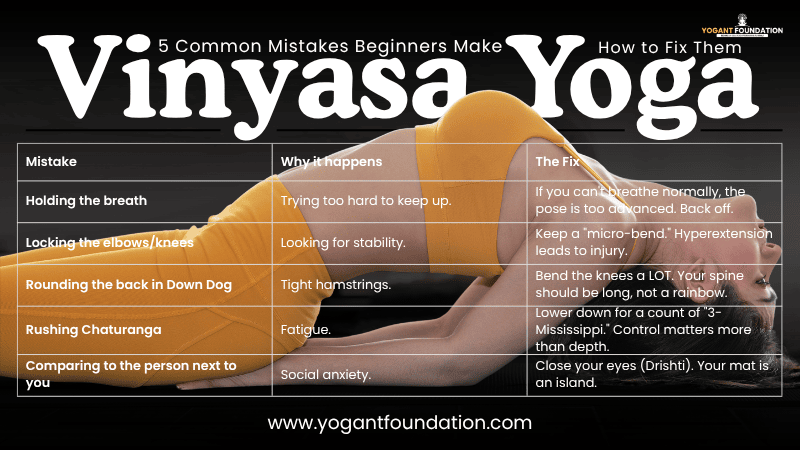
5 Common Mistakes Beginners Make | How to Fix Them
| Mistake | Why it happens | The Fix |
|---|---|---|
| Holding the breath | Trying too hard to keep up. | If you can’t breathe normally, the pose is too advanced. Back off. |
| Locking the elbows/knees | Looking for stability. | Keep a “micro-bend.” Hyperextension leads to injury. |
| Rounding the back in Down Dog | Tight hamstrings. | Bend the knees a LOT. Your spine should be long, not a rainbow. |
| Rushing Chaturanga | Fatigue. | Lower down for a count of “3-Mississippi.” Control matters more than depth. |
| Comparing to the person next to you | Social anxiety. | Close your eyes (Drishti). Your mat is an island. |
Pro Tips & Advanced Insights (For Intermediates)
Once you know what is vinyasa yoga and you no longer fear the difficulty, try these “hidden” strategies to level up.
- Ujjayi Breath (Darth Vader Breath): Constrict the back of your throat slightly so your breath makes a soft ocean sound. This regulates the pace. If you hear the ocean, you are going slow enough.
- Drishti (Gaze): Where your eyes go, your head follows. Where your head goes, your spine follows. Keep a soft, steady gaze (e.g., at your navel, thumb, or nose).
- The “Float” Transition: To make Vinyasa feel less hard, engage your core (bandhas) before lifting your legs. A strong core makes your arms feel weightless.
- Heat vs. Humidity: If you are trying “Hot Vinyasa,” the hardness doubles because of dehydration. Drink electrolytes an hour before.
Vinyasa yoga vs. Other Yoga Styles: A Quick Comparison
| Style | Pace | Difficulty (1-10) | Best For |
|---|---|---|---|
| Hatha Yoga | Slow, static holds | 3/10 | Absolute beginners, injury recovery |
| Vinyasa Flow | Moderate to Fast | 6/10 | Those who get bored easily, cardio lovers |
| Ashtanga | Fixed sequence, rigorous | 8/10 | Discipline seekers, athletes |
| Yin Yoga | Very slow (3-5 min holds) | 4/10 (mentally hard) | Deep connective tissue, stress |
| Bikram (26+2) | Fixed, 105°F room | 9/10 | Those who love sweating |
Frequently Asked Questions (FAQ)
1. Is vinyasa yoga hard for beginners with no flexibility?
No. Flexibility is a result of Vinyasa, not a prerequisite. The “hard” part is coordination, not contortion. Use blocks and bent knees. Every flexible person started stiff.
2. How many calories does a vinyasa yoga class burn?
A 60-minute moderate Vinyasa flow burns approximately 300–500 calories for a 150lb person. Vigorous power Vinyasa can reach 600+. However, focus on the breath, not the burn.
3. Can I do vinyasa yoga yoga every day?
Yes, but vary the intensity. Do 20 minutes of gentle flow on recovery days and 60 minutes of power flow 3x a week. Listen to your wrists and shoulders—they need rest days from weight-bearing.
4. What is the difference between vinyasa yoga and Hatha yoga?
Hatha is “slow and hold.” You pose, stop, breathe, then move to the next pose. Vinyasa is “continuous motion.” You never really stop; the breath carries you from one shape to the next. Hatha is a photograph; Vinyasa is a movie.
5. Why do I feel dizzy during vinyasa yoga?
Three reasons: (1) You are holding your breath (hypoxia). (2) You stood up too fast from a forward fold (blood pressure drop). (3) Dehydration. Solution: Slow down, take Child’s Pose, and exhale fully.
6. What should I wear for vinyasa yoga?
Moisture-wicking fabric. Women: High-support sports bra + fitted leggings (so the teacher can see your alignment). Men: Athletic shorts or joggers + a fitted tank. Avoid cotton t-shirts (they get heavy with sweat).
Conclusion
So, is vinyasa yoga hard? Yes, if you expect to look like a YouTube instructor on day one.
No, if you understand that vinyasa yoga pose is a personal journey. The “hard” is actually the point. The moments you feel like falling, sweating, or stopping are the moments your body is changing.
You don’t need to be strong to start. Get strong by starting. You don’t need to be flexible to flow. You get flexible by flowing.
Your 3-Step Action Plan for Tomorrow:
- Clear a 6×6 foot space in your living room.
- Search YouTube for “Slow Vinyasa Flow for Beginners” (20 minutes).
- The moment you feel lost or tired, sit in Child’s Pose and just breathe.
Don’t master the pose. Master the breath. The pose follows.
Ready to roll out your mat? Share this guide with a friend who says they “aren’t flexible enough” for yoga. They need to hear this. 👇