
A Childhood Memory That Started It All
I still remember the first time I truly noticed a hibiscus flower. I was maybe seven years old, visiting my grandmother in Lucknow during summer break. Her tiny garden wasn’t much—a few marigolds, some curry leaves, and this one massive bush near the gate covered in the deepest red blooms I had ever seen.
Every morning, she’d walk out in her cotton saree, pluck two or three flowers, and bring them inside. Some went into a small bowl near her prayer room. Others? She’d crush them into a paste for my mother’s hair. I had no idea back then what I was looking at. I just knew those red petals felt like velvet under my fingers.
Turns out, that unassuming bush was hiding centuries of history, science, and culture behind its pretty face. If you’ve ever found yourself staring at a hibiscus and wondering what it’s actually called in Hindi, how its strange middle part works, or why your grandmother swore by it for everything from hair oil to tea—you’re in the right place.
Let me walk you through everything I’ve learned about this incredible flower. And I promise, no boring textbook language.
What is a Hibiscus Flower? | Let’s Keep This Simple
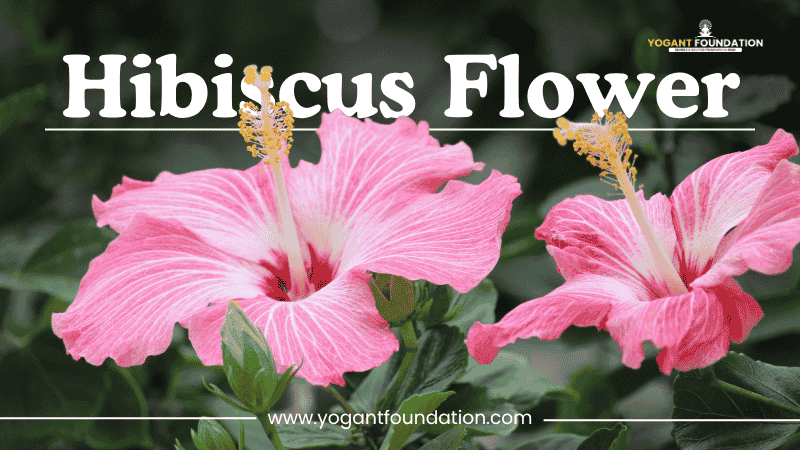
Here’s the easiest way to think about it: a hibiscus is that big, trumpet-shaped flower with five papery petals that seems to smile at the sun. In Hindi, you’ve almost certainly heard it called गुड़हल (Gudhal) . Scientifically speaking, it’s Hibiscus rosa-sinensis—but unless you’re writing an exam, you probably don’t need to memorize that.
What makes it special? Unlike many flowers that hide their private parts, hibiscus wears them right in the middle. That long, thin stalk sticking out? That’s where both the male and female parts live. Pretty bold, if you ask me.
Hibiscus Flower in Hindi: What Do We Call It?
गुड़हल (Gudhal) the word you’ll hear across most of North India. But here’s something I discovered while traveling—every region has its own name for this beloved flower:
| Language | Name |
|---|---|
| Hindi | गुड़हल (Gudhal), जसुम (Jasum) |
| Sanskrit | जपा (Japa), जपापुष्प (Japapushpa) |
| Marathi | जास्वंद (Jaswand) |
| Tamil | செம்பருத்தி (Semparuthi) |
| Telugu | దాసనము (Dasanamu), మందార (Mandara) |
| Malayalam | ചെമ്പരത്തി (Chembarathi) |
| Bengali | জবা (Jaba) |
| Kannada | ದಾಸವಾಳ (Dasavala) |
My grandmother always called it gudhal. But my college roommate from Kerala? She looked at me like I’d grown two heads when I said that. “It’s chembarathi,” she corrected me, laughing.
That’s the beauty of India. One flower, a dozen names, and everyone thinks theirs is the right one.
Oh, and here’s a fun fact you can drop at your next dinner party: English speakers sometimes call it “shoe flower.” Why? Because people actually used the petals to polish leather shoes back in the day. Imagine explaining that to your cobbler now.
Hibiscus Flower Scientific Name: The Taxonomy Explained
Alright, let’s get the formal stuff out of the way. The Scientific name of Hibiscus flower is Hibiscus rosa-sinensis . The “L.” you sometimes see at the end? That stands for Linnaeus—the Swedish guy who went around naming every plant he could find.
- Hibiscus: The genus name derived from the Greek word hibískos, which Pedanius Dioscorides used for marshmallow plants .
- rosa-sinensis: Means “rose of China,” indicating its historical association with East Asia.
- L.: Stands for Carl Linnaeus, the botanist who first formally described the species.
- Family: Malvaceae (Mallow family), which also includes cotton, okra, and cacao .
Taxonomic Classification
| Rank | Name |
|---|---|
| Kingdom | Plantae |
| Division | Magnoliophyta |
| Class | Magnoliopsida |
| Order | Malvales |
| Family | Malvaceae |
| Genus | Hibiscus |
| Species | H. rosa-sinensis |
But here’s what nobody tells you: there are hundreds of hibiscus species. The one in your garden is probably rosa-sinensis. The one in your hibiscus tea? That’s Hibiscus sabdariffa—a completely different cousin. And the one that survives freezing winters? Hibiscus syriacus, also called Rose of Sharon.
Same family, different personalities.
Hibiscus Flower Parts: A Complete Anatomical Breakdown
Remember that weird middle part I mentioned earlier? Let me explain it in a way that actually makes sense.
The Outer Layer: Sepals | Flower’s Bodyguards
Before the flower even opens, five little green leaves—called sepals—hug it tightly. Think of them as bodyguards. They protect the delicate bud from insects, wind, and clumsy gardeners (guilty). Even after the flower blooms and falls off, these sepals stick around. Persistent little fellows.
The Pretty Part: Petals | Corolla
You’ll usually find five petals in a hibiscus. They’re not stuck together like in a morning glory. Each petal stands alone, overlapping just slightly. And the colors? Red is classic, but I’ve seen orange ones that look like sunset, yellow ones so bright they hurt your eyes, and even white ones with pink throats.
If you look closely at the base of the petals, you might notice a darker spot. That’s not a flaw. That’s a nectar guide—nature’s way of saying “Hey bees, free food this way.”
The Star of the Show: The Staminal Column
This is where hibiscus shows off. Instead of having separate male parts scattered around, it bundles everything into one long tube right in the center. That stalk you see sticking out? That’s the staminal column.
Covering this column are dozens of tiny anthers—the parts that make pollen. Touch one gently and your finger will turn yellow. (Don’t rub your eyes after. Learn from my mistake.)
The Female Part: Hiding at the Top
At the very tip of that column, you’ll see five tiny red or yellow dots branching out. Those are stigma heads. They lead down to the ovary at the base of the flower.
Here’s the clever part: the male parts (anthers) are positioned below the female parts (stigma). This makes it harder for the flower to pollinate itself. It wants bees and butterflies to carry pollen from one flower to another. Genetic diversity and all that.
5. Accessory Structures
- Bracts (Epicalyx): Many hibiscus varieties have a whorl of bracteoles (small leaf-like structures) just below the calyx.
- Peduncle: The flower stalk that attaches the flower to the stem.
- Nectaries: Glands that produce nectar to attract pollinators .
Quick Reference: Hibiscus Flower Parts:
| Part | Description |
|---|---|
| Calyx | 5 fused green sepals |
| Corolla | 5 free petals (various colors) |
| Androecium | Numerous stamens fused into a staminal column |
| Gynoecium | 5 fused carpels, superior ovary, branched style |
| Bracts | Leaf-like structures below the calyx |
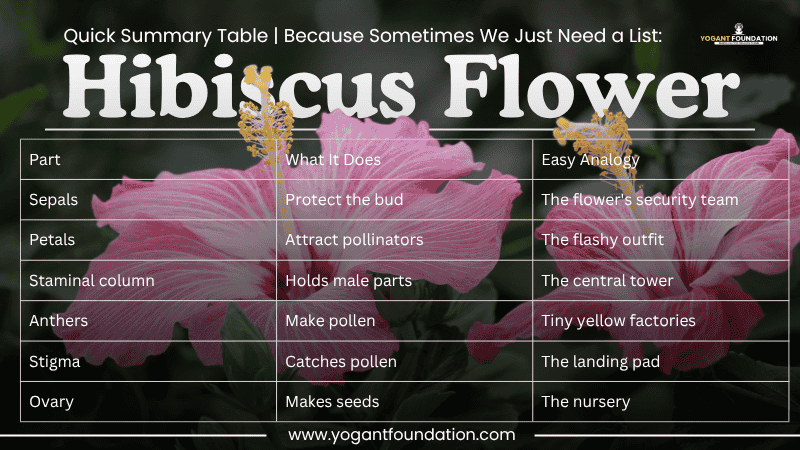
Quick Summary Table | Because Sometimes We Just Need a List:
| Part | What It Does | Easy Analogy |
|---|---|---|
| Sepals | Protect the bud | The flower’s security team |
| Petals | Attract pollinators | The flashy outfit |
| Staminal column | Holds male parts | The central tower |
| Anthers | Make pollen | Tiny yellow factories |
| Stigma | Catches pollen | The landing pad |
| Ovary | Makes seeds | The nursery |
Why the Hibiscus Matters | Benefits Beyond Beauty
I get it. Knowing flower parts is fine for a school project. But why should you, a regular person with a life, actually care about hibiscus?
🌿 Medicinal Uses (Ayurveda & Traditional Medicine)
Let me be honest with you—before I actually researched this, I thought hibiscus was just a pretty face. Something to admire in the garden and maybe offer at the temple. But the more I dug into our grandmothers’ secrets, the more I realized this flower has been quietly working as a healer for centuries.
Across Ayurveda, Siddha, and Unani, hibiscus has earned serious respect. Not because some modern study said so—but because generation after generation saw it work.
🩸 Menstrual Health – A Gentle Friend During That Time of the Month
If you’ve ever dealt with painful periods or unusually heavy bleeding, you know how exhausting it can be. In traditional homes, women would prepare a simple decoction—basically a light tea—using hibiscus flowers and green betel nut. It wasn’t just a ritual. It genuinely helped regulate the cycle and reduce excessive bleeding.
My own aunt swears by this. She says her mother did it, and now she does it for her daughter. No fancy pills. Just flowers from the backyard.
🌡️ Cooling Effect – Nature’s Air Conditioner
Ever felt that strange burning sensation in your body? Maybe after too much sun or spicy food? In Ayurvedic thinking, that’s an imbalance of pitta—basically, your internal heat is running high.
Hibiscus flower buds are considered naturally cooling. A simple infusion is given to calm down urinary discomfort and that “everything is on fire” feeling. It’s not a myth. Try it on a scorching summer day, and you’ll understand.
❤️ Blood Pressure – The Heart Helper
Now, this one has actually been studied quite a bit. The tea made from Hibiscus sabdariffa (the sour variety, not your garden gudhal) is globally famous for helping lower blood pressure.
My uncle was skeptical at first. “A flower tea?” he said. But after drinking two cups daily for three months, his numbers genuinely improved. His doctor was impressed. Not bad for something you can grow in a pot.
🍽️ Digestive Aid – When Your Stomach Acts Up
Acute dysentery is no joke. Loose motions, cramps, feeling drained—it’s miserable. In villages across India, a traditional remedy involves mixing hibiscus flower juice with banana inflorescence juice (that’s the purple thing hanging at the bottom of a banana bunch, believe it or not).
Does it taste good? Not particularly. Does it work? According to countless families who’ve used it for generations, yes.
🌬️ Respiratory Health – For Those Annoying Coughs
You know that dry, tickly cough that just won’t quit? Or the chest congestion that makes every breath feel like work? Hibiscus root extracts have been used traditionally for exactly these moments.
It’s not a magic cure. But as a supportive remedy, especially for mild bronchitis or persistent coughs, it has a real place in the home medicine cabinet.
💄 Cosmetic | Yes, “Botanical Botox” Is a Real Nickname
I first heard the term “botanical Botox” from a friend who runs a small natural skincare business. I laughed. Then she made me try her hibiscus face pack. Now I don’t laugh anymore.
Here’s why this flower has become a cult favorite in natural beauty circles:
💇♀️ Hair Care | Thicker, Stronger, Happier Hair
If you grew up in an Indian household, you’ve probably seen someone—your mother, grandmother, or aunt—mashing hibiscus flowers into a slimy paste and applying it to their scalp.
Turns out, they weren’t being weird. They were being smart.
Hibiscus flowers are rich in amino acids that:
- Promote hair growth (especially around thinning areas)
- Prevent dandruff without harsh chemicals
- Strengthen roots so less hair falls out in the shower
I tried it myself for two months. Mixed fresh petals with a little coconut oil and applied it once a week. My hair felt… thicker. Not dramatically different, but definitely healthier. And the shine? Unreal.
✨ Skin Care | Nature’s Anti-Aging Secret
Here’s the science part (but I’ll keep it simple). Hibiscus leaves contain something called mucilage—basically a natural, slippery gel. When applied to skin, it acts as a gentle conditioner and moisturizer.
But the real magic comes from anthocyanins. These are the pigments that give hibiscus its deep red color. And they’re powerful antioxidants that help boost collagen production.
Collagen, if you don’t know, is what keeps your skin firm and bouncy. Less collagen means wrinkles. Hibiscus helps your skin hold onto what it’s got.
I made a simple face pack once: hibiscus petal paste + honey + yogurt. Left it on for 15 minutes. When I rinsed it off, my face felt softer than it had in months. No irritation. No chemicals. Just flowers.
🎨 Natural Dye | Grandma’s Hair Color
Before chemical hair dyes filled every pharmacy shelf, women in villages used hibiscus petals to add a reddish tint to their hair. It’s subtle—not that harsh, in-your-face red—but it’s beautiful in its own way.
The same pigment can be used as a skin tint or even as a natural fabric dye. Imagine dyeing a cotton scarf with flowers from your own garden. That’s not just crafty. That’s ancestral wisdom.
How to Grow and Care for Hibiscus: A Step-by-Step Guide
I’ve killed exactly four hibiscus plants before I figured out what I was doing wrong. Learn from my failures.
Step 1: Sunlight Is Non-Negotiable
Hibiscus needs at least six hours of direct sun. Not “bright indirect light.” Not “morning sun only.” Real, honest-to-goodness sunlight.
The one I kept in my shady balcony? Produced exactly two flowers in eight months. Moved it to a sunny spot? Bloomed within three weeks.
Step 2: Water—But Don’t Drown It
Here’s the rule: water when the top inch of soil feels dry. Stick your finger in. If it comes out dusty, water. If it comes out muddy, wait.
Overwatering is the #1 killer of potted hibiscus. The roots rot faster than you’d believe.
Step 3: Feed It Like a Hungry Teenager
Hibiscus is a heavy feeder. During spring and summer, give it diluted liquid fertilizer once a week. Look for something high in potassium (the middle number on fertilizer labels).
What happens if you don’t feed it? Fewer flowers, smaller blooms, and leaves that turn pale and sad.
Step 4: Prune in Spring, Not Fall
Cut back your hibiscus in early March. Remove dead branches, shape the plant, and trim about one-third of last year’s growth.
Prune too late? You’ll cut off the developing flower buds. Ask me how I know.
Step 5: Bring It Inside If You Live Somewhere Cold
Hibiscus hates frost. One freezing night and your beloved plant turns into black mush.
If you live where winters dip below freezing:
- Move potted hibiscus indoors before the first frost
- Put it near your brightest window
- Water very sparingly—once every two weeks
- Don’t expect flowers until spring
Mistakes I Made So You Don’t Have To
| What I Did Wrong | What Happened | What I Should Have Done |
|---|---|---|
| Watered every single day | Roots rotted, plant died | Check soil before watering |
| Used high-nitrogen fertilizer | Giant leaves, zero flowers | Switch to high-potash feed |
| Pruned in October | No blooms for six months | Prune only in early spring |
| Kept in dark corner | Two flowers all year | Give at least 6 hours sun |
| Ignored white fuzzy spots | Mealybugs took over | Check weekly, treat early |
Frequently Asked Questions (FAQs)
1. What is hibiscus called in Hindi?
गुड़हल (Gudhal) . Though your neighbor from Maharashtra might call it Jaswand, and your Tamil colleague will say Semparuthi. They’re all talking about the same beautiful flower.
2. What’s the scientific name of hibiscus?
Hibiscus rosa-sinensis for the common garden variety. But remember, the one used in tea is Hibiscus sabdariffa—a different species entirely.
3. Can I really make tea from my garden hibiscus?
Yes and no. The deep red tea you buy at stores comes from Hibiscus sabdariffa, not the common rosa-sinensis. You can make tea from garden hibiscus petals, but it’s milder and less tangy. Worth trying once, just for fun.
4. Why do my hibiscus buds keep falling off?
Usually one of three things:
- Inconsistent watering (let the soil dry out too much)
- Sudden temperature changes (cold draft or heat blast)
- Mealybugs (those white cottony spots)
Check for bugs first. Then fix your watering routine.
5. Is hibiscus safe to eat?
Generally yes, if it’s homegrown without pesticides. The petals are edible raw or cooked. But if you’re pregnant, avoid consuming large amounts—some studies suggest it might affect estrogen levels. Always check with your doctor first.
6. How long do hibiscus flowers last?
Each flower blooms for just one day. Sometimes two if you’re lucky. But don’t be sad—a healthy plant produces new flowers almost every day during peak season.
7. Can hibiscus flower grow in a pot forever?
Absolutely. I’ve seen ten-year-old hibiscus thriving in large pots. Just repot every 2–3 years with fresh soil, and keep up with fertilizing. The pot will limit its size, but that’s fine for most homes.
Conclusion: Your Hibiscus Flower Journey Starts Here
Last year, I gave my neighbor a small Hibiscus Flower cutting I had rooted in water. She had never grown anything before. “I’ll kill it,” she said. I showed her the basics: sun, water when dry, feed once a week. Six months later, she texted me a photo. Her plant had produced its first flower—a brilliant orange one that looked like it was glowing. “I cried,” she wrote. “I made something live.”
That’s what I love about hibiscus. It’s forgiving. It’s generous. And even when you mess up, it often gives you another chance. So go ahead. Find a gudhal. Learn its parts if you’re curious. Grow one if you have a sunny spot. Make tea, or hair oil, or just sit and watch the bees go crazy over those red petals.
And the next time someone asks you what that flower is called in Hindi? You’ll know exactly what to say.
गुड़हल.
Now go grow something beautiful. 🌺