
Saunf is the Hindi name for fennel seeds, the dried seeds of Foeniculum vulgare, a plant in the carrot family. In India people chew it after meals as a mouth freshener and a digestive aid, and early research suggests its main compound, anethole, has carminative and antioxidant effects. This guide explains what saunf is, what it may genuinely do, how to use it, and who should be careful.
What is saunf, and is it the same as fennel bulb?
Saunf is the Indian name for the dried seeds of Foeniculum vulgare, usually sold in English as fennel seeds. They are small, pale green to yellow-brown, and taste mildly sweet with a licorice-like note. That note comes from anethole, which one review puts at roughly 50–75% of the seed’s essential oil.
Fennel bulb is the crunchy, white base of the same plant and is cooked or eaten raw as a vegetable. Saunf is the spice. In India, the small, fine Lucknowi variety is a popular choice for chewing after meals, while thicker, greener seeds are common in cooking.
What nutrients does saunf contain?
USDA Food Data Central lists fennel seed at about 345 kcal and 39.8 g of fibre per 100 g. Nobody eats 100 g, so the teaspoon column below is more realistic. It is calculated from the USDA values for roughly 2 g.
| Nutrient | Per 100 g | Per teaspoon (about 2 g) |
|---|---|---|
| Energy | 345 kcal | about 7 kcal |
| Dietary fibre | 39.8 g | about 0.8 g |
| Calcium | 1,196 mg | about 24 mg |
| Iron | 18.5 mg | about 0.4 mg |
| Potassium | 1,694 mg | about 34 mg |
A teaspoon is a small amount. Saunf is best seen as a flavour-and-habit food, not a major source of any one nutrient.
What are the health benefits of saunf?
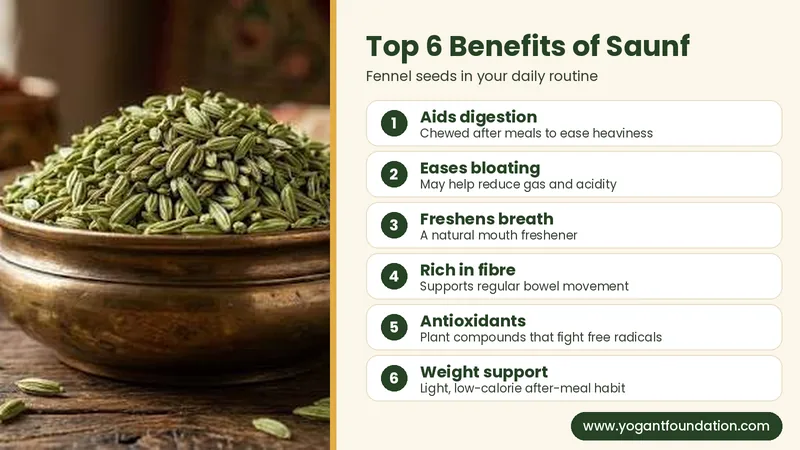
Fennel seeds may help ease mild bloating and gas, add antioxidants to your diet, and freshen breath. Most other claims come from lab or animal studies and are not yet proven in people.
Review papers describe antioxidant, anti-inflammatory, antibacterial and estrogen-like activity in fennel, linked to compounds such as anethole, estragole and fenchone . A later review adds carminative, diuretic and galactagogue (milk-supporting) effects, and notes traditional use for irritable bowel symptoms . A 2024 review calls for more in vivo and laboratory work to confirm how these compounds act.
Which fennel seed benefits are best supported?
| Claimed benefit | What the evidence looks like | How confident can you be? |
|---|---|---|
| Relief from gas and bloating | Long traditional use; carminative action described in reviews | Moderate, mostly traditional and preclinical |
| Fresher breath | Chewing seeds is a long-standing practice; aroma masks odour | Practical, low risk |
| Antioxidant support | Shown in lab studies of seed extracts and oil | Early, not proven for people |
| Milk supply in breastfeeding | Traditional galactagogue use | Weak; safety in lactation is not established (see the safety section) |
| Anti-cancer, hormone and blood-sugar claims | Lab and animal findings only | Very low; do not rely on saunf for these |
Why should you treat saunf as support, not treatment?
Fennel Seeds is a food. It can sit comfortably alongside a balanced diet, but it does not replace medical care for digestive disease, diabetes or hormone problems. If symptoms are persistent, see a doctor.
Is saunf good for digestion?
Yes, for mild, everyday discomfort such as gas and a heavy feeling after a meal, Fennel Seeds is a sensible and low-risk habit. This is the best-known use of saunf, and it rests on long traditional practice plus early research on its carminative properties.
How does saunf work as a carminative?
A carminative is something that helps reduce gas and soothes the gut. Reviews attribute this action mainly to anethole and fenchone, the main aromatic compounds in fennel . Fennel fruit also holds a place in European herbal practice: the European Medicines Agency lists it as a traditional herbal medicine taken as a tea. That is a statement about traditional use, not proof that it works for everyone.
When should you eat saunf for digestion?
The common Indian habit is a small pinch after lunch or dinner. That works well because:
- The seeds are chewed slowly, which also encourages saliva.
- The sweet aroma leaves the mouth fresh.
- It is easy to repeat without extra effort.
Plain Fennel Seeds is the better choice. Sugar-coated or colourful mukhwas mixes add sugar and artificial colour, which defeats the purpose.
Do fennel seeds help with weight loss?
Not on their own. I did not find solid human trials showing that fennel seeds burn fat or cause weight loss, so any promise of that kind is overstated. Fennel Seeds can only support a weight-loss plan indirectly.
What can saunf realistically do in a weight-loss routine?
- Replace sugary habits. A pinch of plain saunf after a meal can stand in for sweets, candy or sugar-coated mukhwas.
- Add a little fibre. Fennel seed is high in fibre by weight (39.8 g per 100 g), but a teaspoon gives under 1 g, so the effect on fullness is small.
- Make water more appealing. If flavoured saunf water helps you drink more water and fewer sweet drinks, that is a real, if modest, benefit.
Weight change still comes from overall food, activity, sleep and consistency. Treat Fennel Seeds as a helpful side habit, not a fat-burner.
What does saunf water do for your body?
Fennel Seeds water is a simple infusion of fennel seeds in water. It is mildly sweet, hydrating and gentle on the stomach for many people. I did not find clinical trials testing saunf water itself, so its benefits are best described as the likely, modest effects of fennel’s aromatic compounds rather than guaranteed results.
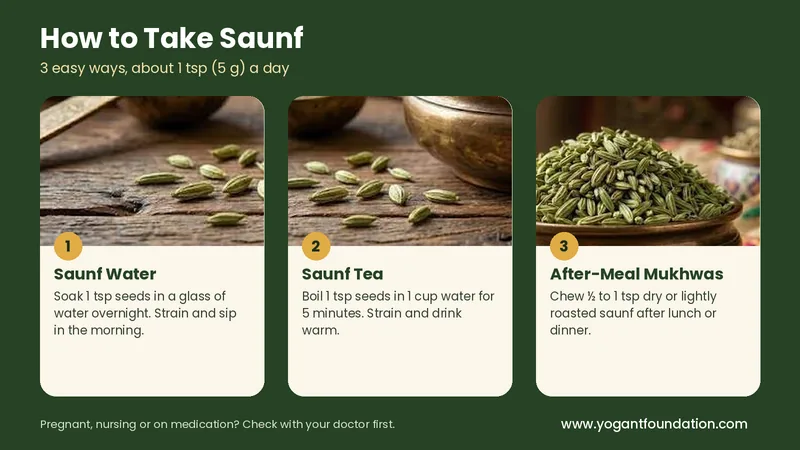
How do you make saunf water at home?
- Measure 1 teaspoon (about 2 g) of saunf.
- Rinse the seeds briefly, then lightly crush them to release the aroma.
- Soak them in a glass of water overnight, or pour hot water over them and cover for about 15 minutes.
- Strain and drink warm or at room temperature.
The 15-minute steep follows the same idea as the European herbal tea preparation, which uses a small amount of fennel fruit in about 100 ml of boiling water, steeped for 15 minutes . A teaspoon in a glass of water lands in a comparable range.
When is the best time to drink saunf water?
Most people take it after a meal or in the morning. There is no proven ideal time, so pick one you can keep up. Start with one glass a day and see how your stomach responds.
Which everyday uses does saunf have?
Fennel Seeds is used as a mouth freshener, a cooking spice, a herbal tea and a simple home infusion. Its sweet, aromatic flavour is the reason it appears in so many kitchens across India, the UK and the US.
Why is saunf chewed as a mouth freshener?
Chew half a teaspoon of plain seeds after a meal. The aroma freshens the breath and the chewing stimulates saliva. Lightly roasted Fennel Seeds has a warmer taste, though I found no evidence that roasting makes it healthier. Avoid versions coated in sugar if you want to keep it a healthy habit.
Which dishes and drinks use saunf?
- Indian cooking: tempered in oil for vegetable dishes, ground into spice blends, and added to pickles and some chutneys.
- Baking and sweets: a pinch gives a gentle licorice note to breads, biscuits and desserts.
- Fennel tea: crush a teaspoon, steep in hot water for about 15 minutes, then strain.
- Savoury dishes: works well with fish, lentils and roasted vegetables.
What role does saunf play in traditional Indian homes?
In many Indian households, Fennel Seeds sits near the dining table or is served after a meal. Ayurvedic tradition describes it as a cooling, digestion-friendly spice. That is a traditional view, and I did not find clinical evidence that confirms a cooling effect on the body.
How is saunf different from jeera, ajwain and anise?
Saunf, jeera (cumin), ajwain (carom) and anise all belong to the carrot family (Apiaceae) and all show up in digestive habits, but their flavours and uses differ. Fennel and anise are the closest in taste because both are anethole-rich.
| Spice | Botanical name | Flavour | Typical use |
|---|---|---|---|
| Saunf (fennel seeds) | Foeniculum vulgare | Sweet, mild licorice | After-meal freshener, tea, baking, cooking |
| Jeera (cumin) | Cuminum cyminum | Earthy, warm | Tempering, curries, spice blends |
| Ajwain (carom seeds) | Trachyspermum ammi | Sharp, thyme-like | Breads, snacks, traditional home remedies |
| Anise seed | Pimpinella anisum | Stronger, sweeter licorice | Baking, liqueurs, tea |
If a recipe asks for anise and you only have saunf, saunf works as a milder substitute. The reverse swap can taste too strong.
Who should be careful with saunf?
Pregnant or breastfeeding women, children, people with fennel or celery-family allergies, and anyone on hormone-related or blood-thinning medicines should check with a doctor before using Fennel Seeds regularly. A pinch after a meal is a different matter from concentrated or medicinal use, and cautions mostly target the latter.
- Pregnancy and breastfeeding: the European Medicines Agency says safety in pregnancy and lactation has not been established and does not recommend fennel herbal products in these periods .
- Children and teenagers: the EU bitter-fennel fruit monograph advises against herbal use under 18 because of limited data and the estragole content.
- Allergy: fennel is in the carrot family, and allergic reactions to fennel have been recorded.
- Bleeding disorders and blood thinners: the same monograph notes fennel might slow blood clotting.
- Hormone-sensitive conditions: reviews describe estrogen-like activity, so ask your doctor if this applies to you.
How much saunf is safe to eat in a day?
I did not find an official daily limit for ordinary culinary use. One teaspoon (about 2 g) of seeds, or one glass of saunf water, is a common home practice, not a prescription. Estragole, a minor compound in fennel, is the reason regulators are cautious about large or long-term intake of concentrated products, so more is not better.
What common mistakes should you avoid with saunf?
- Buying sugar-coated mukhwas and calling it saunf. Check the label for added sugar and colour.
- Treating saunf water as a weight-loss drink. It is a pleasant habit, not a fat-burner.
- Giving saunf water to babies without advice. Ask a paediatrician first.
- Using large amounts for “detox” or medicinal effects. Concentrated use is where safety questions start.
- Ignoring persistent symptoms. Ongoing pain, vomiting or bloating needs a medical opinion.
What else do people ask about saunf?
Can you eat saunf every day?
For most healthy adults, a small pinch after meals is a common daily habit. Keep it to culinary amounts, choose plain seeds, and speak to a doctor first if you are pregnant, breastfeeding, allergic to celery-family plants, or taking blood thinners or hormone medicines.
Does saunf cool the body?
Ayurveda and Indian home tradition describe saunf as cooling. I did not find clinical evidence that proves a measurable cooling effect, so treat it as a traditional belief.
Is it safe to give saunf water to a baby?
Check with your paediatrician before giving it. Official European guidance advises against fennel herbal products for people under 18 because data are limited and estragole is present.
Does saunf increase breast milk?
Fennel is a traditional galactagogue, meaning it is believed to support milk flow, but the evidence is weak. The EMA says safety in lactation has not been established, so discuss it with your doctor or lactation consultant.
Is saunf suitable for people with diabetes?
Plain saunf contains little sugar and is used in tiny amounts, so a pinch is unlikely to matter. Lab studies on blood-sugar effects are not proof for people. Avoid sugar-coated mukhwas and keep following your treatment plan.
Is roasted saunf better than raw saunf?
No evidence shows one is healthier. Roasting mainly changes aroma and flavour: roasted seeds taste warmer and nuttier, while raw seeds taste sweeter and fresher.
How should you store saunf?
Keep it in an airtight jar, away from heat, light and moisture. Stored well, whole seeds hold their aroma for months. If the smell fades or turns musty, replace it.
Is saunf worth adding to your daily routine?
Yes, as a small, low-cost habit. Saunf gives you a fresh mouth, a gentle after-meal ritual and, for many people, relief from mild gas and heaviness. Research on fennel’s anethole and other compounds is interesting, but most of it is early, so keep your expectations realistic. It will not melt fat or replace medical care.
To get the best from it, choose plain seeds, keep to about a teaspoon a day, try saunf water if you like the taste, and take extra care if you are pregnant, breastfeeding or on regular medication.
The same steady, simple approach applies to yoga and healthy living. If you want to build daily habits around digestion, movement and mindful eating, explore the yoga and wellness resources on the Yogant Foundation website.