
An Introduction to the Bhagavad Gita Slokas Eternal Wisdom:
Okay, let’s be honest. When you hear “Bhagavad Gita Slokas,” what comes to mind? Maybe a thick, dusty book on a shelf? A philosophical text that feels… intimidating? I used to think that too.
Then, a few years ago, during a particularly messy patch in my life—career confusion, personal drama, the whole works—a friend didn’t give me advice. Instead, she scribbled a single Sanskrit line on a napkin. It was a Bhagavad Gita sloka. She said, “Just sit with this one line. Don’t overthink it.”
That crumpled napkin was my start. It wasn’t about swallowing 700 verses at once. It was about finding one lifeline. That’s what this is about. Forget the scholarly tone. Let’s talk about the Bhagavad Gita saar—the raw, practical essence—through the verses that feel like a firm hand on your shoulder when you’re about to lose your cool. These famous Bhagavad Gita slokas aren’t relics; they’re conversations starters for our modern chaos.
Why These Slokas? Discovering the Gita’s Core Message:
Look, 700 verses is a lot. You wouldn’t eat a whole cake in one bite, right? You’d start with a slice. Think of these important bhagavad gita slokas as the most flavourful slices. They answer the questions we’re all secretly asking into our pillows at 2 AM:
- “Why am I so anxious about this presentation?”
- “How do I deal with that difficult person?”
- “What is my actual purpose here?”
- “Why do I feel so lost even when I ‘have it all’?”
The best slokas of Bhagavad Gita we’re going to walk through are the ones that have, time and again, yanked me out of my own head. They’re less about religion and more about radical common sense. Whether you’re spiritual, sceptical, or just stressed, there’s something here for you.
18 Important Bhagavad Gita Slokas for Beginners
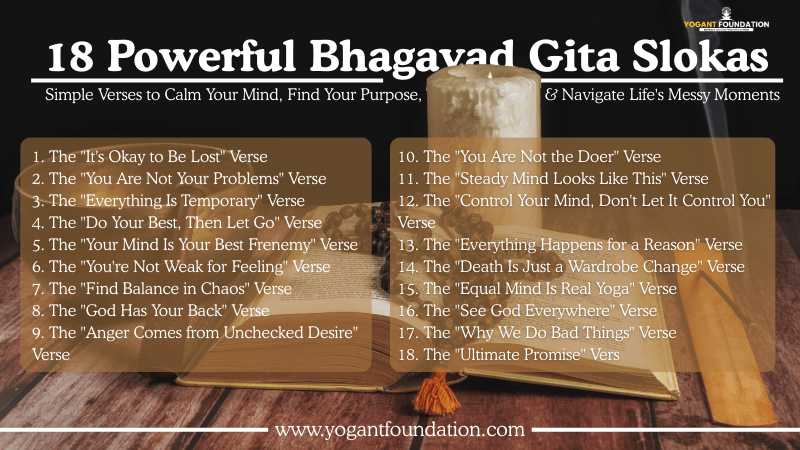
Here’s my personal, deeply human take on the 18 important slokas of Bhagavad Gita. This isn’t an academic list; it’s a journey from “What the heck am I doing?” to “Okay, I can handle this.”
1. The “I’m Completely Lost” Verse (Chapter 2, Sloka 7)
Arjuna basically says: “Krishna, I’m a mess. My mind is a tornado. I don’t know what’s right anymore. Just tell me what to do. I’m your student. Guide me.”
My take: Can we just appreciate how human this is? Arjuna, the great warrior, finally stops pretending. He admits he’s confused and asks for help. This is where any real change begins. Before we find answers, we have to admit we have a question. This bhagavad gita slokas gives us permission to say, “I don’t know,” and to seek guidance. It’s the ultimate first step.
2. The “You Are Not Your Bad Day” Verse (Chapter 2, Sloka 20)
“The soul is never born and never dies… It is not slain when the body is slain.”
My take: This is the ultimate perspective shifter. You are not your failing project, your aching back, or that harsh comment from your boss. You are the awareness witnessing all of that. This Bhagavad Gita famous sloka is my go-to when I’m over-identifying with a problem. It whispers: This too shall pass, because the real you is permanent. It’s the deepest form of stress relief I know.
3. The “This Feeling Won’t Last” Verse (Chapter 2, Sloka 14)
“The contact with senses gives summer and winter, pleasure and pain. They come and go. Bear them, Arjuna.”
My take: Krishna isn’t telling us to be robots. He’s giving us weather report wisdom. Happiness is a season. So is sadness. You don’t build a house for summer and expect it to be gone in winter. Don’t build your entire identity around a temporary feeling. When I’m riding a high, this verse grounds me. When I’m in a low, it gives me hope. It’s a masterclass in emotional resilience.
4. The “Do Your Best, Forget the Rest” Verse (Chapter 2, Sloka 48)
“Do your job, but do not attach yourself to the outcome. Yoga is equanimity.“
My take: If I could tattoo one Bhagavad Gita popular slokas to my mind, this would probably be it. The aim is to obtain the best possible result. What happened? Do they appreciate my work? This verse reverses the script. If you’re a yoga practitioner, it’s more than just a practice on the mat. It is also about maintaining calm and composure when giving a talk or presentation. Action is what you do. What will be the result? That’s life’s department. Here’s the freedom you can have from all anxiety.
5. The “Your Mind is Your Best Frenemy” Verse (Chapter 6, Sloka 6)
“For one who has conquered the mind, it is the best friend. For one who has failed, it is the greatest enemy.”
My take: Ouch, but true. How many times has your own mind kept you awake with “what-ifs” or torn you down with self-criticism? This important sloka of Bhagavad Gita is blunt. That voice in your head? You need to make friends with it, or it will ruin you. Meditation, mindfulness, journaling—this is the work of befriending your mind. It’s the most important relationship you’ll ever fix.
6. The “Change is the Only Constant” Verse (Chapter 11, Sloka 32)
Krishna reveals his form as Time and says: “I am Time, the ultimate destroyer. I am here to destroy all.”
My take: This is the most dramatic of the Bhagavad Gita slokas, and it’s terrifyingly beautiful. Everything you love, everything you’ve built, will change. Your job, your relationships, your body. Fighting this truth causes suffering. Embracing it? That’s liberation. It makes you cherish the present moment fiercely. It’s not morbid; it’s a wake-up call to stop clinging and start living.
7. The “The Universe Has Your Back” Verse (Chapter 9, Sloka 22)
“Those who focus their attention on Me and meditate with a single-minded concentration, I give them what they need while preserving what they already have.”
My take: Do not get too hung up with the “Me” as a figure of religion. Consider it the Principle of Truth, Goodness or Your Highest Self. Things flow when I am focused, committed, and in alignment with my true purpose (not my small desires). Opportunity appears. Aid arrives. This verse promises that sincere and focused efforts are never wasted. It is supported by the universe.
8. The MVP of Gita Verses (Chapter 2, Sloka 47)
“You have a right to your action, but never to its fruit. Don’t be attached to inaction either.”
My take: This is the superstar, the one everyone quotes. And for good reason. It’s the bhagavad gita saar in a nutshell. I apply it to everything: writing this blog, cooking a meal, planning a project. Pour your heart into the work. Then, let go of how it’s received. Did the dinner get compliments? Did the project succeed? That’s not your identity. Your integrity in the doing is. This kills perfectionism and fear of failure.
9. The “There’s Something Bigger Than This” Verse (Chapter 15, Sloka 6)
“That abode of Mine is not lit by sun or moon… Those who reach it never return.”
My take: This verse helps me to zoom out when the minutiae of everyday life start getting on my nerves – office politics, noise from social media. This verse reminds me of an inner, vast and peaceful world. The spiritual equivalent of looking up at the starry night sky and feeling your problems shrink. It’s not an escape; it’s a perspective reset. We are spiritual beings having a human experience.
10. The “You’re In Charge of You” Verse (Chapter 6, Sloka 5)
“One must lift oneself by oneself. Don’t degrade yourself. You are your own friend and enemy.”
My take: No one is coming to save you. That sounds harsh, but it’s empowering. Your growth, your mood, your reactions—that’s your domain. Blaming others is a dead end. This Geeta shloka is a call to radical self-responsibility. Be the friend who encourages yourself, not the enemy who berates yourself. The power is literally in your hands.
11. The “We’re All in This Together” Verse (Chapter 6, Sloka 29)
“The yogi is able to see the Self within all things, as well as all other beings. The same thing is everywhere.“
My take: That difficult person at work? Same consciousness as you. The stranger on the street? Same light inside. When I actually remember this, something shifts. Impatience becomes patience. Irritation becomes curiosity. It’s not philosophy anymore—it’s just seeing the divine in the person right in front of me.
12. The “Just Let Go” Verse (Chapter 18, Sloka 66)
“Abandon all duties and surrender to Me. I will free you from all sin. Do not fear.”
My take: After chapters of detailed instructions, Krishna ends with this simple, profound offer. Surrender. Not to weakness, but to a trust bigger than yourself. It’s like finally letting go of the steering wheel in a storm and trusting the car has GPS. For me, it’s surrendering my need to control every outcome. It’s saying, “I’ve done my part. Now, I trust the process.” It’s incredibly peaceful.
13. The “Name Your Demon” Verse (Chapter 3, Sloka 37)
“It is desire, born of passion, that becomes anger. Know this as the sinful enemy.”
My take: Krishna doesn’t beat around the bush. The root of most suffering? Unchecked desire that turns into rage when we don’t get our way. That desperate craving for validation, for that object, for things to go my way. This verse asks us to spot it. To see the craving before it becomes a monster. Just naming it—”Ah, there’s my desire talking”—takes away half its power.
14. The “Be a Better Human” Checklist (Chapter 16, Sloka 1-3)
It lists divine qualities: fearlessness, purity, self-control, honesty, compassion, gentleness, modesty…
My take: Spirituality isn’t vague. It’s practical. This list of important slokas of bhagavad gita is like a mirror. Am I being truthful today? Was I compassionate in that tough conversation? Am I free from the need to gossip? It turns lofty ideals into daily to-dos. Work on one quality at a time. That’s the real spiritual practice.
15. The “All Seekers Welcome” Verse (Chapter 7, Sloka 16)
“Four types of people search Me: the desperate, the seeking of knowledge, wealth and wisdom, as well the wise.“
My take: I love how inclusive this is. You don’t have to be a saint to approach the Gita’s wisdom. Are you in pain? Come. Are you curious? Come. Do you want prosperity? Come. Are you already wise? Come. It meets you where you are. It validates every starting point on the spiritual path. Your reason is good enough.
16. The “What Does Wisdom Look Like?” Verse (Chapter 2, Sloka 54)
Arjuna asks: “How does a person of steady wisdom speak, sit, and walk?”
My take: This is my favourite question in the whole Gita. Arjuna is like, “Okay, great philosophy. But what does it look like in the grocery store?” He wants a practical example. The answer that follows paints a picture of someone unshaken, content, and gentle. It gives us a tangible benchmark. It’s not about being perfect; it’s about the direction you’re moving in.
17. The “You Are Unbreakable” Verse (Chapter 2, Sloka 23)
“Weapons cannot cut through it. Wind and water can’t dry it. “
My take: After a failure or a heartbreak, I come back to this. That core “you”—your spirit, your resilience—cannot be damaged by external events. You might feel scorched, but you are not the fire. You are the space in which the fire burns. This famous bhagavad gita slokas is an anthem of inner invincibility. It’s pure psychological armour.
18. The Happy Ending Verse (Chapter 18, Sloka 78)
“Where there is Krishna (divine wisdom) and Arjuna (the focused human), there is victory, prosperity, and goodness.”
My take: The Gita ends on a note of hope. It’s a formula. When your human effort (Arjuna the archer) is guided by divine wisdom (Krishna the charioteer), good things follow. Not just material success, but moral victory and inner abundance. It’s the promise that integrating these best of bhagavad gita slokas into your life actually works. You find your way.
Integrating the Gita’s Wisdom Into Modern Life:
So, you’ve read these 18 important slokas of bhagavad gita. Now what? Don’t try to swallow them all.
- Pick one. Just one that tingled for you. The one that made you pause.
- Write it down. Put it on your fridge, your phone lock screen, your bathroom mirror.
- Live with it for a week. Let it be your mantra. See how it changes your reactions.
- When you stumble (and you will), re-read it. The Gita isn’t about perfection; it’s about returning, again and again.
This is the bhagavad gita slokas made practical. It’s personal work, done in the mess of your everyday life.
Conclusion: Your Journey With the Bhagavad Gita Slokas
These verses aren’t meant to be worshipped from afar. They’re meant to be wrestled with, argued with, and ultimately, embraced. They’ve been my anchors in stormy seas. I hope one or two can be that for you.
Conversation starter Be Arjuna on your battlefield-confused, conflicted, human. These timeless words will guide you. What about the journey, though? It’s all yours and you can begin right now.