

Make Orange Juice Like a Pro
You wake up feeling that familiar tickle in your throat. Your energy is tanking by 2 PM. Or maybe you’re just standing in the grocery aisle, staring at a carton, wondering: Is this actually healthy, or am I drinking liquid candy? For decades, orange juice has been a breakfast table hero. Lately, it has also become a villain in the diet world. So, what is the truth? In this deep-dive guide, we will settle the debate once and for all. You will learn exactly is orange juice good for you, the real orange juice calories count, what vitamin is in orange juice that makes it famous, and even how to make orange juice that beats anything from a carton.
Let’s squeeze the facts out of this juicy topic.
What is Orange Juice?
Orange juice is the liquid extract from the fruit of the Citrus sinensis tree, consumed either fresh-squeezed, pasteurized, or from concentrate. It is globally renowned for its high concentration of vitamin C, potassium, and antioxidants, though its nutritional value varies significantly between commercial cartons and fresh homemade versions.
Part 1: Is Orange Juice Good for You? The Nutritional Breakdown
To answer the primary question—is orange juice healthy—we must look beyond the marketing labels and examine the actual science.
The Good Stuff: Why Doctors (Sometimes) Love It
When consumed in moderation and in its purest form, orange juice is a powerhouse. Here is why:
- Immune Support: You’re likely aware of vitamin C’s reputation, but did you realize that a single cup can provide more than a full day’s worth?
- Heart Health: Potassium helps lower blood pressure. Flavonoids (hesperidin) reduce inflammation and arterial stiffness.
- Kidney Stone Prevention: Surprisingly, citrus juices increase urinary citrate levels, which prevents calcium oxalate stones.
- Brain Function: Folate (vitamin B9) in OJ is critical for preventing cognitive decline.
The Dark Side: Sugar, Acid, and Calories
Here is where most articles stop telling the truth. A single 12-ounce glass of store-bought orange juice contains roughly the same amount of sugar as a can of Coca-Cola (about 36 grams).
Orange juice calories are not “empty,” but they add up quickly:
- Fresh squeezed (1 cup): ~110-120 calories
- Commercial (1 cup): ~110-130 calories (often with added sugar)
- From concentrate (1 cup): ~100-120 calories
The verdict so far: Whole oranges are superior (fiber slows sugar absorption). But OJ can be healthy if you follow the “4-ounce rule” and avoid added sugars.
Part 2: What Vitamin is in Orange Juice? | The Complete List
Most people stop at Vitamin C. That is like saying a car has wheels—you are missing the engine.
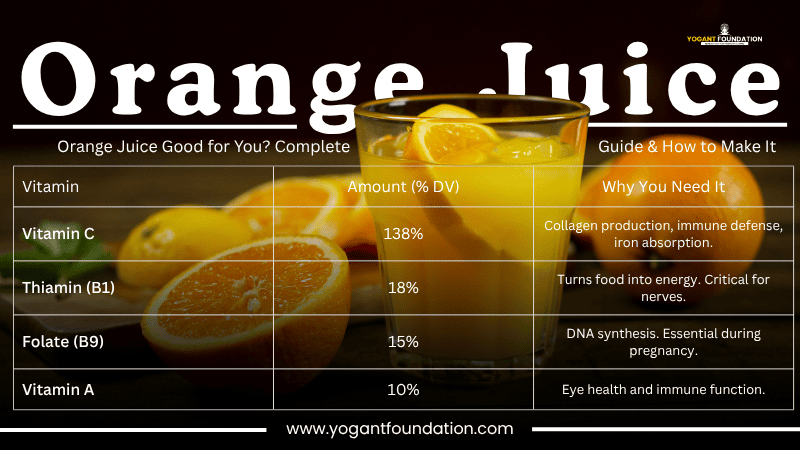
Here is the full vitamin profile in one cup of fresh orange juice:
| Vitamin | Amount (% DV) | Why You Need It |
|---|---|---|
| Vitamin C | 138% | Collagen production, immune defense, iron absorption. |
| Thiamin (B1) | 18% | Turns food into energy. Critical for nerves. |
| Folate (B9) | 15% | DNA synthesis. Essential during pregnancy. |
| Vitamin A | 10% | Eye health and immune function. |
| Potassium | 14% | Muscle contractions and blood pressure regulation. |
Pro Tip: The vitamin C in orange juice degrades rapidly with heat and light. This is why juice in a clear plastic bottle on a sunny shelf is nearly useless.
Part 3: Is Orange Juice Good for a Cold? | Myth vs. Reality
You have heard it a million times: “Drink your OJ, you are getting sick.”
Is orange juice good for a cold? The answer is nuanced.
The Case FOR Orange Juice
- Vitamin C can shorten duration: A 2013 Cochrane review found that regular Vitamin C supplementation (not just when sick) reduces cold duration by 8% in adults and 14% in children.
- Hydration: Fevers and mucus production dehydrate you. OJ provides fluids plus electrolytes.
The Case AGAINST Orange Juice
- Sugar suppresses immunity temporarily. Drinking a large glass of sugary OJ can reduce your white blood cells’ ability to kill bacteria for up to 5 hours.
- Acid irritates a sore throat. If your throat is raw, citric acid burns.
The Expert Strategy: Do not down a 16oz carton the moment you sneeze. Instead, take 1-2 ounces of fresh-squeezed juice mixed with warm water and honey. You get the vitamin C without the sugar spike.
Part 4: How Much Juice in One Orange? | The Math for Real Life
If you want to make orange juice, you need to know your yield. Nothing is worse than planning for 4 cups and only getting 2.
Here is the exact breakdown based on orange type:
| Orange Variety | Juice per Orange | Oranges needed for 1 cup (8 oz) |
|---|---|---|
| Navel | 2 – 3 tablespoons (1 – 1.5 oz) | 5 – 7 oranges |
| Valencia | 4 – 5 tablespoons (2 – 2.5 oz) | 3 – 4 oranges |
| Blood Orange | 3 – 4 tablespoons (1.5 – 2 oz) | 4 – 5 oranges |
| Mandarin/Clementine | 1 – 2 tablespoons (0.5 – 1 oz) | 8 – 10 pieces |
How much juice in one orange (average, all types): Roughly 2.5 tablespoons or 1.3 fluid ounces.
Real-world example: For a typical 12-ounce glass of fresh juice, you’ll need about four or five Valencia oranges, or seven or eight Navel oranges.
Part 5: How to Make Orange Juice | 3 Methods + Pro Secrets
Forget the frozen concentrate tubes. Here is how to make orange juice that tastes like liquid gold.
Method 1: The Manual Squeezer | Best for 1-2 glasses
- Roll room-temperature oranges on the counter firmly (this bursts internal membranes).
- Cut in half.
- Press onto a reamer/squeezer. Twist back and forth.
- Pro tip: Strain through a fine-mesh sieve if you hate pulp.
Method 2: The Electric Juicer | Best for 4+ glasses
- Peel oranges only if you dislike bitter oils (the white pith adds nutrients but bitterness).
- Feed halves into a centrifugal or masticating juicer.
- Mistake to avoid: Do not juice at high speed for more than 60 seconds (heat destroys vitamin C).
Method 3: Blender Method | Highest Fiber, Pulp Lovers
- Peel 4 oranges. Remove as much white pith as possible.
- Add to blender with ½ cup water.
- Blend 20 seconds. Strain through a nut milk bag (or drink thick).
The “Secret Recipe” for the Best OJ
- Add a pinch of sea salt – cuts bitterness and replaces electrolytes.
- Add 1 drop of lemon essential oil – amplifies the vitamin C absorption.
- Chill for 30 minutes – cold temperatures mute acidity while keeping sweetness.
Part 6: Orange Juice Calories and Weight Loss – Friend or Foe?
Weight management is a common concern, and the orange juice calories count frequently comes up.
The Numbers (8oz serving):
- Whole orange: ~65 calories + 3g fiber.
- Orange juice: ~110 calories + 0g fiber.
The Psychological Trap: Liquid calories do not trigger satiety signals in your brain. You can drink 200 calories of OJ in 90 seconds and still feel hungry. Eating two whole oranges takes 5 minutes and fills you up.
When is OJ good for weight loss?
- Post-workout: The natural sugars plus potassium make it an excellent recovery drink (mix with water 50/50).
- Meal replacement: Never. But as a side to a high-protein breakfast? Fine.
When is it bad?
- Drinking it mindlessly with breakfast (eggs, toast, OJ = ~600 calories before 9 AM).
- Buying “tropical blends” (these add apple and pear juice—pure sugar).
Part 7: Common Mistakes That Ruin Your Orange Juice
Even health-conscious people make these errors. Avoid them to keep your juice actually healthy.
❌ Mistake #1: Buying “Not From Concentrate”
Marketing genius. “Not from concentrate” simply means they pasteurize it once and store it in massive tanks for up to a year. It is often older than “from concentrate.”
❌ Mistake #2: Brushing Teeth Immediately After
OJ is highly acidic (pH ~3.5). Brushing right after scrapes softened enamel. Wait 30 minutes or rinse with water first.
❌ Mistake #3: Drinking it with Iron-Rich Meals
The polyphenols in OJ block non-heme iron absorption (from plants). However, vitamin C increases iron absorption. Confused? Here is the rule: Fresh OJ helps iron. Store-bought OJ hurts iron. (Preservatives in cartons inhibit absorption).
❌ Mistake #4: Throwing Away the Pulp
The pulp contains 90% of the flavonoids and 100% of the fiber. “Extra pulp” is not a texture choice—it is a health upgrade.
Part 8: Comparison Table | Fresh vs. Store-Bought vs. Concentrate
Which should you actually buy? Here is the no-BS comparison.
| Feature | Fresh Squeezed (Homemade) | Carton (Pasteurized) | Frozen Concentrate |
|---|---|---|---|
| Vitamin C retained | 95-100% | 30-40% (degrades in storage) | 50-60% |
| Sugar added? | No | Often yes (check label) | Sometimes yes |
| Enzymes alive? | Yes | No (heat killed) | No |
| Cost per gallon | $8-$12 | $4-$7 | $3-$5 |
| Taste | Bright, complex | Cooked, uniform | Metallic, flat |
| Best for | Health benefits | Convenience | Budget cooking |
Winner: Fresh squeezed (by a landslide). Runner up: Flash-pasteurized, cold-pressed brands (like Suja or Evolution Fresh).
Part 9: Advanced Insights | The “Time of Day” Effect
Here is an expert-level insight most blogs miss. When you drink OJ changes its metabolic impact.
- Morning (empty stomach): A quick surge of sugar, then an energy crash by ten o’clock. It’s the worst.
- Morning (with fat/protein): Pair with eggs or Greek yogurt. Fat slows gastric emptying. Best time.
- Post-workout (within 30 min): Muscles absorb sugar directly without insulin spike. Excellent time.
- Night time: Worst idea. Sugar before sleep disrupts melatonin production.
The pro strategy: If you love OJ, drink it as a pre-workout fuel (30 minutes before exercise). The natural sugars become immediate energy, and the vitamin C reduces exercise-induced oxidative stress.
Frequently Asked Questions (FAQ)
1. Is orange juice good for you every day?
Yes, but only 4-6 ounces per day, preferably fresh-squeezed. Drinking a large glass daily increases diabetes risk by 21% according to some studies. Stick to a small juice glass, not a pint.
2. Is orange juice healthy for kids?
In moderation. Kids under 6 should have no more than 4-6 oz per day. Excessive juice replaces milk and water, leading to cavities and childhood obesity. Always dilute with 50% water.
3. What vitamin is in orange juice besides C?
Thiamin (B1), Folate (B9), Vitamin A, and trace amounts of Vitamin E and K. The B vitamins are crucial for energy metabolism and brain development.
4. How much juice in one orange for baking recipes?
One medium navel orange yields exactly 3 tablespoons (1.5 oz) of juice. For a recipe calling for ½ cup (4 oz), use 3 medium navel oranges or 2 Valencias.
5. Is orange juice good for a cold if I have a fever?
Yes for hydration, no for sugar content. Dilute 1 part fresh OJ with 3 parts water and add a pinch of salt. This creates a natural oral rehydration solution better than Gatorade.
6. Does orange juice go bad?
Fresh juice lasts in the refrigerator for a day or two. If you buy it, the opened container should be good for five to seven days. Watch for any signs of spoilage: bubbles, a vinegary odor, or mold around the edges.
7. Can I freeze fresh orange juice?
Yes, perfectly. Pour into ice cube trays. Once frozen, store in a bag. Use cubes in smoothies or thaw for recipes. Freezing preserves 95% of vitamin C.
Conclusion: Should You Drink Orange Juice?
Let’s bring this full circle.
Is orange juice good for you? The answer is yes – but only the right kind, in the right amount, at the right time.
- Skip the gallon-sized cartons of “orange drink” or pasteurized juice that sat on a truck for two weeks.
- Make your own fresh juice (it takes 3 minutes).
- Limit yourself to 4 ounces.
- Pair it with protein or exercise.
When you treat orange juice as a functional food—not a beverage—it becomes a powerful source of vitamin C, potassium, and flavonoids. When you chug it like water, it becomes soda with a health halo.
Your action step: Tomorrow morning, skip the Tropicana. Buy 3 Valencia oranges. Squeeze them into a 4-ounce juice glass. Drink it alongside your eggs. Notice how you don’t crash by 10 AM. That is the real power of real food.