
- Tadasana: Unlocks Your Hidden Height
- What Is Tadasana? The Mountain Pose Breakdown
- The Posture Crisis: Why Tadasana Is Non-Negotiable
- The Complete Tadasana Benefits: From Physical Vitality to Mental Clarity
- How to Do Tadasana: The Ultimate Step-by-Step Procedure
- Critical Mistakes to Avoid in Tadasana
- Expert Tips and Real-Life Application Strategies
- Frequently Asked Questions About Tadasana
- Conclusion: Your Practice, Your Mountain
Tadasana: Unlocks Your Hidden Height
Have you ever seen your reflection in the shop window and not liked the slouched image in the reflection? You try to stand tall again by straightening your posture, shoulders back, and chest out, but the moment you look away, you start to slouch again. Your shoulders curve, chin juts forward, and your lower back commonly aches. ” Tadasana Yoga “
You’re not alone. We live in a world that bullies our posture. Hours hunched over laptops, craning our necks toward phones, and sinking into overstuffed sofas have created a generation fighting against gravity—and losing.
You’ve tried the posture correctors that dig into your armpits. You’ve set hourly “sit up straight” reminders that you swipe away by 10 AM. You’ve watched countless posture-fix videos, yet nothing sticks.
Here’s the harsh truth most advice misses: You cannot force your way to beautiful posture. Real, lasting alignment isn’t about pulling your shoulders back aggressively. It’s about retraining your body’s entire relationship with the ground. And that is precisely the magic of Tadasana.
Often dismissed in yoga classes as “just standing,” Tadasana yoga is the foundational posture that makes every other pose possible. When taught correctly, it’s not passive—it’s a fiery, full-body activation that rewires your neuromuscular patterns. It teaches your body to inhabit space the way it was designed to.
In this deep-dive guide, you’ll learn precisely how to do Tadasana with anatomical precision, discover the comprehensive range of Tadasana benefits that modern science validates, uncover the fascinating truth about whether Tadasana increases height, and master the exact Tadasana procedure that transforms simple standing into a transformational ritual.
Let’s rebuild your foundation, starting from the ground up.
What Is Tadasana? The Mountain Pose Breakdown
The word ‘Tadasana’ is derived from the Sanskrit words ‘tada,’ which means ‘mountain,’ and ‘asana,‘ which means ‘pose.’ Mountain Pose helps the practitioner of yoga stand fully aligned from head to toe, helping the practitioner to draw attention to the alignment of the whole body. The feet should be firmly and evenly rooted into the ground, the thighs should be slightly contracted, the knees should be gently held, the pelvis is tucked in to a neutral position, the spine lengthens to its natural position, and the head is lifted straight to the ceiling.
The shoulders are rolled backwards and downwards, the arms are held along the sides of the body with the palms facing the front and the head is held level to the ground. Although this pose appears to be a merely standing position, Tadasana requires the contraction of the muscles of the feet, the quadriceps, the deep muscles of the body and the muscles of the spine to practice this pose. Because of this, this ‘pose’ is deceptively complex and allows the practitioner to build awareness and attention to all the other standing yoga poses and the movements of daily life.
The Posture Crisis: Why Tadasana Is Non-Negotiable
Before we explore the technique, we need to understand the physical crisis Tadasana addresses. The statistics paint a grim picture. The average office worker now spends nearly 10 hours sitting daily. The human body was simply never designed for this static, flexed position.
When you sit for prolonged periods, a predictable chain reaction occurs. Your hip flexors shorten and tighten. Your gluteal muscles switch off, forgetting how to fire. Upper back rounds into a C-curve. Your head drifts forward of your shoulders, adding roughly 10 pounds of extra load to your cervical spine for every single inch of forward drift.
This is not just an aesthetic problem. This collapsed posture compresses your internal organs, restricts diaphragmatic breathing, and is correlated with everything from tension headaches to digestive issues and decreased energy levels.
Tadasana directly reverses this chain reaction. It teaches your hips to open, your core to support your spine, and your head to balance effortlessly above your center of gravity. It’s not a stretch; it’s a complete neuromuscular reprogramming session you can do anywhere, anytime, without anyone even noticing.
The Complete Tadasana Benefits: From Physical Vitality to Mental Clarity
If you think Tadasana is too simple to be beneficial, you’re underestimating the power of alignment. The benefits cascade from the physical structure into your mental and emotional state. Here is what a dedicated practice unlocks:
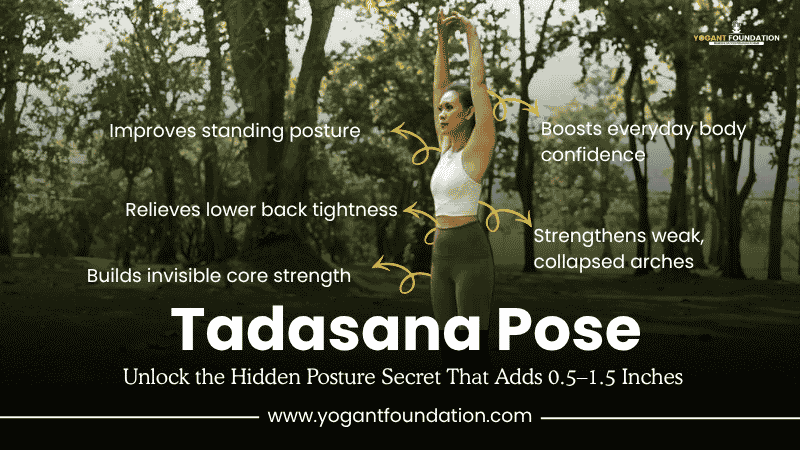
Physical Structure and Health Benefits
1. Masterful Postural Realignment
Tadasana enhances proprioception. This is the body’s advanced ability to track where it is in space without the aid of sight. By consistently building proper body alignment, Tadasana creates muscle memory to replace habitual slouching. The body will not have to put in much effort to sit and stand straight. This will also relieve tension from the neck and the upper shoulders.
2. Deep Functional Core Activation
Forget endless crunches that focus only on the superficial rectus abdominis. Tadasana awakens the transversus abdominis, your body’s natural corset. By gently drawing the navel toward the spine while lengthening the tailbone, you build the deep cylindrical stability that protects your lumbar spine during lifting, walking, and twisting. This isn’t about six-pack muscles; it’s about creating a resilient, injury-resistant trunk.
3. Rebuilding Foot Intelligence and Stability
Decades spent in thick-soled, narrow-toe-box shoes have left most of us with functionally asleep feet. The intrinsic muscles of the sole have atrophied. Tadasana, practiced barefoot, reawakens this forgotten foundation. Learning to spread your toes and distribute weight through the tripod of your foot reactivates the spring-like arches, improving your dynamic balance and reducing the risk of conditions like plantar fasciitis and shin splints.
4. Optimized Joint Longevity (Knees and Hips)
Improper standing often involves locking the knees back (hyperextension) or collapsing into the hip joints. Tadasana teaches a micro-bend in the knees and a neutral pelvis, actions that align the femur properly between the hip socket and the knee joint. The even distribution of forces reduces the wear on your meniscus and cartilage. This will keep you joints in good health for a long time.
The Truth About Height: Does Tadasana Increase Height?
Let’s address the most searched question directly and stop the clickbait. Does Tadasana increase height? The answer is nuanced.
No, Tadasana cannot magically lengthen your bones once your growth plates have sealed. Genetic skeletal length, controlled by the epiphyseal plates, is fixed after puberty. No amount of yoga will turn a 5’8″ adult’s skeleton into a 5’10” frame.
However, yes, Tadasana can absolutely increase your measurable functional height by 0.5 to 1.5 inches. Here is the biomechanical science behind it:
- Spinal Decompression: Gravity compresses the gelatinous discs between your vertebrae throughout the day, making you literally shorter by evening. Tadasana creates an active axial elongation—a decompression force that invites fluid back into the discs, temporarily restoring their plumpness and height.
- Postural Kyphosis Correction: The exaggerated rounding of the upper back caused by desk work steals vertical inches. The hunch literally shortens the distance between your head and your hips. By retraining the thoracic spine toward extension, Tadasana gives you back the inches that poor posture stole. A 20-degree postural reduction can easily mask an inch of your true height.
- Anterior Pelvic Tilt Reversal: When your pelvis tips forward excessively, your spine has to take a longer curved path to reach vertical, effectively shortening your torso. By finding a neutral pelvis, you stack your spinal blocks straight, maximizing your standing height.
For young people with open growth plates, the decompression, improved posture, and stimulated circulation may support the body’s natural genetic growth potential. For adults, Tadasana doesn’t make you grow; it makes you stand up to your full, natural architectural height. And for most people, that’s a life-changing postural victory.
Mental and Energetic Benefits
5. Instant Grounding and Anxiety Reduction
There is powerful neurobiological feedback in the simple act of pressing your feet into the earth. Tadasana signals safety to your nervous system, helping to down-regulate the fight-or-flight sympathetic response and activate the calming parasympathetic nervous system. When you practice it with slow, regular breathing, this tool can be invaluable when giving a public speech or working under pressure.
6. Embodied Confidence and Presence
Your physical posture dictates your neurochemistry. Research on embodied cognition has revealed that adopting an expansive, upright posture actually increases testosterone (the confidence hormone) and decreases cortisol (the stress hormone). Standing in Tadasana isn’t just projecting confidence to the outside world; it’s biochemically telling your own brain, “I am capable, I am stable, I am here.”
How to Do Tadasana: The Ultimate Step-by-Step Procedure
This is the complete, high-resolution Tadasana procedure. Do not rush. Treat each step as a meditation. You are not just striking a pose; you are mapping new neural pathways.
Phase 1: The Foundation — Rooting the Feet
Step 1: Set Your Base
Stand with your feet together (touching at the big toe mounds, heels slightly apart) or for a more forgiving variation, place them hip-width apart. The hip-width stance is often better for beginners or those with lower back tension.
Step 2: Find the Four Corners
Close your eyes for a moment. Rock forward onto the balls of your feet, then back onto your heels. Now rock left and right. Settle into the center where the weight falls evenly across the four corners of your feet: the mound of the big toe, the mound of the little toe, the inner heel, and the outer heel. Feel a perfect rectangle of pressure.
Step 3: Spread, Lift, and Release
Lift all ten toes high, spread them as far apart as they will go, and then gently lay them back down. Feel how this action awakens the transversalis fascia and lifts the inner and outer arches of your feet. Do not grip the floor with your toes; let them be soft and extended.
Phase 2: The Pillars — Engaging the Legs
Step 4: The Quadriceps Cue
Without moving your feet, engage your front thigh muscles powerfully. Visualize lifting your kneecaps straight up toward your pelvis. Isometric contraction of the quadriceps stabilizes the knee joint. Critical: Do not push your knees backward until they lock. Keep a microscopic softness—a “micro-bend.”
Step 5: Neutralizing the Pelvis
Place your hands on your hips, finding the bony landmarks at the front (ASIS) and your pubic bone at the front center. These three points form a triangle. Tilt your pelvis forward and backward a few times to feel the extremes. Settle in the middle where the front hip bones and pubic bone are in the same vertical plane. Visualize a bowl of water resting on your sacrum that you don’t want to spill out the front or the back.
Step 6: Inner Spiral Alignment
Without clenching your buttocks, gently firm your outer hips inward. Feel a subtle wrapping sensation from the back of your legs forward, widening your sitting bones. This releases the lower back and integrates your legs into your core.
Phase 3: The Central Column — The Spine and Core
Step 7: Deep Core Hug
Draw your navel back toward your spine with only about 20% effort. You want a gentle corseting, not a vacuum. You must still be able to breathe fully into the sides and back of your ribcage. This activates the transversus abdominis, turning your torso into a stabilized cylinder.
Step 8: Tailbone Lengthening
Let your tailbone descend heavily toward the floor. This action is the “un-tucking” of the pelvis, decompressing the sacred space of the sacrum and lower lumbar vertebrae. Simultaneously, feel the pubic bone gently lifting toward the navel, creating length in the lower belly.
Step 9: The Ribcage Reset
The tendency is to pop the front ribs forward when we try to “stand up straight.” Instead, breathe into the back of your ribcage. Feel the skin on your back broadening. Then, gently soften the front, lower ribs inward. Your sternum, however, should lift like a proud figurehead on a ship. The lift comes from the upper chest, not the flared ribs.
Phase 4: The Expression — Shoulders and Head
Step 10: The Shoulder Roll
Inhale and lift your shoulders all the way up to your ears. Exhale and roll them backward, sliding the shoulder blades down your spine like they are melting butter. Feel the collar bones widen from the center of the chest.
Step 11: Arm Positioning
Externally rotate your upper arms until your palms face forward. Relax your fingers, allowing energy to stream out through the tips. Your arms should hang not as dead weight but as actively suspended sheaths of energy.
Step 12: The Skull Float
Imagine a balloon attached to the very crown of your head. Feel it lift you upward, specifically from the back of the skull. Keep your chin parallel to the floor. Do not tuck your chin down or snap it upward. Soften your tongue away from the roof of your mouth, release the jaw, and relax the eyes in their sockets.
Phase 5: The Life Force — Breathing into the Mountain
You have built the architecture. Now breathe life into it. Slow, soft Ujjayi breaths through the nose. Feel the tidal volume of your breath expand the ribs sideways against the resistance of your toned core. Stay here for 2 to 5 minutes, continuously scanning your body. The moment your mind wanders, return to the sensation of your breath and the pressure on the soles of your feet.
Critical Mistakes to Avoid in Tadasana
Even experienced yogis fall into these traps. Train your awareness to catch them:
| The Mistake | The Harm | The Instant Fix |
|---|---|---|
| Knee Hyperextension | Creates joint laxity, cuts off energy flow, and bypasses leg strength. | Keep a spring-like micro-bend; focus on lifting the kneecaps, not pushing back. |
| Flared Ribcage | Looks like a deep backbend but actually compresses the T12-L1 junction causing pain. | Inhale into the back of the ribs; draw the frontal ribs softly inward without slouching. |
| Duck Butt (Excessive Anterior Tilt) | Shortens the lumbar spine, triggering back pain and a distended belly. | Lengthen the tailbone down; engage the lower abs to zip up the front of the pelvis. |
| Flat Back (Posterior Tilt) | Destroys the natural spring-like curvature of the spine, creating disc stress. | Stick the buttock flesh out slightly to create a thumb-width natural curve in the lower back. |
| Forward Tech Neck | Strains the suboccipital muscles, leading to tension headaches and cervical degeneration. | Align the ear holes directly over the shoulder joints. |
Expert Tips and Real-Life Application Strategies
The Wall Test: Practice with your heels, buttocks, and shoulder blades touching a wall. The back of your head should lightly touch it too. This gives you hard feedback on how far forward your head usually sits. It can be a shocking but effective learning tool.
The Block Squeeze: Place a standard yoga block between your upper inner thighs. Squeeze it firmly without letting your feet roll out. You will immediately feel a chain reaction of stability shoot from your pelvic floor up into your core.
The Mirror vs. The Feeling: We often look to the mirror for approval, but this disconnects us from our inner sense. Practice Tadasana with eyes closed for 30 seconds. When you open them, check if your “felt sense” of symmetry matches the visual reality.
Micro-Dosing Mountain Pose: You don’t need a 60-minute practice to get the benefits. At your standing desk or while waiting for your coffee to brew, run through the Tadasana checklist. Thirty seconds of conscious rooting and lifting can reset your nervous system for the next hour.
Frequently Asked Questions About Tadasana
Q1: Does Tadasana actually increase height, or is that a yoga myth?
It is both a myth and a truth. It cannot physically lengthen fused adult bones. However, by decompressing the intervertebral discs and correcting the postural kyphosis (slouching) that makes you shorter, it reliably restores up to an inch of “hidden” functional height. You simply stand to your full skeletal potential.
Q2: How long should I hold Tadasana to see real benefits?
For pure neuromuscular retraining, frequency beats duration. Holding for 2 minutes with perfect, focused awareness four times a day is more transformative than holding for 10 minutes once a week. The goal is to make the alignment unconscious, which requires high-frequency repetition.
Q3: I have flat feet. Can I still practice Tadasana?
Absolutely, and you should. In fact, it’s therapeutic. Focus heavily on Phase 1 of the procedure. The action of lifting the toes and rooting the toe mounds encourages the muscles supporting the medial arch to re-engage. Visualize lifting the inner ankle bone without gripping the toes.
Q4: Is it possible to practice Tadasana if I have back pain?
Generally, yes, but listen to your body’s signals. For acute back pain, try the supine (lying down) version on your back, pressing your legs and shoulders into the mat. For chronic issues, the wall variation is safer, and ensuring a neutral pelvis (not an exaggerated swayback) is critical for pain management.
Q5: What’s the real difference between Tadasana and just standing regularly?
Intent and engagement. Casual standing is a passive loading of joints and ligament, often sloppy. Tadasana is an active meditation. Muscles are dynamically contracting to create a state of “active rest.” The difference is the same as the difference between a tent that is collapsed in a heap versus one that is beautifully staked and tensile.
Conclusion: Your Practice, Your Mountain
You have just been given the blueprint to one of the most deceptively powerful postures in the yoga canon. Forget the Instagram-worthy contortions. If you only ever mastered Tadasana, you would revolutionize your spine, your confidence, and your presence.
The mountain is not in a hurry. It simply rises, rooted and vast, unshaken by the storms swirling around its peak. You carry that same capacity within you. The next time you feel small, overwhelmed, or physically collapsed, remember that you know how to do Tadasana. You can root down, align your bones, and rise up into your full, unapologetic height—right there in the grocery line, in the boardroom, or in your living room.
Stand up. Find your earth. Touch the sky with the crown of your head. You’ve got this.
Has Tadasana changed your posture or your perspective? I’d love to hear about your experience. Share your journey in the comments below and if you found this guide helpful, share it with someone who could use a little loving attention to their posture.