
You know that feeling. You rush into the yoga studio, mind still buzzing from traffic, and unroll your mat between everyone else. Then you notice them. A practitioner moves in the corner with a steady, quiet rhythm. Their breath sounds like ocean waves in a shell—steady, powerful, and constant. They’re not following the teacher in the same way; they’re deep inside their own experience. That was my first glimpse of Ashtanga yoga. And I’ll be honest, my first thought was, “That looks intense. I could never do that.”
I saw it as a performance of superhuman flexibility and strength. It took me years to finally understand what I was truly witnessing: a moving meditation. A dedicated conversation between one person’s breath, body, and mind.
This isn’t a practice of perfection. It’s a practice of presence. And if you’ve ever been curious about what’s really happening on those mats, let’s pull up a chair and chat. This is the story of Ashtanga yoga—not as a rigid discipline for the elite, but as a profoundly human path anyone can walk.
What is Ashtanga Yoga?
Ashtanga Yoga meaning: Let’s start with the name, because it says everything. “Ashtanga” comes from Sanskrit and simply means “eight limbs” (ashta = eight, anga = limb). Think of it not as a single tree, but as an entire, interconnected forest.
The 8 limbs of Ashtanga Yoga Path Explained
Those Eight limbs of Ashtanga Yoga are a practical guide to living a meaningful life, laid out thousands of years ago. They are:
- Yamas: How we interact with the world around us (being kind, being truthful, not taking what isn’t ours).
- Niyamas: How we care for our own inner world (staying clean and content, cultivating self-discipline, reflecting on ourselves).
- Asana: The physical postures.
- Pranayama: The art of breathing.
- Pratyahara: Turning inward our senses.
- Dharana: Focusing on the present.
- Dhyana: Meditation.
- Samadhi: A state of peaceful connection.
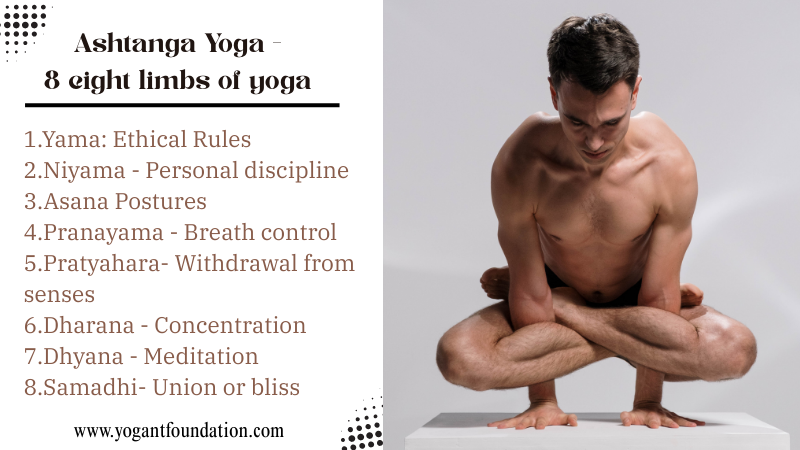
See that? The physical postures, the asana, are just one piece of the puzzle—the third limb! The modern Ashtanga yoga method we practice on the mat is like a dedicated training ground for all eight. We start with the body and the breath, and if we stick with it, the lessons naturally begin to seep into the rest of our lives.
Ashtanga Yoga in Hindi:
अष्टांग योग सिर्फ शारीरिक व्यायाम नहीं है – यह तो एक सच्चा मित्र है जो जीवन भर साथ देता है। सुबह-सुबह चटाई बिछाकर जब मैं उज्जायी प्राणायाम की आवाज़ सुनता हूँ, यह मेरे दिन की सबसे शांत और सार्थक बातचीत बन जाती है। इसकी “आठ limbs” यम, नियम, आसन से लेकर समाधि तक जाती हैं। आसनों का निश्चित क्रम एक पुरानी कहानी की तरह सुकून देता है, और ड्रिश्टि का फोकस मुझे बाहरी शोर से दूर अपनी आंतरिक शांति से जोड़ता है। यह अभ्यास मुझे सिखाता है कि चुनौतियाँ आएँ तो धैर्य से कैसे साँस लेना है, और जीवन की भागदौड़ में भी शांत कैसे रहना है। यह मेरे शरीर को मजबूत बनाता है, लेकिन इससे भी ज़्यादा, यह मेरे मन को मजबूत बनाता है।
The Tristhana Method: The Three Pillars of an Ashtanga Practice
So, what does it actually feel like to be on that mat? The Tristhana, a tri-part focus, is the key to the trick and the challenge. What turns a simple series of stretches in to a deeply moving meditation is this three-part focus.
1. Breath (Ujjayi Pranayama)
If Ashtanga yoga were a song, the Ujjayi breath would be the drumbeat. It’s this soft, whispering sound you make at the back of your throat, like trying to fog up a mirror with your mouth closed. It might feel strange at first, but this breath becomes your best friend.
When my mind starts to spin out about a work email I forgot to send, I come back to the sound of my breath. When my legs are shaking in a challenging pose, I steady them by lengthening my breath. It’s the anchor that keeps you from getting swept away by your thoughts. It’s the engine that builds a purifying, internal heat, washing your body and mind clean from the inside out.
2. Posture (Asana)
Now, for the part everyone sees: the poses. In Ashtanga yoga, the sequences are set in stone. There are six series, but please, don’t let that intimidate you. Most practitioners spend a lifetime exploring just the first one or two.
- The Primary Series (Yoga Chikitsa): Think of this as “yoga therapy.” It’s designed to realign your spine, detoxify your body, and build a foundation of strength.
- The Intermediate Series (Nadi Shodhana): This is the “nerve purifier,” working deeply on your energetic pathways.
The beauty of a fixed sequence? You can’t get lost. You don’t have to wonder what’s coming next. This frees up your mind to stop performing the poses and start experiencing them. You learn to listen to the subtle story your body is telling you each day.
3. Gaze Point (Drishti)
This was the game-changer for me. Every single pose has a specific place for your eyes to rest—the tip of your nose, your navel, your hand.
At first, I thought, “What’s the point? I can still see everything.” But the Drishti isn’t about blocking your vision; it’s about focusing your attention. The practice of not looking around the room to compare your pose to your neighbor’s. It’s the act of turning down the volume on the outside world so you can hear your own inner voice. It’s the first, practical step of turning inward.
When you weave these three threads—the steady breath, the mindful movement, and the soft gaze—together, something clicks. You stop doing yoga and start being yoga.
The Unique Structure of an Ashtanga Class: Led vs. Mysore
If you’re thinking of trying it, you should know there are two main ways classes are offered. They feel completely different, and I love them both for different reasons.
Led Primary Series
Imagine a conductor leading an orchestra. As the teacher shouts out poses in Sanskrit the whole room breathes and moves as one. It’s electric to feel the collective energy! This is a great way to get the rhythm down and feel the support of your friends and family. This is a sweaty and unified experience.
Mysore Style (The Heart of the Practice)
Now, this is the secret heart of Ashtanga yoga. And it’s probably not what you picture when you think of a yoga class.
Walk into a Mysore room, and you might see chaos. People are at different points in the sequence, moving at their own pace. There’s no one calling out instructions. Instead, the teacher moves quietly through the room, offering a gentle adjustment here, a whispered instruction there.
You learn the sequence one pose at a time, like chapters in a book. You don’t move on until you’ve truly absorbed the current chapter. This is the ultimate in personalized, non-competitive practice. It’s just you, your breath, and your journey. The teacher is your guide, not your drill sergeant. It’s where you truly make the practice your own.
The Transformative Benefits of a Consistent Ashtanga Yoga Practice
So, why put yourself through this? Why bother to show up every day? They are subtle but profound, and they can be felt both on the mat as well as off.
Physical Benefits: Building a Resilient Body
I used to think yoga was just about stretching. Ashtanga yoga showed me it’s about building a body that works.
- Real, Functional Strength: You’re not just holding poses; you’re constantly moving, supporting your own body weight. You build lean, capable muscle everywhere.
- Intelligent Flexibility: This isn’t about forcing yourself into a split. It’s about actively engaging muscles to safely open your body, creating a flexibility that protects your joints, not one that strains them.
- A Inner Heat: That Ujjayi breath builds a fire inside. You sweat. A lot. And it feels like a deep, cleansing purge for your entire system.
- Stamina: It’s a cardiovascular workout in disguise. You’ll walk out of the studio feeling energized, not drained.
Mental & Emotional Benefits: Cultivating a Steady Mind
This, for me, is the real gold.
- A Toolkit for Life: The practice is a mirror. You learn to meet frustration, impatience, and your own ego head-on. The discipline of showing up on your mat, especially on the days you don’t want to, trains you to show up for your life with the same commitment.
- Quieting the Anxiety: When your entire focus is on the trinity of breath, movement, and gaze, there’s no room for the “what-ifs” and the “should-haves.” It’s the most effective stress-relief I’ve ever found.
- Quiet Confidence: When you learn that you can overcome physical and psychological discomfort by breathing steadily, you gain a newfound self-confidence. That confidence doesn’t shout; it emanates from a place of deep inner knowing.
Busting Common Myths: Is Ashtanga Yoga Right for You?
Let’s tackle the big fears head-on, because I had them all.
Myth 1: “You Have to Be Young, Thin, and Flexible to Start.”
The Truth: Please, hear me on this. This is the practice’s biggest PR problem. You come to Ashtanga yoga to get flexible and strong, not because you already are. The first time I tried, I couldn’t touch my toes. My teacher handed me a strap and said, “Great, this is your starting point.” The practice meets you exactly where you are. It’s for every body—young, old, stiff, injured. A good teacher will show you how.
Myth 2: “It’s a Cult-Like, Dogmatic Practice.”
The Truth: There is deep respect for the tradition, but the modern Ashtanga yoga community is full of thoughtful, questioning people. The real “dogma” is the empowering discipline of self-care. It’s about finding your own truth within a time-tested framework. It’s a personal journey, not a blind following.
Myth 3: “It’s Too Intense and You Will Get Injured.”
The Truth: Any physical activity can cause injury if you push with your ego instead of listening to your body. The brilliant, self-paced nature of Mysore style is actually one of the safest ways to practice. You are never pushed to do a pose you aren’t ready for. The number one rule is, and always will be, “Listen to your body.” It’s your most important teacher.
Your First Ashtanga Yoga Yoga Class: A Beginner’s Guide to Starting
Ready to take the leap? Here’s my best advice, from my own nervous first steps.
- Find Your Guide, Not Just a Teacher: Look for a studio that offers “Intro to Ashtanga” or “Mysore Style.” Don’t be shy—email them and ask about their experience with beginners. You want someone who makes you feel safe and encouraged.
- Be Brave, Start with Mysore: I know, I know. A led class feels safer. But trust me, walking into a Mysore room is the kindest thing you can do for yourself. You’ll get one-on-one attention and won’t have to frantically look around to see what everyone else is doing.
- Your Starter Kit:
- A Sticky Mat: You’ll need the traction.
- Zero Expectations: Seriously, leave them at the door. Your only job is to breathe and try.
- A Towel and Water: You will sweat, and it will feel amazing.
- Embrace the Quiet: Ashtanga spaces are often hushed, almost like a library. It’s not unfriendly; Respectful of everyone’s inner focus. It’s a gift of silence we so rarely give ourselves.
- Practice, and All is Coming: This is the famous saying from the founder, Pattabhi Jois. Don’t rush. Don’t force. Just show up, practice with honesty, and trust that the transformation will come in its own time.
How Ashtanga Yoga Philosophy Applies to Daily Life
This is where it all comes together. The real magic of Ashtanga yoga isn’t what happens on the mat; it’s what happens when you step off it.
That patience you learn when a pose just won’t come? You’ll find it when you’re stuck in a long line at the DMV.
The discipline to unroll your mat on a rainy Tuesday morning? That’s the same discipline that helps you finally write that book, or stick to a budget, or have that hard conversation.
The ability to keep your breath calm when every muscle is shaking? That becomes your superpower during a stressful work presentation or a disagreement with a loved one.
The practice becomes a blueprint for living. It teaches you how to meet challenge with grace, effort with ease, and chaos with a centered heart.
The Journey of a Thousand Miles Begins with a Single Vinyasa
Ashtanga yoga is not a quick fix. It’s a lifelong conversation. Some days, the conversation is easy and flowing. Other days, it’s a gritty, grinding negotiation. And all of it is valuable.
You won’t look in the mirror one day and see a completely different person. The changes are subtler. You’ll notice you’re standing taller. Catch yourself taking a deep, Ujjayi-like breath when you feel stressed. You’ll find a new reserve of calm in the middle of life’s storms.
It’s a path of coming home to yourself. So, if you’re looking for more than just a workout, if you’re yearning for a practice that will hold you, challenge you, and ultimately reveal you to yourself, your mat is waiting. Take a deep breath, and begin.