
Introduction: The Gentle Backbend
All of us have been there. We all know what it’s like to be hunched up over a laptop, on a phone, or in a car. But what if I told you there was a simple, standing stretch, rooted in ancient yoga practice, that could be your spine’s best friend? Enter Ardha Chakrasana, or the Half Wheel Pose. It’s not the flashiest yoga pose you’ll see on Instagram, but my goodness, it might be one of the most important ones you ever learn.
Think of it as a gentle, accessible reboot for your back. It’s the kind of pose you can do first thing in the morning to shake off sleep, or in the middle of a workday to reset your posture. Over my years of practice, it’s become a non-negotiable part of my routine, and I want to share why it might just become a cornerstone of yours, too. We’ll walk through it together—step-by-step, benefit-by-benefit—keeping things safe, practical, and utterly human.
What is Ardha Chakrasana? Decoding the Pose
Ardha Chakrasana gets its name in Sanskrit. “Ardha”, meaning half and “Chakra”, meaning wheel. “Asana”, meaning posture, is derived from Sanskrit. When performed correctly, it looks like the body is forming a half wheel or an arch. This standing backbend is typically introduced early in yoga curricula because it teaches essential alignment principles that apply to more advanced asanas.
It’s a standing backbend, but please don’t let that intimidate you. Unlike the gymnastic-looking full wheel, Ardha Chakrasana is your introduction to the world of backbends. It’s where you learn the rules of the road: how to protect your lower back, how to use your legs for support, and how to breathe through the delicious stretch across your chest. It’s foundational, which in yoga, always means powerful.
Preparing for Practice: Essential Precautions and Setup
Look, I’m not a doctor, and this isn’t medical advice. But as a fellow practitioner, I’ve learned that the smartest yogis are the ones who know when to be cautious. So, let’s talk about Ardha Chakrasana contraindications—the “who should be careful” list. This isn’t to scare you off; it’s to empower you to practice wisely.
Hold off or get expert guidance if you have:
- A recent or serious back injury, especially in your neck (cervical spine) or lower back (lumbar).
- Uncontrolled high blood pressure or heart issues.
- Severe vertigo or dizziness.
- A migraine in full swing.
- If you’re in the later stages of pregnancy, deep backbends are generally a no-go—check with your prenatal yoga teacher.
And for everyone? Warm up! Never leap into a backbend with a cold body. Take five minutes. Do some gentle neck rolls. Circle your shoulders. A few Cat-Cow stretches on your hands and knees are perfect. Think of it as coaxing your spine awake with a kind whisper, not an alarm bell.
Mastering the Movement: Ardha Chakrasana Steps and Procedure
Alright, you’re warm, you’re mindful, and you’re ready. Here is the Ardha Chakrasana procedure, broken down into simple, manageable Ardha Chakrasana steps. I’ll talk you through it like I would if you were in my living room.
Step 1: Find Your Foundation (Tadasana)
Stand with your feet hip-width apart. Not glued together, not super wide—just directly under your hips. Feel all four corners of your feet (big toe mound, little toe mound, both sides of the heel) rooting down. Engage your thighs gently, soften your knees (don’t lock them!), and let your tailbone tuck slightly downward. Stand tall, as if a string is pulling the crown of your head up. Take a breath here. This is your home base.
Step 2: Reach for the Sky
On a smooth, deep inhale, slowly sweep your arms out to the sides and up overhead. Your palms can face each other or touch. Here’s the first big tip: keep your shoulders away from your ears. Feel your shoulder blades slide down your back. If your shoulders are tight, it’s totally fine to keep your arms shoulder-width apart.
Step 3: The Gentle Arc
Now, on your next inhale, start to lean back. The crucial detail? Initiate the movement from your upper back, not your lower back.
- Imagine you’re arching over a large, soft exercise ball behind you.
- Keep your legs strong and engaged. Your glutes and core should be awake and working to protect your lumbar spine.
- Let your chest lift and open towards the ceiling.
- Your head can follow the line of your spine. If your neck is happy, you can let your gaze go back. If you feel any pinching, keep looking straight ahead or even slightly up. Your neck’s comfort is paramount.
Step 4: Find Your Edge
This isn’t a competition. The goal isn’t to see how far back you can go. The goal is to feel a magnificent stretch along the entire front of your body—your abdomen, chest, and throat—without any crunching, sharp pain, or breath-holding in your lower back. Your hands might only go back an inch. That is a perfect Ardha Chakrasana.
Step 5: Breathe and Be
Hold for 3-5 deep, easy breaths. With every inhale, feel a little more expansion. With every exhale, settle a little deeper into the strength of your legs and core. Smile if you want to! It changes the experience.
Step 6: Coming Up with Care
This part is as important as going in. Engage your core. On an inhale, lead with your heart and chest to come back up to standing. Don’t lead with your head—that’s a one-way ticket to dizziness. Once you’re upright, exhale and lower your arms. Stand quietly for a moment in Mountain Pose. How do you feel? Notice the new space, the slight buzz of energy, the openness.
The Life-Changing Ardha Chakrasana Benefits
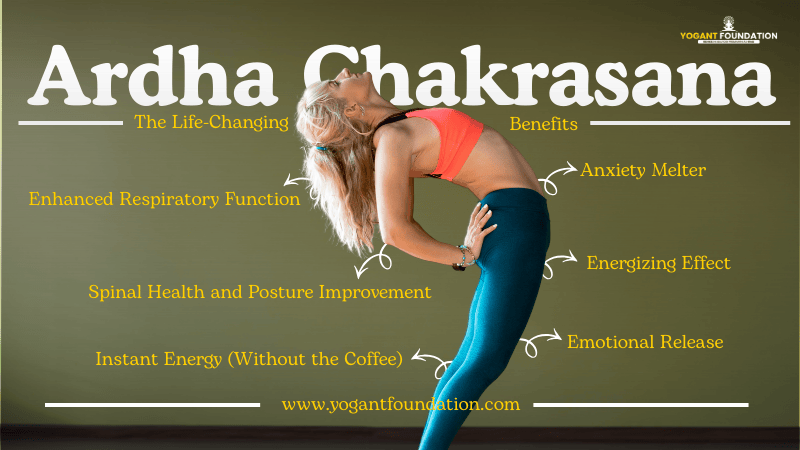
Okay, so it feels good. But what’s really happening in there? The Ardha Chakrasana benefits are profound and touch every part of your being.
Ardha Chakrasana Physical Benefits
The Ultimate Posture Corrector: This exercise directly combats “tech neck” and slouched shoulder. The exercise strengthens your weak upper back muscles and stretches your tight chest muscles, allowing you to take a confident, upright posture.
Spinal Superfood: It nourishes the disks between your vertebrae with gentle movement, keeping your spine fluid and young.
Breath of Fresh Air: Literally! It opens up your ribcage, allowing your lungs to fully expand. You might find yourself taking deeper, easier breaths throughout the day.
A Quiet Core & Leg Workout: To hold this pose, your abdominal and leg muscles are working hard in the background, building strength you can use in everything from walking to lifting groceries.
Ardha Chakrasana Mental and Energetic Benefits
Instant Energy (Without the Coffee): By reversing the usual forward slump, you increase blood flow to your brain. The result? A clear-headed, natural pick-me-up that won’t give you the jitters.
Anxiety Melter: There’s a physical reason we cross our arms when we’re stressed—it’s protective. Ardha Chakrasana does the opposite. It exposes the vulnerable front of your body. This physical act of opening can signal to your nervous system that it’s safe to relax.
A Boost of Courage: According to yoga philosophy, the backbend is linked with your heart. This can help you feel more optimistic and open off the mat.
Integrating Ardha Chakrasana into Your Routine
For Beginners
Start by practicing near a wall. As you stand, turn your back towards the wall. While you are bending backwards, let your hands slide along the wall to provide alignment and support feedback. Instead of focusing on the amount of bend, focus more on how the chest opens.
In a Yoga Sequence
Ardha Chakrasana fits beautifully:
- Use it as an energizer after warming-up poses in the morning routine.
- A counter-pose after forward bends like Uttanasana (Standing Forward Fold).
- A preparatory position to deeper backbends such as Ustrasana or Chakrasana.
Always follow it with a gentle forward fold, like Paschimottanasana (Seated Forward Bend) or Balasana (Child’s Pose), to neutralize the spine.
Practice Frequency
Aim for 3-5 repetitions, holding for 15-30 seconds each, 3-4 times per week. Consistency is more important than duration.
Listen to Your Body: A Final Word on Wisdom and Contraindications
We touched on Ardha Chakrasana contraindications earlier, but it’s worth repeating: Yoga is about self-study. A mild shake in a working muscle is different from a sharp, shooting pain. Discomfort as you stretch is different from pinching or compression.
Be the most attentive student of your own body. Some days your half-wheel will feel deep and glorious; other days, it might feel tighter. Both are perfect. The practice is in showing up and meeting yourself where you are, without judgment.
Weaving Ardha Chakrasana Into the Tapestry of Your Day
You don’t need a 90-minute class to reap the rewards. Do three rounds in the morning while your coffee brews. Do one at your standing desk (just make sure you have space behind you!). Combine it with the forward fold like touching your feet to help balance your back. The tool is versatile and powerful.
Beyond the Physical: The Deeper Journey of the Half Wheel
Ardha Chakrasana is not just a physical practice. It is an exercise of courage and vulnerability, which involves opening the Anahata Chakra with a hand gesture symbolizing openness towards the world outside. You are practicing trust each time you arched back: you trust your breath, your body, and the present moment.
This pose helps you find balance between effort and ease. It teaches how to go deeper while still respecting your limits. Use it in conjunction with the forward folding, like touching your toes. This tool has a lot of versatility and power.
Conclusion: Your Journey with Ardha Chakrasana Begins Now
Ardha Chakrasana is more than just a backbend. This is a gentle reminder that growth and healing can come when we lean back, open up and trust our own system of support–our solid legs, engaged core and steady breathing. This is a brave act for both your body and mind.
So, the next time you feel that familiar stiffness, or need a moment to reset your mental state, come back to this guide. Plant your feet, reach up, and lean into the gentle, supportive curve of your own half-wheel.