
Anjaneyasana for Tight Hips | Release Stored Tension
Have you ever noticed how your body feels after a long day of sitting? That tightness in your hips, the dull ache in your lower back, the way your shoulders curl forward as if they’re trying to protect something. It’s a feeling so many of us know too well | Anjaneyasana
I remember my first attempt at a low lunge. I was in a crowded yoga class, trying to follow along, and when the teacher said “lower your back knee and sink into your hips,” my body simply refused to cooperate. My hips felt like they were made of stone. I looked around the room at gracefully arching backward with their arms reaching for the sky, and there I was, wobbling, gripping the floor with my fingertips, wondering if I’d ever feel that sense of openness everyone else seemed to find so easily.
If that sounds familiar, I want you to know something important: your body is not broken. Those tight hips are not a failure. They’re simply responding to how you’ve been living—all those hours behind a steering wheel, at a desk, on a couch. And the good news? There’s a pose that speaks directly to this modern condition.
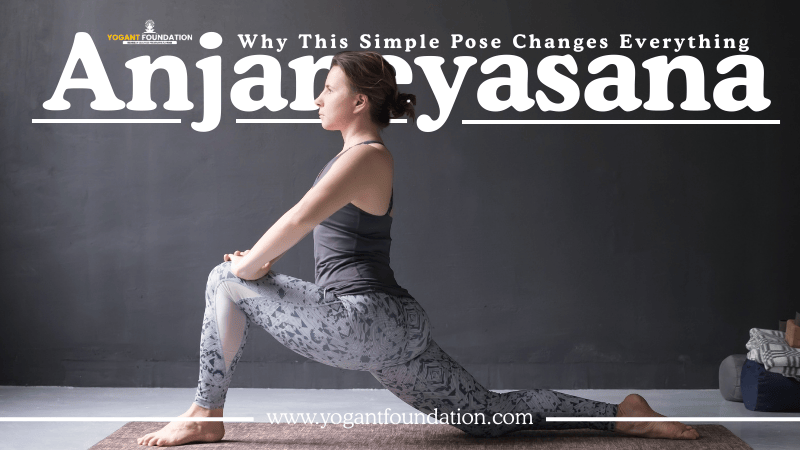
Anjaneyasana—often called Low Lunge or Crescent Pose—has become my daily conversation with my own body. It’s not about forcing flexibility or achieving some Instagram-worthy backbend. It’s about meeting yourself exactly where you are and gently, patiently creating space.
What is Anjaneyasana?
Picture this: one knee rests on the ground behind you while your other foot plants firmly in front, knee bent at a right angle. From there, you lift your arms overhead, maybe arching slightly backward if that feels available. That’s Anjaneyasana.
The name comes from Anjani, mother of the Hindu deity Hanuman. It carries this sense of devotion and reaching—not straining, but reaching. Your front leg grounds you while your back leg stretches deeply through the hip flexors, those muscles that shorten and tighten from all our sitting. Your arms rise not in aggression but in openness, like someone greeting the morning sun.
Why You Need This Pose | The Multifold Anjaneyasana Benefits
Here’s something worth considering: your body doesn’t know the difference between physical stress and emotional stress. When your hips are tight, when your psoas muscle (that deep hip flexor) is constantly shortened from sitting, your nervous system can interpret that as a state of threat. It’s like your body is perpetually preparing to flee or fight, even when you’re just answering emails.
Anjaneyasana offers a way to speak to your nervous system in a different language. It says, “We can soften now. We can open. We’re safe.”
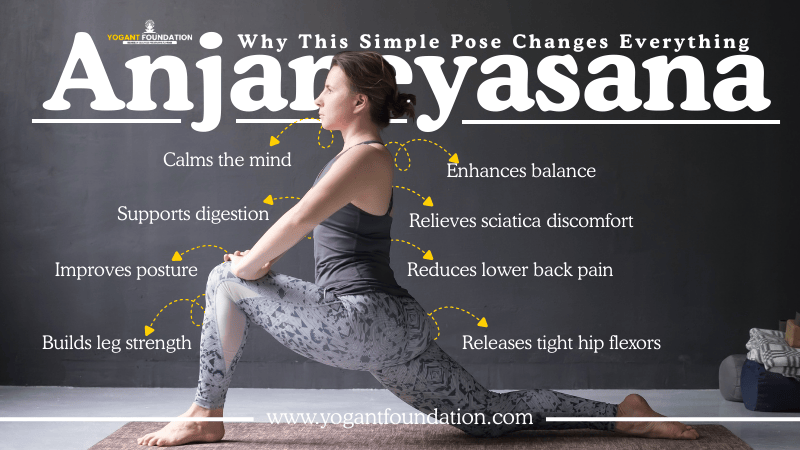
The Anjaneyasana benefits unfold in layers:
Your hips begin to release. Not all at once, not dramatically, but slowly. You might notice one day that the familiar pinch when you first stand up isn’t quite as sharp.
Your posture shifts. When your hip flexors loosen, your pelvis can return to a more neutral position. Your lower back stops compensating. Standing becomes more effortless.
Breath deepens. With your arms lifted and chest open, you’re literally creating more physical space for your lungs to expand. And breath, as you probably know, is intimately connected to your state of mind.
Your focus sharpens. Balancing on one knee and one foot requires just enough concentration to pull you out of your mental loops. For those few breaths, you’re not worrying about tomorrow or replaying yesterday. You’re just here.
Your Step-by-Step Guide to Anjaneyasana
We’ll walk together through it slowly and without any judgments about the way you think it should look.
Step 1: Find Your Starting Point
Start on your hands and knees in a tabletop position. This feels safe, stable. From here, step your right foot forward between your hands. Your right knee should end up somewhere near your right wrist, your right foot near your left wrist. Don’t worry if it’s not perfect—you can adjust.
Step 2: Lower Down with Control
Slide your left knee back an inch or two until you feel a gentle sensation in the front of your left thigh. Not pain. Not sharpness. Just awareness. The top of your left foot can rest on the floor, or if that feels intense, tuck your toes under.
Step 3: Alignment Check | The Knee
Take a moment here. Look down at your right knee. Is it stacked somewhere over your right ankle? Good. If it’s jutting out past your toes, scoot your foot forward a bit. Your knee will thank you later.
Step 4: Square the Hips
This part matters. Most of us let the back hip drop toward the floor or swing out to the side. Gently draw your left hip forward and your right hip back. Imagine your hip points are headlights—you want them both shining straight ahead.
Step 5: Rise and Shine
Press through your front foot and the top of your back foot. On an inhale, begin to lift your torso. Your hands can come to your front thigh if that feels right. Or you can sweep them out to the sides and up overhead. Maybe your palms face each other. Maybe they press together. Your choice.
Step 6: The Final Expression | Optional Backbend
If it feels available, draw your tailbone slightly down and forward (a small tuck) to protect your lower back. Then lift your chest and let your gaze follow your hands. This isn’t about dropping your head back dramatically. It’s about opening through the front of your body.
Step 7: Hold and Release
Breathe here for five to ten breaths. Notice what arises—physically, emotionally. Then release, change sides, and offer the same patience to the other leg.
Practical Tips for Success | Expert Strategies
Over years of coming back to this pose again and again, a few truths have revealed themselves.
The pose changes daily. Some days my back knee protests and I need extra padding. Other days my hips feel unusually spacious and I can sink deeper. Some days my mind is so scattered that simply balancing feels like an accomplishment. All of it is practice. None of it is failure.
Small adjustments create big shifts. The difference between a collapsed lunge and an aligned one can be subtle—a slight tuck of the tailbone, a gentle engagement of the lower belly, a conscious softening of the jaw. These micro-movements transform the entire experience.
The breath is your guide. When I’m struggling in this pose, I notice my breathing becomes shallow and quick. The invitation is always there to deepen it, to let the exhale carry me into more surrender. The pose becomes a moving Meditation on this simple truth: you can’t force openness. You can only create conditions for it to arise.
5 Common Mistakes to Avoid
Let’s be honest about the challenges that can come up.
If your front knee hurts, check your alignment first. Is your knee tracking over your second toe, or is it collapsing inward? Is your weight too far forward? Sometimes the smallest shift makes all the difference.
If your back knee feels crushed, grab a blanket. Fold it thickly and place it right under your kneecap. Your bones deserve cushioning. There’s no medal for suffering on a hard floor.
If your lower back complains, you might be arching too much from your lumbar spine. Try drawing your front ribs slightly toward your back body. Imagine lengthening your tailbone toward the floor. The stretch should live in your hip, not your spine.
If you can’t balance, keep your hands on blocks or on your front thigh. Balance is a conversation between your body and gravity. Sometimes you lead. Sometimes gravity leads. Both are okay.
Variations: Make the Pose Fit You
| Variation | Who It’s For | How To Do It |
|---|---|---|
| Beginner / Sensitive Knees | Those with knee discomfort or lack of ankle flexibility. | Place a folded blanket under the back knee for cushioning. Keep hands on the front thigh (like a runner’s lunge) instead of raising them overhead to focus solely on the hip stretch . |
| With Blocks | Those who can’t reach the floor comfortably or want more stability. | Place a yoga block on each side of the front foot. Keep your hands on the blocks. This lifts the floor up to you, allowing you to keep your spine long . |
| High Lunge (Intermediate) | Those wanting to build more leg and core strength. | Instead of lowering the back knee, keep it lifted. Balance on the ball of your back foot. This requires more core engagement and quadriceps strength in the back leg . |
| Twisted Crescent (Advanced) | Those looking for a spinal mobility challenge. | From the pose, bring your hands to Anjali Mudra (prayer position) at your chest. Twist your torso to the right, hooking your left elbow outside your right thigh. Gaze over your right shoulder. |
Pro Tips: Advanced Insights
One of the beautiful things about Anjaneyasana is how it adapts to whoever shows up for it.
Some days your body just doesn’t want to cooperate. That’s okay. On those mornings, leave your hands on your thigh. Cushion that back knee. Let your gaze stay soft and forward. This isn’t less of a practice. It’s exactly the practice you needed today.
For days when you’re craving more challenge, explore the high lunge variation—lift your back knee off the floor and balance on the ball of your back foot. Feel the fire in your thighs. Feel the strength building.
For moments when you want to cultivate focus, try the twist variation. From your lunge, bring your hands to prayer at your chest and rotate your torso toward your front leg, hooking your opposite elbow outside your knee. Stay for several breaths before releasing.
For times when you need stillness, drape your upper body over your front thigh in a humble variation. Let your head hang heavy. Let your arms rest on the floor or on blocks. Sometimes lowering is actually rising.
Frequently Asked Questions
1. Is it normal to feel shaking in my legs?
Absolutely. Your muscles are working and lengthening at the same time. The shaking is just conversation. Listen to it, but don’t let it scare you away.
2. How will I know if I’m pushing too hard?
Pain is your body’s honest communication. Sharp, stabbing, or pinching sensations are not invitations to push through. They’re requests to adjust or ease back. A dull, stretching sensation is different—that’s just your edges talking.
3. Can I practice this if I have knee issues?
Many people with knee concerns still practice Anjaneyasana safely. The key is modification. Keep your back knee padded. Keep your front knee tracking properly. Consider keeping your hands on blocks or your thigh rather than lifting them overhead. And always, always listen to what your body tells you.
4. What if my hips are extremely tight?
Welcome to the club of most humans in the modern world. Extreme tightness just means you start where you are. You might barely move at first. You might not feel a “stretch” in the way you expect. That’s fine. Consistency matters more than intensity. Show up regularly, and change will come on its own timeline.
5. How does this pose affect my mood?
There’s something about opening the front of the body that shifts something internally. The chest opens. The breath deepens. The gaze lifts. Many people report feeling more expansive, more hopeful, more grounded after spending time here. It’s not magic—it’s just your body and mind reconnecting.
Conclusion: Your Journey to Open Hips Starts Now
I used to think yoga was about achieving poses. Get the heel down. Touch the floor. Wrap the arms behind the back. It was a list of accomplishments, and my body was perpetually failing to check the boxes.
But Anjaneyasana taught me something different. It taught me that the pose isn’t a destination. It’s a continually unfolding conversation. Some days I sink deep & days I hover at the surface. Some days I spend the whole time just breathing into one tight hip, and that’s enough.
Your body has been carrying you through every moment of your life. It’s held your stress, your grief, your excitement, your exhaustion. When you come into Anjaneyasana, you’re not trying to fix a broken machine. You’re simply offering a moment of attention, a breath of space, a gesture of gratitude.
The pose will be there tomorrow, and the day after, ready to meet you exactly where you are. All you have to do is show up.