
Makarasana | Stop Fighting and Start Floating
Let’s be honest for a second. When was the last time you truly did nothing? Not scrolling, not planning dinner in your head, not worrying about that email you forgot to send—just… nothing. Most of us have forgotten how. We’ve tricked ourselves into believing that productivity equals worth, and that rest is something we have to earn after we’ve exhausted ourselves | Makarasana
I remember a time in my own practice when I would dread the end of a yoga class. Savasana felt impossible. My mind would race, my lower back would ache from holding tension, and I’d be the first one to roll up my mat and bolt out the door. I was treating rest like a failure. It wasn’t until a teacher gently guided us into a pose I’d always skipped—Makarasana—that I realized I had been fighting my own body instead of listening to it. The crocodile taught me how to breathe again.
What is Makarasana?
If you have never tried Makarasana, or if you have and thought it was just a nap break, let me reframe it for you. This isn’t about checking out. It is about checking in.
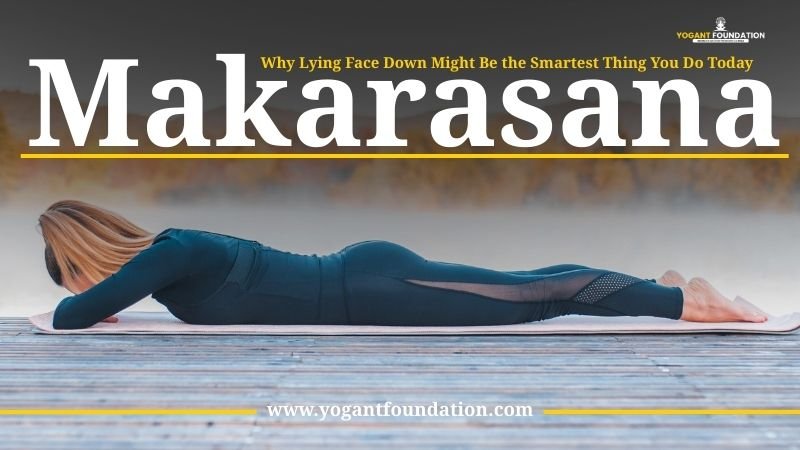
Makarasana, commonly known as Crocodile Pose, is a prone resting posture where you lie face-down with your legs slightly apart and your head resting on folded arms. Unlike passive rest, this specific alignment is designed to mechanically restrict chest breathing, compelling the diaphragm to engage and forcing the body into a state of deep, physiological calm.
Think of it as a gentle hack for your nervous system. You aren’t trying to relax; your body is being tricked into it by the very position you are holding.
Why Your Body Has Been Begging for This Pose
We carry stress in predictable places: the jaw, the shoulders, and especially the lower back. But the most damaging place we hold it is in our breath. When you are anxious, your breath becomes shallow and lives in the upper chest. This signals your brain that danger is near, creating a vicious cycle of tension.
The Back Breath You Never Knew You Had
Here is a strange but wonderful truth: you can breathe into your back. In Makarasana, because your chest is pinned to the floor (or your arms) by gravity, the only place for your breath to go is downward and backward. On a good inhale, you should feel your lower ribs and kidneys gently pressing into the mat. That sensation is your diaphragm working the way nature intended. It is the physical sensation of your nervous system shifting from “fight or flight” to “rest and digest.”
A Quiet Rebellion Against Sitting
Our modern lives are lived in a chair: curved spine, rounded shoulders, compressed discs. When you flip over and lie flat in Makarasana, you are giving your spine a chance to remember its natural shape. It is a passive, gentle traction for the vertebrae. It feels like someone finally took the weight of the world off your back, because, in a way, they have.
Befriending Your Inner Monster
In Hindu mythology, the Makara is a powerful sea creature—sometimes a crocodile, sometimes a dolphin-like beast. It represents the raw, untamed energy within us. The pose isn’t about killing that monster; it’s about learning to coexist with it. You lie on your belly, close to the earth, and you simply watch the waves of your breath. You stop fighting the current of your thoughts and start floating on top of them.
How to Master Makarasana: A Step-by-Step Guide
There are two ways to approach this pose. One is for when you need to rebuild energy (the active version), and one is for when you need to completely dissolve stress (the resting version). Let’s start with the one that will change your life.
The Classic Relaxation Variation | Beginner Focus
This is the version I use on days when my brain feels like a browser with too many tabs open.
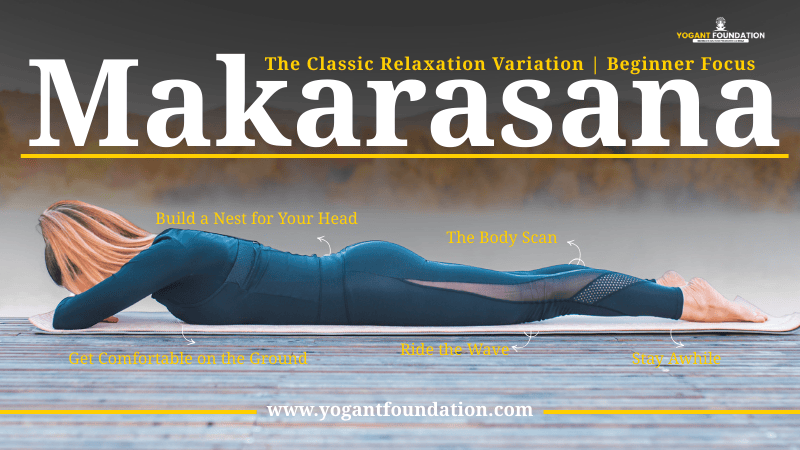
- Get Comfortable on the Ground: Roll out your mat and lie down on your stomach. Don’t overthink it. Let your legs slide apart until they are about hip-width distance or a little wider. Let your toes point inward toward each other. Feel your thighs get heavy.
- Build a Nest for Your Head: Bend both arms and stack your forearms in front of you. Gently place one hand on the opposite elbow. It should feel like you are building a little pillow for your head. Lower your forehead down. If your neck feels strained, lower your arms or use a small towel for extra height.
- The Body Scan: Before you even think about your breath, take a tour of your body. Consciously tell your jaw to unclench. Tell your shoulders to slide away from your ears. Tell your belly to be soft. This step is crucial—if you are holding tension, the breath can’t flow freely.
- Ride the Wave: Now, bring your attention to your lower belly. As you inhale, imagine your breath filling the space between your belly button and the mat. As you exhale, feel everything soften. Don’t force the breath. Just watch it, like you are sitting on a shore watching the tide come in and out.
- Stay Awhile: Commit to staying here for at least five minutes. Set a timer. The first two minutes might feel awkward. By minute four, you will feel a shift.
The “Building Heat” Version | For Strength and Focus
This is for the days you need to cultivate energy rather than release it.
- Lie on your belly with your legs together.
- Bring your hands to the back of your head, interlacing your fingers. Spread your elbows wide, like opening a book.
- On an inhale, gently lift your head, chest, and elbows a few inches off the floor. Keep the gaze down to protect your neck.
- Hold for a breath or two, feeling the muscles along your spine engage.
- Exhale and release back down. Repeat a few times.
Practical Tips and Expert Strategies for a Deeper Practice
You don’t need to be a yogi to benefit from this pose, but a few insider tricks can deepen the experience significantly.
- The After-Work Reset: I have a rule: no phones for the first ten minutes after I walk in the door from work. Instead, I hit the mat for Makarasana. It creates a buffer zone between the stress of the office and the peace of home. It prevents me from bringing my bad mood to the dinner table.
- The Creative Block Breaker: If you are stuck on a problem or feeling creatively stagnant, this pose is magic. The connection to the second chakra (the center of creativity) combined with the steady breath often unlocks answers that staring at a screen never will.
- Don’t Be a Hero with Props: If your shoulders are tight and your forehead doesn’t reach your arms comfortably, grab a blanket. Roll it up and place it under your upper chest. It will support your spine and free up your neck, allowing you to relax completely.
Common Mistakes to Avoid
It sounds easy, right? Just lie there. But our brains are clever at sabotaging rest.
- The “Productive” Mind Trap: You might lie down and immediately think, “I should be doing something else.” Recognize that thought, thank it for its opinion, and let it float away. This is the something else you should be doing.
- Neck Craning: In the active version, don’t look up. Looking forward shortens the neck and defeats the purpose. Keep your gaze down, imagining a string pulling the back of your head long.
- Jumping Up Too Fast: The worst thing you can do is finish your five minutes of bliss and immediately jump up to check your phone. Roll gently onto your side, rest for a moment, and then slowly press up. Let the calm follow you off the mat.
Makarasana vs. Other Prone Poses
It helps to know where this pose fits in the grand scheme of things.
| Pose | Primary Action | Breath Focus | Difficulty |
|---|---|---|---|
| Makarasana (Relaxation) | Passive surrender; arms support head | Deep, diaphragmatic breathing into the back | Beginner |
| Makarasana (Active) | Active lift of head/chest; arms at head | Strengthens spine while maintaining breath | Intermediate |
| Bhujangasana (Cobra) | Active backbend using arms to push up | Opens chest; challenges lower back flexibility | Beginner/Inter. |
| Salabhasana (Locust) | Full-body lift (arms, chest, legs) | Intense back strengthening and engagement | Intermediate |
| Savasana (Corpse) | Supine (on back); complete stillness | Natural, unobserved breath | Beginner |
Going Deeper | The Philosophy of the Crocodile Pose
The ancient texts say that Makarasana generates heat in the body. But I think the heat they are talking about is the fire of awareness. When you lie still, you can’t hide from yourself. You feel the tight spots. You notice the places you hold grudges in your body. The “heat” is the discomfort of sitting with yourself.
The advanced practice of this pose isn’t physical; it’s emotional. Can you stay present when your hip starts to ache? Can you stay calm when a stressful thought bubbles up? The crocodile waits. He watches. He breathes. He’s does not react. That is the mastery we are after.
Frequently Asked Questions About Makarasana
1. Is Makarasana the same as Savasana?
Both. The resting version relaxes your nervous system, while the active version (lifting the head and chest) strengthens the spinal erectors. You choose based on what your body needs that day.
2. Can I do Makarasana if I have lower back pain?
Yes, in general. This gently releases the spine. Always consult with a doctor if you suffer from an acute injury such as a herniated disk or have a recent injury.
3. Who should not practice Makarasana?
This is common. Try adjusting your arm position or using a small cushion under your elbows to take pressure off the nerves. Shaking your hands out afterward restores circulation quickly.
4. Is it okay to do this right before bed?
It is perfect for bedtime. It slows the heart rate and shifts the body into a parasympathetic state, making the transition to sleep much smoother.
5. How is this different from just lying on the couch?
On the couch, your spine is usually curved and your neck is bent. On the floor in Makarasana, your spine is in a neutral, elongated position, and the breath is naturally guided. The floor provides the feedback your body needs to let go.
Conclusion: Your Invitation to Float
We complicate rest. We buy special teas, we download meditation apps, we read books about sleep. But sometimes, the most profound reset is the simplest.
Find your floor. Lie down on your belly. Rest your head. And just breathe.
The crocodile knows that stillness is power. Maybe it is time you remembered, too.
Have you ever tried just lying on the floor when you felt overwhelmed? How did it feel? Share your experience in the comments—I’d love to hear your story.