
Mayurasana | Guide to Balancing Like a Bird
I remember the first time I attempted Mayurasana. I was in a hot yoga studio in Mumbai, full of vata (and probably too much chai), watching the instructor balance gracefully on her hands like she was posing for a sculpture. How hard can it be?
I leaned forward, placed my palms on the mat, tucked my elbows into my belly… and immediately toppled over. My face met the mat with a humbling thud.
If you’ve ever tried the Peacock Pose, you know exactly what I’m talking about. It looks like a party trick, but it feels like a physics experiment gone wrong. But here’s the thing: after years of practice (and a few more falls), Mayurasana has become my secret weapon for digestion, focus, and arm strength.
Whether you are in New York, London, or Delhi, this pose offers benefits that go way beyond the gram. Let’s break down the Mayurasana benefits, how to prep for Pincha Mayurasana (that’s the forearm balance peacock), and exactly how to find your lift.
What Exactly is Mayurasana?
In Sanskrit, Mayura means peacock, and Asana means posture. So, we are literally trying to imitate a peacock. But why a peacock? In yogic philosophy, the peacock is a symbol of beauty, grace, and—interestingly—the ability to eat poisonous things without getting hurt.
The story goes that the peacock can consume toxins and transform them. In our bodies, the Mayurasana pose is believed to do the same thing: stoke the digestive fire (Agni) to burn off toxins (Ama) in the belly.
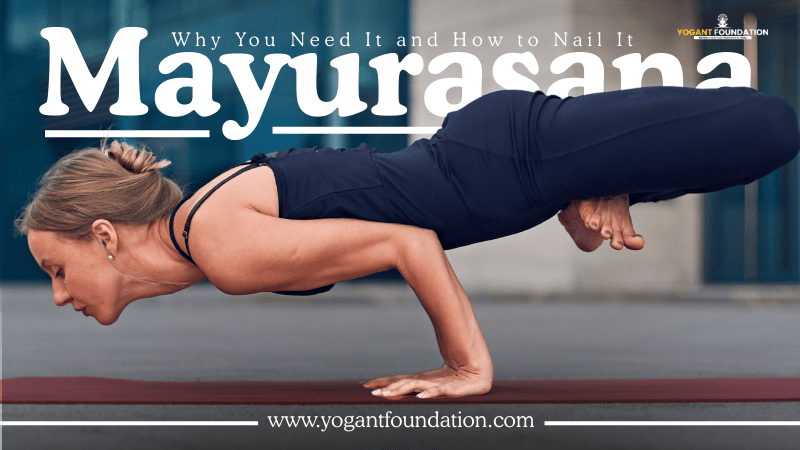
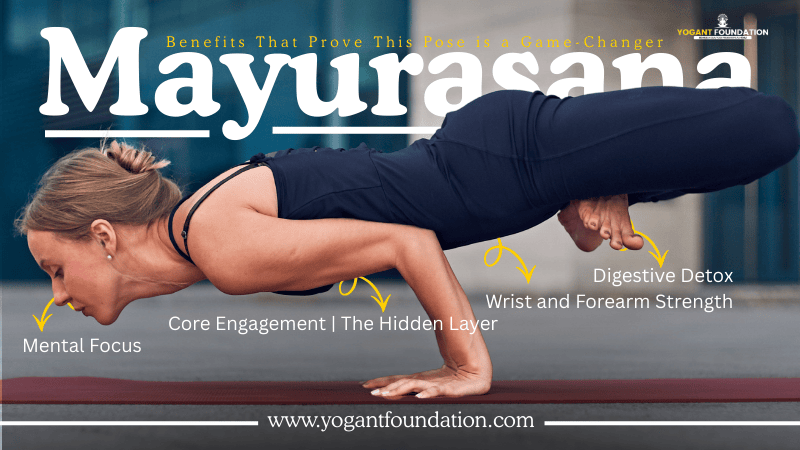
Physically, you balance your entire body on your straight arms, with your elbows tucked deep into your abdomen. Your legs lift off the ground, extending back like a tail.
It’s a compact arm balance. It’s not as “glamorous” as a handstand or as fluid as a vinyasa flow, but man, does it work.
Mayurasana Benefits That Prove This Pose is a Game-Changer
Let’s be real: we all want strong arms. But if you practice Mayurasana regularly, you start noticing changes that aren’t just aesthetic.
1. The Digestive Detox
This is the big one. Because your elbows are pressing directly into your digestive organs—specifically the liver, pancreas, and intestines—you create internal pressure. When you release the pose, there is a rush of fresh blood to those areas.
- Practical takeaway: I’ve noticed that on days when I feel bloated or sluggish, holding Mayurasana for five breaths acts like a reset button. It stimulates peristalsis. Just maybe don’t practice this right after a heavy meal. Wait at least 3-4 hours.
2. Wrist and Forearm Strength
We spend our lives typing on phones and clicking mice, which tightens the forearms. Mayurasana requires extension in the wrists. It strengthens the entire kinetic chain from the fingers up to the shoulders. If you are working towards Pincha Mayurasana (forearm stand), mastering the basic Peacock builds the elbow and shoulder stability you’ll need to kick up with control.
3. Core Engagement | The Hidden Layer
Unlike a crunch, where you isolate the abs, Mayurasana engages the deep core muscles—the transverse abdominis—to keep the legs floating. You aren’t just “sucking in”; you are locking everything upward to find balance.
4. Mental Focus
Honestly, you cannot think about your grocery list while in Mayurasana. If your mind wanders, you tip. It demands Drishti (focused gaze) and single-pointed concentration. It’s moving meditation with a high risk of falling, which keeps things interesting.
Before You Fly: Breaking Down the Mayurasana Pose
Okay, let’s get practical. How do we actually get into this thing without face-planting?
Most people think the Peacock is about arm strength. It’s not. It’s about leverage.
Think of your body as a seesaw. The elbows are the fulcrum. Your head and chest are the heavy side, and your legs are the light side. To lift the legs, you have to lean forward enough so the back end becomes light.
Here is the step-by-step breakdown:
- The Setup: Kneel on the mat. Place your palms flat on the floor with your fingers pointing back toward your feet (yes, backward!).
- The Elbow Placement: Bend your elbows slightly and press your belly against them. You want the elbows to touch your lower belly, not your ribs.
- The Lean: This is the scary part. Walk your feet back until your legs are straight. Then, shift your weight forward. Tuck your chin slightly and look forward, not down.
- The Lift: Squeeze your legs together like you’re holding a block between your thighs. Engage your glutes. As you lean forward, one foot will naturally want to lift. Let it. Then, hopefully, the other follows.
Pro Tip: Place a blanket or a pillow in front of you. Fear of falling forward is the number one reason people don’t lift off. If you remove the fear of getting hurt, your brain lets your body try.
The Big Brother: Pincha Mayurasana | Feathered Friend
Once you’ve made friends with Mayurasana, you might look toward Pincha Mayurasana. This is the forearm balance, often called “Feathered Peacock Pose.”
It looks completely different. You are upside down, balancing on your forearms. But the energetic connection is there.
- In Mayurasana, you press the earth away to lift up.
- In Pincha Mayurasana, you press the earth away to lift up (just with your head pointed down).
If you are working on Pincha Mayurasana, the arm strength and shoulder stability you build in the basic Peacock are invaluable. To transition mentally, remember the same principles of leverage and core lock. Start practicing Pincha against a wall. Walk your feet up the wall and focus on pressing through your forearms so your shoulders don’t collapse.
Common Mistakes | That I Definitely Made
I wish someone had told me these things when I started. It would have saved me some bruises.
- Elbows too wide: If your elbows splay out like a chicken, you have no stability. Keep them hugged in toward the midline.
- Looking down: When you drop your head, you round your upper back, and gravity wins. Keep your gaze slightly forward to keep the spine long.
- Forgetting the feet: If your feet are flopping, you are leaking energy. Point your toes and squeeze the legs together. It creates a single, solid unit rather than floppy limbs.
- Rushing it: This is not a pose you “get” in a week. I practiced for months just lifting one foot at a time. That’s okay.
Weaving It Into Your Routine
You don’t need to dedicate an entire hour to arm balances. Just add Mayurasana after your core work or at the end of your practice before cooling down.
Here is a mini-sequence to try:
- Child’s Pose (to center)
- Cat-Cow (to warm the spine)
- Plank Pose (to warm the wrists and core)
- Low push-up holds (Chaturanga practice)
- Mayurasana (attempt the lift)
- Balasana (Child’s Pose to rest the wrists)
Frequently Asked Questions About Mayurasana
Q: Is Mayurasana only for advanced yogis?
A: Not necessarily. It’s an intermediate pose, but beginners can start the conditioning work immediately. Practicing the lifting of one leg at a time and strengthening the wrists is something anyone can do.
Q: Can Mayurasana help with digestion?
A: Absolutely. In Ayurveda and yogic science, the compression of the belly stokes the digestive fire. Many practitioners, myself included, find it helps relieve constipation and bloating.
Q: What is the difference between Mayurasana and Pincha Mayurasana?
A: Great question. Mayurasana (Peacock Pose) is balanced on your hands with your elbows tucked into your belly, body parallel to the floor. Pincha Mayurasana (Feathered Peacock Pose) is a forearm balance where the body is inverted (upside down).
Q: My wrists hurt. What should I do?
A: First, check your alignment. As you spread your fingertips, make sure that the thumbs are pointing outward. Also ensure that the fingers are pressed down all the way to the knuckles and not only the palm heel. Then, use circles and wrist flexors to warm the hands up. Alternatively, if pain persists you may want to skip the pose altogether and instead work on wrist mobility.
Q: How long should I hold the pose?
A: Start with holding for 5 seconds. As you gain stability, work your way up to 30 seconds or 5 deep breaths. It’s better to hold it correctly for a short time than to wobble for a long time.
The Takeaway: Fly When You’re Ready
Mayurasana is a humbling pose. Some days you lift off with grace, floating like a feather. Other days, you tip over after two seconds. And that’s the beauty of a consistent practice.
It teaches you that balance isn’t about force; it’s about finding the precise point where effort meets surrender. It’s about pressing your belly against your elbows, trusting your strength, and leaning forward into the unknown—literally.
So, roll out your mat. Get a little messy. Try not to hit your chin. And when you finally feel both feet leave the ground, even for just a breath, you’ll understand why the peacock flies.
Have you tried Mayurasana yet? What’s your biggest struggle—the wrist discomfort or the fear of tipping? Let me know in the comments below.