
All About Nadi Shodhan Pranayama
Hook: Do you feel like your brain is a browser with 87 tabs open? You’re not the only one. With the constant barrage of notifications, anxious thoughts and that heavy feeling in your chest, modern life keeps your nervous system in “fight or flight” mode. What if I told you that 5 minutes of a specific breathing technique could be like a “reset button” for your mind and body? Enter Nadi Shodhan Pranayama —an ancient yogic breath control practice that feels suspiciously like a stress-busting superpower.
By the end of this guide, you will know the benefits of nadi shodhan pranayama, the steps to do it correctly (even as a complete beginner), and the Hindi mean behind this powerful technique. No jargon. No fluff. Just real, actionable peace.
What is Nadi Shodhan Pranayama?
Nadi Shodhan Pranayama is also known as “Alternate Nostril Breathing”, a yogic breathing technique. In Hindi, Nadi is translated as “energy channel” or “nerve”, Shodhan is “purification” or “cleansing” and Pranayama is “breath control”. Therefore, the literal Hindi meaning is “a breathing practice that purifies the energy channels of the body.”
Let me break this down like I am your friend, not your yoga teacher.
- Nadi = Energy channel (think of it as a tiny river inside your body)
- Shodhan = Cleaning or purifying
- Pranayama = Controlling your breath
So the full Hindi meaning is:
“A breathing practice that cleans out your energy pipes.”
In English, most people call it Alternate Nostril Breathing.
Fancy name. Simple action.
Imagine your body has two main energy highways (Ida and Pingala). This technique balances the traffic between them, leaving you calm, focused, and grounded.
The Real Importance of This Breathing Technique
Most people think “breathing is just breathing.” But here is the truth: How you breathe directly impacts how you feel.
Nadi Shodhan is not a mystical ritual for monks on a mountain. It is a clinically backed tool that:
- Shifts your nervous system from stress mode (sympathetic) to rest mode (parasympathetic) .
- Calms the “monkey mind” before a big meeting or after an argument.
- Prepares your brain for meditation without the struggle of “trying to stop thinking.”
So here is why thousands of normal people (not monks) do this every single day:
- It kills that “chest tightness” feeling before a big meeting
- It stops the 2 AM brain chatter
- No side effects & prescriptions. No cost.
- It helps you react less and respond better
If you have ever felt “wired but tired,” this technique was made for you.
Top 9 Benefits of Nadi Shodhan Pranayama
Let us move beyond the vague “it feels nice” and get specific. Here is what consistent practice of alternate nostril breathing actually does to your body and brain.
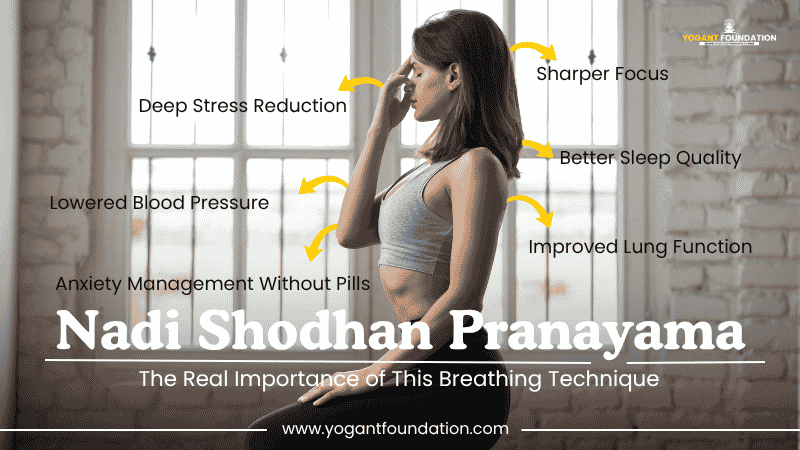
1. Deep Stress Reduction (The Cortisol Killer)
When you are stressed, your right nostril (linked to the sympathetic nervous system) tends to dominate. Nadi Shodhan forces a balance. Studies show it significantly lowers cortisol levels—your body’s primary stress hormone. You will feel this as an immediate “sigh of relief.”
2. Anxiety Management Without Pills
This is not about pretending your anxiety doesn’t exist. It is about giving your amygdala (the fear center of your brain) a break. By slowing the breath, you send a safety signal to your brain. Within 3-4 minutes, heart rate variability improves, and the feeling of “impending doom” softens.
3. Sharper Focus & Brain Clarity
Have you noticed how your brain works better when your breath is calm? Alternate nostril breathing increases oxygen flow to the prefrontal cortex (the CEO of your brain). Many students and corporate workers use this before exams or pitches to cut through brain fog.
4. Better Sleep Quality (Fall Asleep Faster)
If you are the type who stares at the ceiling at 2 AM replaying embarrassing memories from 2015, listen up. Doing 5-7 rounds of Nadi Shodhan right before bed prepares your system for deep, restorative sleep. It acts like a natural melatonin booster.
5. Lowered Blood Pressure
Here is a tangible, measurable benefit. Regular practice has been shown to reduce both systolic and diastolic blood pressure. The reason? It improves baroreflex sensitivity—your body’s built-in blood pressure regulation system. Always consult your doctor, but this is a powerful complementary tool.
6. Improved Lung Function (Respiratory Health)
Unlike shallow chest breathing (which most of us do), this technique encourages diaphragmatic breathing and full lung expansion. For people with mild asthma or seasonal allergies, it can reduce the feeling of “tightness” in the chest.
7. Emotional Balance (Less Reactivity)
Ever snapped at someone and instantly regretted it? That is a “blocked nadi” in action. Regular purification of energy channels leads to a gap between stimulus and response. You will find yourself pausing instead of punching (metaphorically, of course).
8. Preparation for Deeper Meditation
Let’s be real: sitting down to “meditate” when your mind is a tornado is impossible. Nadi Shodhan is the warm-up your brain needs. It creates the mental stillness required for deeper practices. Think of it as clearing the table before you eat.
9. Reduction in Migraine Frequency
For some people, migraines are linked to nervous system dysregulation. Preliminary evidence suggests that regular, gentle alternate nostril breathing can reduce the frequency and intensity of tension headaches and migraines by improving cranial circulation.
How to Do Nadi Shodhan Pranayama: A Step-by-Step Guide for Beginners
Do not overcomplicate this. You do not need a yoga mat, incense, or a specific posture. You just need a quiet corner and 5 minutes.
Before you start: Sit on a chair or cushion with your spine straight—not stiff like a soldier, but tall like a string is pulling the crown of your head up. Relax your shoulders. Close your eyes.
Step 1: Find Your Hand Position (Vishnu Mudra)
Take your right hand. Fold your index and middle fingers gently toward your palm. This leaves your thumb, ring finger, and pinky extended.
- Thumb = Controls the right nostril.
- Ring finger = Controls the left nostril.
- Your left hand can rest on your lap.
Step 2: Get Comfortable With Your Breath
To settle down, take a few breaths naturally. Which nostril seems to be more open? Don’t criticize; just watch.
Step 3: Close the Right Nostril & Inhale Left
Your thumb should gently close your right nostril. Slowly breathe in through the left nostril, as you inhale, count to four in your head.
Step 4: Switch Nostrils
Use your ring fingers to close the left nose at the end of your inhale. Exhale through your left nostril for a count 4 and then slowly exhale out of your right nostril.
Step 5: Inhale Right, Exhale Left
Keep your left nostril closed, and then inhale into the right nostril (count of 4). After closing the right nose with your thumb and releasing the left, exhale left nostril (count of 4).
Step 6: Repeat the Cycle
You have just completed 1 round. Continue for 5–10 minutes. Always finish with an exhale on the left side.
Visual Summary Table (The 4-Part Cycle)
| Phase | Action | Nostril Used |
|---|---|---|
| 1 | Inhale | Left |
| 2 | Exhale | Right |
| 3 | Inhale | Right |
| 4 | Exhale | Left |
Pro Tip for beginners: Do not hold your breath between inhales and exhales. Keep the flow smooth, like a gentle wave, not a series of sharp commands.
7 Common Mistakes (And How to Fix Them Immediately)
Even well-meaning practitioners mess these up. Here is how to avoid the pitfalls.
1. Pushing too hard: Your breath should be silent. If you hear a whistle or a hiss, you are forcing it. Back off.
2. Mashing your nose: Gentle touch. You are not trying to win an arm wrestling match with your face.
3. Moving your head: Only your fingers move. Your head stays still. Imagine you are a statue.
4. Uneven breathing: Inhale 4 counts. Exhale 4 counts. Equal. Not one short and one long.
5. Doing it on a full stomach: Wait 2 hours after eating. Otherwise you will feel sick. Trust me.
6. Trying once and quitting: This is like brushing your teeth. One time does nothing. Daily practice does everything.
7. Forgetting to relax: If your jaw is clenched or your eyebrows are furrowed, you are missing the point.
Expert Tips: How to Level Up Your Practice
Once you have mastered the basic 1:1 ratio (equal inhale and exhale), try these advanced insights.
The 1:2 Ratio (For Deep Relaxation)
Once you are comfortable, try making your exhale twice as long as your inhale.
- Example: Inhale for 4 seconds → Exhale for 8 seconds.
- Why it works: Long exhales directly activate the vagus nerve, triggering profound relaxation. Use this for insomnia or panic attacks.
The “Nadi Shodhan Pranayama for Focus” Protocol
Need to write a report or study for an exam? Do 6 rounds of 1:1 ratio (4 seconds each), then immediately switch to normal breathing. You will notice a “clean windshield” effect on your thinking.
Pair it With a Mantra (Internal)
If your mind wanders, silently repeat a simple sound with each breath:
- Inhale: “So”
- Exhale: “Hum”
(This means “I am that” – it gives the monkey brain a job to do.)
How Long Until You See Results?
Let me be straight with you.
- First try: You will feel calmer within 3 minutes. Not magic. Just biology.
- One week: You will notice you snap less. Sleep improves.
- One month: Friends will ask “what are you doing differently?”
Consistency beats intensity. 5 minutes daily > 1 hour once a week.
When NOT to Practice (Safety First)
I love this practice, but I love honesty more.
- Severe nasal congestion: If you have a full cold or sinus infection, do not force it. Wait until you can breathe freely.
- Active ear infection or recent ear surgery: The pressure changes can be uncomfortable.
- Extreme high blood pressure (uncontrolled): Practice without retention (kumbhaka). Exhale immediately after inhaling.
- During a panic attack: Do NOT try this if you are in full crisis mode. Focus on grounding first (e.g., naming 5 things you see). Use Nadi Shodhan Pranayama after the peak passes.
Disclaimer: This is not medical advice. If you have a serious respiratory or cardiac condition, talk to your doctor first.
Nadi Shodhan Pranayama vs. Other Breathing Techniques (Comparison Table)
Not sure which breathwork is right for you? Here is a quick cheat sheet.
| Technique | Primary Benefit | Best For | Difficulty |
|---|---|---|---|
| Nadi Shodhan Pranayama | Balances hemispheres, reduces anxiety | Stress, focus, sleep prep | Beginner |
| Bhastrika (Bellows Breath) | Energizes & heats the body | Morning sluggishness, clearing sinuses | Intermediate |
| Bhramari (Humming Bee) | Instantly calms the nervous system | Insomnia, anger, tinnitus | Beginner |
| Kapalbhati (Skull Shining) | Abdominal strength & detox | Digestion, subtle energy work | Advanced |
| Box Breathing (4-4-4-4) | Tactical calm & performance | High-pressure situations (military, sports) | Beginner |
Verdict: Nadi Shodhan Pranayama is the most balanced, all-purpose technique for everyday mental health.
Pro Insights: The Ancient Science Meets Modern Neurology
Let’s get a little nerdy (in a fun way).
The Left vs. Right Nostril Thing Is Real
Nasal cycles are tied to your autonomic nervous system. The left nostril is connected to the right hemisphere (creativity, emotion, intuition). The right nostril is connected to the left hemisphere (logic, analysis, linear thinking).
By alternating, you are forcing both hemispheres to communicate. Brain scans show increased corpus callosum activity during this practice. That is the bridge between your logical and emotional self. When that bridge is strong, you make better decisions.
The “Hindi Meaning” Deep Dive
Why does the language matter? Because Shodhan (purification) is not about scrubbing. In yogic philosophy, nadis get “dirty” with unprocessed emotions and stale energy. This breathwork is the shower for your subtle body. Understanding the Hindi mean connects you to the intention of clearing blockages, not just breathing for the sake of breathing.
FAQ: Your Burning Questions, Answered
1. Is Nadi Shodhan safe to do every day?
This is one of safest techniques for pranayama. It is recommended that you practice 10-15 minutes a day to help with stress, concentration, and nerve system regulation. Only avoid if you are suffering from active sinusitis or high blood pressure that is not under control.
2. Can I do Nadi Shodhan Pranayama before sleeping?
Yes, it is. This is the perfect bedtime routine. Sitting upright and doing 5-7 circles in bed will shift your nervous system to parasympathetic mode. This helps you sleep faster.
3. What if I can’t hold my breath or my nose is stuffy?
Don’t hold your breath at all as a beginner. Simply inhale and exhale smoothly. For a stuffy nose, try a nasal rinse first, or do a modified version using only the open nostril until congestion clears.
4. How long until I see the benefits of nadi shodhan pranayama?
The majority of people will experience a calmer state after just 3 minutes. If you want to see long-term effects like lowered blood pressure or anxiety reduction, then practice daily for 5-10 minute for two weeks. Intensity is not as important as consistency.
5. What is the difference between Nadi Shodhan Pranayama and Anulom Vilom?
In modern usage, they are the same. Traditionally, Anulom Vilom is a general term for alternate breathing, while Nadi Shodhan includes specific mental focus on energy channels. Most teachers use the names interchangeably.
6. Can pregnant women practice this?
With variations. No breath holding. Gently inhale and exhale. The third trimester may make it more comfortable to lie on the left side than sit. Always consult your prenatal care provider.
7. Why do I feel dizzy after doing it?
You are likely forcing the breath or hyperventilating. Take a break. Return to normal breathing. When you try again, make your inhale shorter (e.g., 3 seconds) and ensure the exhale is not forced. Dizziness means “too much effort.”
Your 7-Day “Nadi Shodhan Pranayama Starter” Challenge (Actionable Conclusion)
Here is the truth: Reading this article will change exactly nothing. Practicing for 3 minutes today will change everything.
I challenge you to a 7-day starter plan:
- Days 1-3: Do 5 rounds each morning (takes 3 minutes). No judgment. Just practice.
- Days 4-5: Increase to 10 rounds (5-6 minutes). Notice how you react to stress.
- Days 6-7: Add a 5-minute session before bed. Track your sleep quality.
Here is your CTA (Call to Action):
Do not wait for “the perfect time.” The perfect time is right after you finish this sentence. Sit up. Close your eyes. Right thumb to right nostril. Inhale left. Exhale right.
Do one single round. Right now.
How do you feel? Share “I did it” in the comments below (or mentally high-five yourself). Bookmark this page and come back in 7 days to tell me what changed.
Your breath is the cheapest, most effective medicine you will ever own. Use it wisely.