
You know that quiet moment just before sleep? Or the sudden pause after a laugh? In that tiny silence, if you listen, your body is humming a secret. It’s not a thought. It’s not a song from your headphones. The sound of you, being alive. It’s the gentle whoosh of breath that, believe it or not, is actually whispering an ancient truth. That truth is Soham. And it might just be the most important thing you’re already doing, without even knowing it.
What is the meaning of Soham? Decoding the Universe’s Breath
Let’s cut through the mystery. Soham (say it slow: So-Hum) isn’t some magical word you need to learn from a wise, bearded teacher on a mountaintop. Honestly, you’re already saying it. Right now.
Here’s the thing. Sit still for a second. Breathe in normally. As the air fills your lungs, listen to the subtle sound it makes.
- On the inhale: A subtle, natural sound like “Sssss” or “Sooo” arises.
- On the exhale: A natural, effortless sound like “Humm” or “Ah” emerges.
Together, that’s it. That’s Soham.
In Sanskrit, it gets translated as “I am That.” A bit cryptic, I know. But think of it this way: the “I” is the you reading this—the you that feels separate, with a to-do list and a favorite coffee mug. The “That” is everything else. The stars, the tree outside your window, the person you love, the ground beneath your feet. Soham is the moment of realizing they aren’t two separate things. It’s the breath stitching you back into the fabric of everything.
The coolest part? Your body has been chanting this on autopilot since your first cry. Yogis call it the Ajapa Japa—the un-chanted chant. They figure it happens about 21,600 times a day. That’s 21,600 daily reminders of who you really are, and most of us are just… missing them.
What is the meaning of Soham in hindi?
सीधे शब्दों में कहूँ, तो सोहम का शाब्दिक अर्थ संस्कृत में “मैं वह हूँ” है। पर ये सिर्फ़ एक अनुवाद नहीं, एक अनुभव है।
असल जादू यहाँ है: आप इसे किताब से नहीं, अपनी सांस से सीखते हैं। ध्यान दीजिए। जब आप सांस अंदर लेते हैं, तो एक सहज सी आवाज़ “सो” बनती है। और जब सांस बाहर छोड़ते हैं, तो “हम” की ध्वनि होती है। सो…हम। यही तो है सोहम।
ये दो शब्द हमारे अस्तित्व का सबसे गहरा सत्य बताते हैं। “मैं” यानी आपकी व्यक्तिगत चेतना, और “वह” यानी ब्रह्मांड की सार्वभौमिक ऊर्जा। सोहम वह पल है जब आप महसूस करते हैं कि आप उस सबसे अलग नहीं हैं, बल्कि उसी का एक हिस्सा हैं। आपकी हर सांस यही गाना गा रही है, बस आपको सुनना है। यह कोई रटने का मंत्र नहीं, बल्कि खोजने का सत्य है।
Soham vs Hamsa: The Two Sides of the Cosmic Coin
Now, if you go digging, you might bump into its cousin: Hamsa. This can feel confusing. Is it a different thing?
Think of it like perspective.
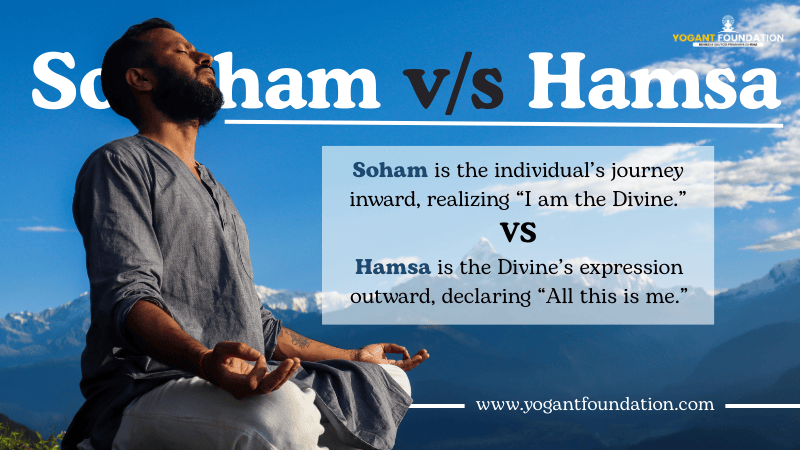
Soham is your journey. It’s you, in your human experience, breathing in and realizing, “Wait, I am part of this vast, beautiful cosmos.” Inhale: So (I am). Exhale: Ham (That).
Hamsa is the flip side. It’s the universe’s perspective. The creative force of life (sometimes pictured as a graceful swan, or hamsa) breathing out the world with a “Ham” and drawing it all back in with a “Sa.” It’s the cosmos saying, “All of this is me.”
Think short of it like this:
- Soham is the individual’s journey inward, realizing “I am the Divine.”
- Hamsa is the Divine’s expression outward, declaring “All this is me.”
It’s not a debate. It’s just which doorway you walk through. For our purpose—for that quiet, personal meditation on your couch—Soham is the one that fits perfectly. It’s the echo of the cosmos you were born with.
The Profound Meaning: Why “I Am That” Changes Everything
Okay, so it’s a neat sound trick. But why does this matter in real life? When your inbox is overflowing and the news is stressful, what good is a silent, two-syllable breath?
It matters because this tiny mantra tackles the root of almost all our anxiety: the feeling of being alone. Of being a tiny, separate island in a chaotic ocean.
When you breathe with Soham, you’re doing mental rewiring. You’re gently arguing with that lonely feeling.
- It Softens Your Edge. That critical voice in your head? The one that judges you and others? It thrives on separation. “I am different from them.” Soham slowly dissolves that. How can you harshly judge what you are fundamentally connected to?
- It Eases Fear. So much fear is rooted in loss—losing what we think defines “me.” But if “I” am part of the eternal “That,” then my essence can’t be lost. It just changes form. This isn’t intellectual. It’s a felt sense that grows, breath by breath.
- It Builds Quiet Confidence. This isn’t arrogant ego-confidence. It’s the unshakable calm of knowing you belong. You are not a stranger in a strange land. You are the land, breathing. That changes how you walk into a room, how you handle conflict, how you live.
The Science of the Sound: How Soham Meditation Rewires Your Brain
I love the poetry of this. But I’m a practical person. I need to know how it works. Turns out, modern science has some pretty awesome answers.
First, let’s talk about your vagus nerve. It’s like the superhighway of calm in your body. That long “Humm” on the exhale? It creates a gentle vibration in your chest and throat that literally massages this nerve. It’s like flipping a biological switch from “fight-or-flight” to “rest-and-digest.” You can feel it instantly. Your shoulders drop. Your jaw unclenches. That’s biology, not magic.
Then there’s your busy, busy mind. Neuroscientists call its default mode the “Default Mode Network.” It’s the daydreaming, worrying, storytelling part of you. Soham gives that network a new job. By anchoring your attention to the breath and the silent sound, you’re building a new neural pathway. You’re teaching your brain a healthier default: presence.
Every time you notice you’ve drifted into a worry and gently bring yourself back to “So… Hum…”, you’re doing mental weightlifting. You’re strengthening your focus muscle and weakening the anxiety loop. Lliterally changing your brain’s structure with your breath. How incredible is that?
How to Practice Soham Meditation: A Simple Guide
Enough theory. Let’s get practical. You don’t need special clothes, a perfect cushion, or an hour of free time. You just need you.
Find Your Seat:
Seriously, don’t overthink this. Sit in a chair where your feet can flat on the floor. On your bed, propped against the headboard. The goal is to be comfortable enough to forget your body, but alert enough not to snooze. Spine reasonably straight, hands resting on your knees.
Tune Into the Breath:
Close your eyes. Take three big, slow breaths, sighing out loud on the exhale. Ahhh. Good. Now, let your breath return to normal. For a minute, just be a curious scientist. Where do you feel it? In your nostrils? The rise of your chest? No need to change it. Just listen.
Introduce the Mantra:
Now, on your next natural inhale, silently hear the word “So” in your mind. Let it float in on the air. On your natural exhale, silently hear the word “Hum.” Don’t force your breath to be longer or louder. Let the words ride the wave of your normal, easy breath. So in. Hum out.
Embrace the Rhythm:
Continue for just 5 minutes. Set a gentle timer. Your mind will wander. It’s supposed to! It’s like a puppy. When you notice it’s run off chasing a thought (What’s for dinner? Did I send that email?), don’t scold it. Smile. Gently pick it up and bring it back to the next breath. So… Hum….
Conclude with Silence:
When the timer goes off, let the words go. Sit for another 30 seconds in the quiet. Notice the space in your head. The feeling in your body. It might feel subtle. A little more peace, a little less static. That’s the gold.
A Tiny Tip from Me: Sometimes, I like to imagine the “So” sound collecting all my scattered energy on the inhale. The “Hum” sends it back out into the world as peace on the exhale. Find your own imagery.
Integrating Soham Mantra Benefits Into Your Daily Life
The real magic happens when you step off the meditation cushion. Soham is a pocket-sized peace tool.
- In Traffic or a Long Line: This is the perfect lab. Feel the irritation rise. Instead of feeding it, breathe. So (I am here, in this moment, not my frustration)… Hum (and I release this tension). Do it three times. Watch the situation transform.
- Before a Hard Conversation: Take 60 seconds in your car or a bathroom stall. Breathe with Soham. It grounds you. You enter the conversation from a place of connection, not reaction.
- While Walking the Dog: Sync your steps. So (left foot), Hum (right foot). Turn your neighborhood stroll into a walking meditation. You’ll notice the color of the sky, the smell of the air.
- As You Drift to Sleep: Lying in the dark, let your breath and Soham be the only story you follow. It’s the gentlest lullaby, straight from your own soul.
Common Challenges and Gentle Solutions
Let’s be real. It’s not always serene.
- “I can’t stop thinking!” Welcome to the club. The goal isn’t to stop thoughts. It’s to change your relationship with them. Each time you notice a thought and choose to return to the breath, you’ve won. That’s the whole practice.
- “It feels silly or pointless.” That’s your logical brain throwing a fit because you’re not being “productive.” Thank it for its opinion, and do it anyway for one week. Just five minutes a day. Track how you feel. The proof is in your own calm.
- “I keep forgetting to do it.” Pair it with an existing habit. Soham with your first sip of morning coffee. Soham while you wait for the kettle to boil. Tie it to an anchor you already have.
- “I don’t feel a mystical connection.” Good. Don’t aim for fireworks. Aim for a slightly quieter mind. A slightly softer heart. The profound changes are cumulative and often quiet.
The Ultimate Goal: From Practice to Realization
Here’s the beautiful endgame. One day, after weeks or months of this gentle practice, you might be sitting there and something shifts. The words “So” and “Hum” might just… fade away. But the feeling they pointed to remains. A deep, wordless peace. A sense of being exactly where you should be, as you should be.
You stop saying the mantra and start being the mantra. The separation between you breathing and the world breathing blurs. That’s the union. That’s the “I am That” not as a phrase, but as your lived reality. You realize Soham was never something to achieve. It was always just a reminder of what you already are.
Your Journey with the Eternal Mantra Begins Now
So here’s my invitation to you. Don’t believe a word I’ve said. Test it. Your own breath is the only yogis you need.
Right now, as you finish this sentence, take one conscious breath. Inhale: So. Exhale: Hum.
Feel that? That tiny pocket of peace? That’s your anchor. That’s your home. It’s always there, beneath the noise and the hustle. The secret universe in your chest, humming your name with every single breath. All you have to do is listen.