
Introduction: Discover the Power of Bakasana
Most likely, you’ve seen it: a yogi perfectly balanced, with feet folded up as if a bird is about to fly. It can look like pure magic, or maybe just pure intimidation. I get it. For the longest time, I thought Bakasana, or Crane Pose, was a club I just wasn’t cool enough to join. My wrists ached, my feet felt glued to the floor, and my fear of falling flat on my face was… substantial.
But here’s the quiet truth no one shouts from the mountaintops: Bakasana isn’t about being the strongest person in the room. It’s about a conversation. A conversation between your breath and your fear, between your wobbles and your will. It’s about finding a fleeting moment of lightness where you feel heavy. This guide isn’t just a list of instructions; it’s an invitation to start that conversation for yourself. We’ll walk through the bakasana steps together, uncover the deeply personal bakasana benefits, and maybe even laugh about the times we tip over. Consider me your friendly spotter.
What is Bakasana? Understanding the Crane Pose
Let’s demystify it. In Sanskrit, “Baka” means crane, that elegant, one-legged bird symbolizing focus and patience. The bakasana pose mimics this—not by standing on one leg, but by creating that same poised, concentrated energy with your arms as your foundation.
It’s easy to get tangled up in the names (Crow Pose vs. Crane Pose). Think of it this way: if your elbows are bent deeply with knees wide, you’re in the crow’s nest. If you work toward straighter arms, bringing a graceful, elongated feel, you’re stretching into the crane. But honestly? Don’t sweat the semantics. Start where you are. Your version is perfect. This journey into bakasana yoga is yours alone.
Step-by-Step Guide: Mastering the Bakasana Steps
Throw out the idea of nailing it on the first try. Bakasana steps is a practice of discovery. Discovering is not only about execution.
Step 1: Warm-Up and Preparation
Grab a pillow or a folded blanket. Place it right in front of your mat. This isn’t just a prop; it’s a promise to yourself: “It’s okay to fall. I’ve got a soft place to land.” Warm up your whole body, but give extra love to your wrists. Roll them. Gently press them. Thank them for the work they’re about to do.
Step 2: The Setup
- Come into a Deep Squat: Feet about hip-distance. Heels can lift—no forcing them down. This is your launching pad.
- Plant Your Hands Like Roots: Place your palms flat, fingers spread wide like you’re pressing into wet sand. Feel that connection.
- Create a “Shelf”: Lift your hips a little. Now, gently place your knees on the back of your upper arms, as high up toward your armpits as is comfortable. It might feel a bit clumsy. That’s normal.
- Look Forward, Not Down: This is the golden rule. Fix your gaze about a foot ahead of your fingertips. Where your eyes go, your energy follows.
Step 3: The Lift-Off
This is the heart of it. Don’t think “jump” or “launch.” Think “lean.”
- Inhale deeply.
- As you exhale, slowly, slowly, start to tilt your torso forward. Feel the weight in your feet get lighter.
- Let your nose lead the way, gently reaching past your Fingertips. Feel that wobble? That’s not failure—that’s you having a real, honest conversation with your balance.
- Hold and Breathe: Find balance. Keep your gaze steady and breathe deeply. Even a one-second hover is a victory!
Step 4: Release Gently
However long you stayed—a millisecond or a minute—exhale and lower your feet back down with as much control as you can muster. Then, my friend, sink into Child Pose. Forehead to the mat. Thank your body. Feel the buzz in your core. That’s the magic.
Pro Tip: Place a folded blanket or pillow in front of your face for psychological safety as you learn. It’s okay to fall—it’s part of the process!
The Multifaceted Bakasana Benefits: More Than Just an Arm Balance
Sure, the physical bakasana benefits are impressive. Bakasana yoga builds a core of steel, strengthens your arms and wrists like nothing else, and improves your balance in a way that makes walking feel new. But the real rewards? They’re quieter, and they seep into your life off the mat.
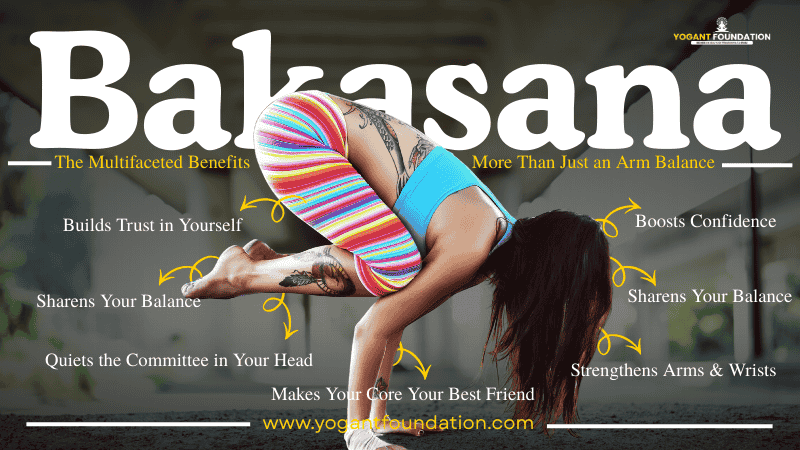
Physical Benefits
1. A Core That Actually Supports You
Forget endless crunches. Bakasana is your secret core coach. When you tuck your knees up and balance, every single abdominal muscle has to wake up and work as a team just to keep you from tipping over. This isn’t about getting a six-pack (though that can be a nice side effect); it’s about building a natural, internal corset. You’ll start noticing it in daily life – standing taller at your desk, picking up groceries without that twinge in your back, feeling fundamentally more sturdy in your own body.
2. Strong Shoulders & Happy Wrists
We live in a forward-hunch world—over laptops, phones, steering wheels. Bakasana gently fights back. It asks your shoulders, arms, and often-neglected wrists to do their real job: to bear weight and create stability. As you practice, you’re not just building strength; you’re rehabilitating your upper body from the modern “desk slump.” You might find yourself sitting up straighter without even thinking about it, simply because your body remembers what strong, open shoulders feel like.
3. Finding Your Feet (Even When They’re in the Air!)
This pose is a masterclass in balance. But I am not talking about the tricks performed by circus performers. It’s the ability to know where you are in space. The proprioceptive skill is similar to your internal GPS. Bakasana is a great way to fine-tune that GPS. You’ll notice a difference. Your everyday movements become more fluid and graceful. Your confidence increases as you move through a crowd or in a dimly lit hallway.
4. A Gentle Opening Where You Hold Stress
That low squat you do at the start? And the forward fold of your torso? These are quiet releases for areas that hoard our tension. Your inner thighs (the groins) and your upper back are classic storage units for stress. Bakasana’s setup gently coaxes them to let go, creating a feeling of openness and ease. It’s less of a deep stretch and more of a sigh of relief for muscles that are tired of being tight.
Mental & Energetic Benefits
1. The Ultimate Confidence Builder
The first time you hover, even for a second, you beat a fear. The internal dialogue shifts from “I can’t” to “Oh my gosh, I just did.” The small win on the mat can be a powerful symbol. You learn that your body is capable of handling any situation. It’s not just on the mat. This confidence in yourself seeps through into everyday life to remind you that you are capable of handling other uncertainties and wobbles.
2. A Vacation for Your Busy Brain
Bakasana is a singular solution in a world full of tabs, notifications and endless options. Your gaze softens on one point. Your mind has to fully inhabit your body to find balance. There is literally no mental space to worry about your to-do list or that awkward thing you said yesterday. For those few breaths, you experience a state of pure, unbroken concentration. It’s a mental reset button.
3. An Internal Tune-Up
What is that squeeze in your stomach? Imagine it as a gentle massaging of your digestive system. When you release the compression, this can stimulate digestion. Plus, lifting your chest, even just a little, can bring a new rush of circulation and energy, leaving you feeling refreshed.
4. The Feeling of Being Light
In yoga philosophy, there’s a concept called Laghiman—lightness. Bakasana is a direct path to feeling it. You will feel light and almost float when you have mastered the art of balance. This physical feeling creates an emotional shift, reminding us that our physical and/or emotional heaviness is not what defines us. Even briefly, we can find grace and levity.
Exploring Advanced Variations: Padma Bakasana and Parsva Bakasana
Once you and basic Bakasana are on friendly terms, you might feel a nudge to play. Think of these not as “advanced poses,” but as new conversations.
Parsva Bakasana (Side Crane): The Twist
Imagine your classic Crane, but you set up for a twist first, placing your knees to one side. Parsva Bakasana feels like a secret. It asks for more from your obliques and challenges your balance in a fresh, lateral way. It’s a reminder that growth often comes from a change of perspective.
Padma Bakasana (Lotus Crane): The Integration
It’s a combination of meditation and arm-balance. Padma Bakasana is a combination of Lotus Pose, followed by finding balance in your hands. It is an ancient symbol for bringing calmness to the challenge of action. It’s a goal for many, but the journey toward it opens the hips and deepens patience immeasurably.
Bakasana in Hindi: सीखिए बकासन और इसके लाभ (Learn Bakasana and Its Benefits)
योग भारत की प्राचीन देन है, और संस्कृत व हिंदी में इसके नामों को जानना इस कला से हमारा जुड़ाव गहरा करता है। बकासन (Bakasana in Hindi) को क्रेन पोज़ या कौवा मुद्रा भी कहा जाता है।
बकासन के लाभ (Bakasana Benefits in Hindi)
- मानसिक दृढ़ता: यह आसन सिखाता है कि डर के आगे झुकना नहीं है। एक बार संतुलन मिल जाए, तो आत्मविश्वास खुद-ब-खुद बढ़ता है।
- शारीरिक संतुलन: हाथों पर संतुलन बनाना पूरे शरीर के समन्वय को बेहतर करता है।
- एकाग्रता का वरदान: इसमें नज़र एक जगह टिकानी पड़ती है, जिससे दिमाग का भटकना कम होता है और ध्यान केंद्रित करने की शक्ति बढ़ती है।
- पाचन में सहायक: पेट के अंगों पर दबाव पड़ने से पाचन तंत्र सक्रिय होता है।
यह सिर्फ एक शारीरिक मुद्रा नहीं, बल्कि खुद पर विश्वास का एक अभ्यास है।
Common Challenges & How to Overcome Them
- “My wrists hurt!”: You’re not alone. Press through the base of your fingers, not just the heels of your palms. Build strength slowly with Plank and Tabletop poses.
- “I just… can’t lift.”: Are you really leaning far enough forward? Often, we’re scared to let our head go past our hands. Let the pillow catch you and truly experiment with that forward tilt. The lift is a natural consequence.
- “I tumble forward every time.”: Wonderful! You’re taking the risk. Now, work on hugging your elbows in toward each other and engaging your core before you lean. Imagine pulling your belly button up and back toward your spine.
Integrating Bakasana into Your Yoga Practice
Don’t treat it like a lonely island. Integrate it. Come to Bakasana yoga when you’re warm—after a few Sun Salutations and some core work. But don’t wait until you’re exhausted. Hold it for a few breaths, rest, and try again. Listen to your body more than the clock. Some days you’ll feel light as a feather; others, your feet will feel like anchors. Both days are perfect.
Conclusion: Embrace the Journey, Not Just the Pose
You’re going to be surprised by this fact: my very first Bakasana was not in a perfect, quiet studio. It happened in my living room, with my dog watching curiously. I hovered for maybe two breaths. I let out a sound that was half-gasp, half-laugh. And then I toppled right over onto my pillow. I felt invincible.
That’s what this Bakasana pose is truly about. It’s not the picture-perfect pose for social media. It’s that private, triumphant, slightly messy moment where you surprise yourself. The quiet “I did it” that echoes long after you’ve left the mat.
You can achieve the benefits of Bakasana by exploring the Bakasana foundational steps. Or you can progress to Parsva Bakasana or Padma Bakasana.
With warmth and belief in your practice.