
You know that feeling? The one where your mind is buzzing like a beehive, your to-do list is running on a loop, and true quiet feels like a distant memory. I’ve been there more times than I can count. It was in the middle of one of those frantic weeks that I found myself, almost by accident, staring at a small statue on my desk. The Buddha, seated in unwavering calm, his hands cradled gently in his lap in a gesture I would later learn is called the Dhyana Mudra.
It used to be that I thought it was a simple pose or a choice of style for sculptures. It’s much more than I thought. This ancient, silent language speaks directly to the nervous system. Dhyana Mudra are a way to unlock a state of calm, focused concentration. The Dhyana Mudra is a tool used by people of all walks of life for many years.
If you’ve ever felt overwhelmed, disconnected, or just curious about how to deepen your moments of quiet, this gesture has something to offer you. Let’s explore this beautiful symbol together, not as a rigid rule, but as a friendly guide on the path to inner peace.
What is Dhyana Mudra? More Than Just a Hand Gesture
Let’s break down the name, because it’s wonderfully descriptive. “Dhyana” (pronounced something like dee-ya-na) is a Sanskrit word that means “meditation” or profound contemplation. “Mudra” means a “seal,” “mark,” or “gesture.” So, put simply, the Dhyana Mudra is the “Gesture of Meditation.”
Think of it like this: while your mind is learning to be still, your body can physically practice being still in a very specific way. This mudra is that practice. It’s the body’s way of telling the mind, “Hey, we’re meditating now. Let’s settle in.”
We most famously see it in images of the Buddha, but its roots run deep into the heart of ancient Indian spirituality. For me, the most powerful way to understand it is to see it not as an active doing, but as a receptive being. It’s not about grasping or holding on; it’s about creating an open, calm space for peace to simply arrive.
Dhyana Mudra: Historical and Spiritual Roots
I love the story behind this mudra. It’s not just a pretty pose; it’s a gesture of immense determination. Legend tells us that this was the very hand position Siddhartha Gautama used when he sat under the Bodhi tree, vowing not to move until he had found the answer to human suffering.
Imagine that for a moment. He wasn’t guaranteed success. He was frustrated, he had tried everything else, and this was his last, resolute stand. His Dhyana Mudra wasn’t just about peace; it was about unwavering commitment in the face of the unknown. It’s the physical representation of the moment you stop searching out there and decide to look deeply in here.
That historical context makes it so much more relatable for me. It’s not a gesture for people who are already perfectly enlightened. It’s a gesture for seekers, for anyone who has ever set an intention to understand their own mind a little better.
The Symbolism and Meaning Woven into the Gesture
Every time I form this mudra with my hands, I try to remember the beautiful symbolism woven into it. It turns a simple hand position into a meaningful story.
The Hands: The Union of Dualities
My logical side, the “get it done” one, and my intuitive, softer side, were always at odds. This is beautifully resolved by the Dhyana mudra.
- The hand that rests on top (usually the right) symbolizes “method” or action—your compassion, your drive, how you engage with the world.
- The hand that supports it from below (usually the left) symbolizes “wisdom”—your intuition, your inner knowing, your deep understanding.
When the active hand rests upon the wise hand, it’s a powerful physical reminder: Let your actions be guided by your inner wisdom. It’s the perfect, harmonious balance of doing and being. It tells me that I don’t have to choose one over the other; I can let them work together.
The Shape: The Sacred Vessel and the Cosmic Egg
My favorite part. You will see a lovely, hollow space between your fingers when you do the mudra properly. It’s easy to see this two ways:
- The Sacred Vessel: This space is like an empty bowl. It represents my mind when I sit to meditate—I’m trying to empty it of the day’s clutter, my worries, and my endless thoughts, to make room for something new: a moment of peace, a spark of insight, or just a few minutes of quiet. It’s a gesture of humble openness.
- The Cosmic Egg: Sometimes, I think of it as a tiny, personal universe held in my hands—the “cosmic egg” from which all of creation emerges. It connects my small, individual practice to the vast, creative energy of everything, which is a wonderfully grounding and expansive feeling all at once.
The Thumbs: The Seal of Balance
Don’t overlook the gentle touch of the thumbs! This small detail is like the final click of a lock. The thumbs are often linked to our inner fire and our sense of self. When they lightly touch, it’s not about crushing the ego, but about gently balancing it. It keeps the calm, focused energy you’re generating from slipping away, sealing it within your own system.
The Step-by-Step Guide to Practicing Dhyana Mudra
Okay, let’s get practical. How do you actually do this? It’s simple, but the details make a difference. Remember, we’re aiming for comfort, not contortion.
- Find Your Seat: First, get comfortable. This isn’t about forcing your legs into a full lotus if that’s not your thing. Sit cross-legged on a cushion on the floor, or simply sit upright in a chair with your feet flat on the ground. The goal is to have your spine feel long and natural, not stiff.
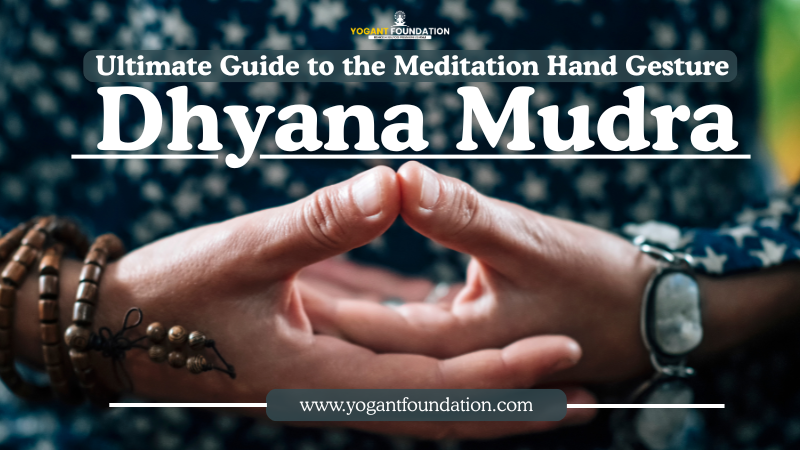
- Rest Your Hands: Gently place the back of your left hand into the palm of your right hand. (A quick note: some traditions reverse this. Try both and see what feels more natural to you!).
- Create the Bowl: Let your fingers rest comfortably on top of one another. They don’t need to be ramrod straight—just relaxed and aligned. You should see that lovely, oval-shaped bowl beginning to form.
- Touch the Thumbs: Bring the tips of your thumbs to meet. The touch should be feather-light, as if you’re holding a single piece of paper between them. If you press too hard, you’ll create tension.
- Position in the Lap: Now, rest your composed hands in your lap. I like to place them so that the thumbs are right around my navel level. You might feel a gentle rise and fall of your hands with your breath, which is a wonderful, calming rhythm.
A Little Advice from My Own Experience: If your shoulders start to hunch or your wrists ache, prop a pillow or a folded blanket in your lap to support your hands. The mudra should feel supportive, not stressful.
The Science & Dhyana Mudra Benefits
Why Dhyana Mudra Works?
You might be wondering, “Does this actually do anything, or is it all in my head?” From my experience, and from what science can tell us, it’s both—in the best way possible.
1. Cultivating Deep Concentration and Focus
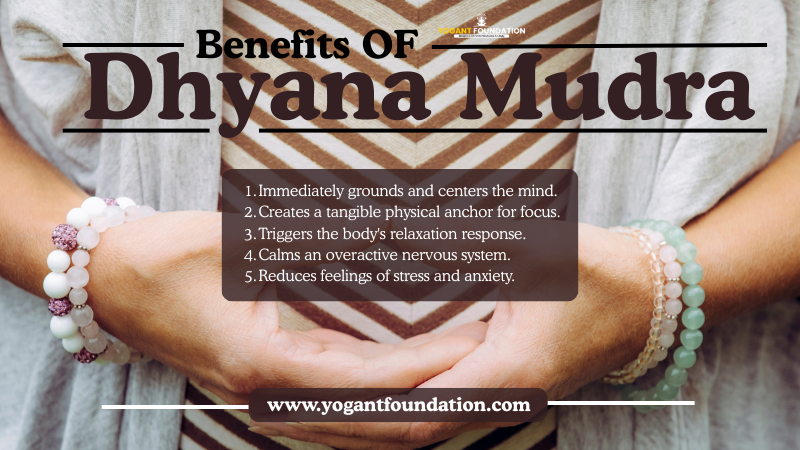
My mind is a champion wanderer. Giving it a physical anchor—the gentle, constant sensation of my thumbs touching and my hands resting together—works wonders. This tangible sensation in my lap can help me to gently redirect my attention when my mind begins to stray to my dinner plans. It’s a quiet “home base” for my attention.
2. Calming the Nervous System
This is where it gets really interesting. Our hands are incredibly connected to our brain. A huge part of our brain’s sensory and motor cortex is dedicated to them. By holding our hands in this specific, calm, and symmetrical position, we’re sending a direct signal to our brain: “All is well. You can switch from fight-or-flight to rest-and-digest now.” It’s a bio-hack for calmness.
3. Balancing the Elements (Ayurvedic Perspective)
It is a beautiful perspective. The Ayurvedic system believes that each finger represents a different element:
- Thumb: Fire
- Index Finger: Air
- Middle Finger: Space
- Ring Finger: Earth
- Little Finger: Water
By bringing all the elements of our hand together in harmony, the Dhyana Mudra is thought to bring balance to these corresponding forces within our own body and mind. The light touch of the fire-element thumbs, for instance, can help soothe an overactive, anxious mind (too much air and fire) and ground us more in the stability of earth.
4. Facilitating Mindfulness and Present-Moment Awareness
This mudra reminds you to live in the moment. This mudra is a physical reminder to be mindful. This connection between a physical form and a mental state is incredibly powerful for pulling us out of our heads and into the present moment.
Integrating Dhyana Mudra into Your Daily Practice
You don’t need a silent retreat or an hour of free time to benefit from this. Here’s how I’ve sneaked it into my own, sometimes chaotic, life.
For Your Formal Meditation Session: This is the classic use. When you sit down for your meditation, whether it’s for five minutes or thirty, simply form the Dhyana Mudra and let your hands rest. It sets the tone for the entire practice.
As a Mini-Mindfulness Break: This has been a game-changer for me. Stuck in traffic? Feeling overwhelmed before a meeting? I subtly place my hands in the Dhyana Mudra on my lap (or even on my desk) and take just three to five deep, conscious breaths. It’s an instant pause button that brings me back to center.
Combining with Pranayama (Breathwork): When you pair the mudras with the breath, the experience will be enhanced. You can feel your hands rising and falling gently as you inhale. The physical gesture is directly connected to your inner rhythm.
Pairing with Mantra or Visualization: Feel the mantras like “I Am Calm” or “I Am Here” resonating in your sacred hands. Sometime I visualize a gentle, warm glow in this space that fills me with a feeling of peace.
Dhyana Mudra vs. Other Meditation Mudras
It’s easy to get mudras mixed up! Here’s a simple way to distinguish the Dhyana Mudra from its cousins.
- Jnana Mudra: This is the one you often see with the thumb and index finger touching in a circle, hands on knees. While also meditative, Jnana Mudra is about connecting individual consciousness to universal consciousness. The Dhyana Mudra is more about creating a container to hold that unified state.
- Bhumisparsha Mudra: This “earth-touching” gesture is all about calling on the earth as a witness—a moment of fierce determination. Our Dhyana Mudra is what comes after—the serene, abiding calm.
- Abhaya Mudra: This is the “fear not” gesture, with a hand raised, palm out. It’s outward-facing and protective, while our mudra is inward and receptive.
Personalizing Your Practice: A Journey, Not a Destination
Some days the Dhyana Mudra makes me feel like I am coming home. My hands settle, my breath deepens, and everything just clicks. Other days, it feels awkward, and my mind refuses to quiet down.
And that’s perfectly okay.
This practice is a journey of a thousand tiny returns. The goal isn’t perfection; it’s gentle, consistent practice. Listen to your body. Adjust. It’s yours. It’s not about replicating the statue perfectly, but rather discovering what Dhyana Mudra awakens in you.
Conclusion: Your Invitation to Inner Stillness
The Dhyana Mudra became a loyal friend to me. The teacher is silent and steady. The invitation is open, and available at any time. It invites you to listen to quiet wisdom, which lies beneath all the noise.
So, the next time you feel that buzz of busyness, or you simply crave a moment of connection, I invite you to try it. Sit down. Gently cradle your hands. Touch your thumbs lightly. And take a breath.
You’re not just making a hand gesture. You’re speaking the silent, ancient language of your own inner peace. And you might be surprised by what it has to say back to you.