
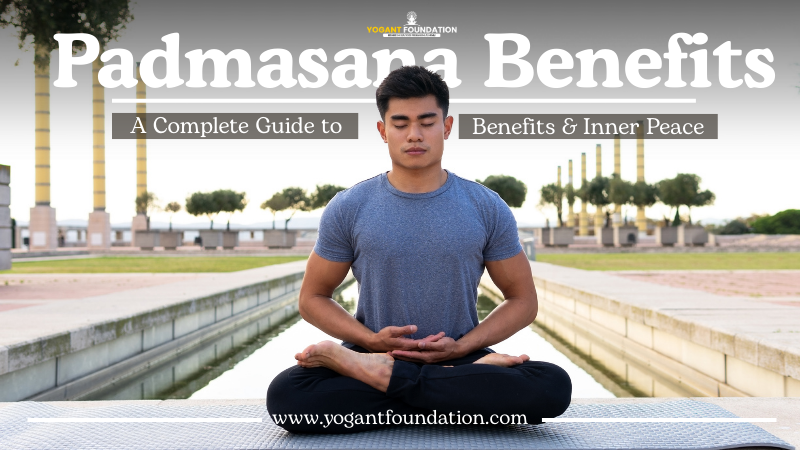

Imagine this for a moment: You’re sitting on a smooth, sun-warmed stone by the Ganga in Rishikesh. The air is clean, carrying the faint scent of marigolds and clay lamps. You close your eyes, feel a gentle breeze on your skin, and for the first time all week—maybe all year—the noisy chatter in your mind just… settles. That feeling? That’s what we’re really talking about when we talk about yoga. And there’s a beautiful secret to finding it, a physical key to an inner lock. It’s called Padmasana, the Lotus Pose.
What is Padmasana?
Similar to a lotus blooming from the mud, our true peace comes from within. There are many possibilities that exist and open for you when you are in the peace of your heart.
In the spiritual paradise of the Himalayas, we discover that yoga is much more than poses of yoga asanas.
It captures our inner peace. Padmasana, often known as the lovely Lotus Pose, is at the core of this comfort.
In truth, Padmasana is more than about flexibility. It is a deep access for improving meditative states of being.
For all those who are new to the yoga journey or have experienced what feels like a lifetime of yoga and want to develop and refine your seat.
This guide offered by our Rishikesh ashram will serve you well.
Padmasana Benefits: A Journey to Well-Being
The Padmasana benefits occur when we sit in it. When it becomes an atmosphere of health that flows into our experiences. A totality that extends beyond the physical.
- On one level (the physical), Padmasana is a lovely hip-opening pose. It stretches the ankles and knees while improving hip flexibility and range of motion.
- All key for staying in a seated position because of your own comfort (rather than having to shift around uncomfortably).
- Padmasana strengthens your spine for an upright and graceful position, which can also relieve common back pain.
- The slight pressure on the pelvic area (as if you can’t relieve gas!) keeps the abdominal organs gently supported, perhaps stimulating circulation and digestion.
- Most importantly, the pose encourages such an extraordinary sense of stability, allowing your entire nervous system to fully relax and settle. It is a natural antidote for stress.
- The effects of Padmasana can also influence you mentally and emotionally. The strong base of the pose will steady your mind and deepen the focus of your awareness.
- As a way to attain gentle stillness of mind, it is a satisfying method to curb the persistent chatter of your daily worries.
In Rishikesh we know, and try to remind ourselves, that authentic yoga is about self-awareness. Padmasana, at some point in your own experience, may help you feel more connected to your true self.
Spiritually, Padmasana Benefits as the best base for meditation and Pranayama (breathing exercises).
With its sturdy base, energy can move freely, allowing for the awakening and balancing of the lower chakras—Mooladhara (root) and Swadhisthana (sacral).
It is believed to be the finest posture for anyone on a spiritual path since it represents the peacefulness and depth found on the Ganges’ banks.

How to Practice Padmasana: A Step-by-Step Guide from the Banks of the Ganges
Please, please forget the images of forced flexibility. This is a practice of kindness. If you only remember one thing, let it be this: Never force your knees. They are precious. We coax, we invite, we patiently prepare.
First, Warm Up Like You Mean It:
Spend 5-10 minutes here. It’s not a chore; it’s a ritual of care.
- Butterfly Pose (Baddha Konasana): Sit, soles of your feet together, knees out to the sides. Gently flap your knees up and down like butterfly wings. Breathe into any tightness.
- Ankle Rolls: Point and flex your feet. Roll your ankles in circles. Wake them up.
- Half Shoelace Pose: Sit with one leg bent in front, the other bent behind you, knees stacked. It’s a deep hip opener—go only as far as feels good.
Now, The Journey to Your Lotus Seat:
- Start Simple (Dandasana): Just sit with your legs straight out. Feel the floor under you. Wiggle your sitting bones. Take a deep breath. This is your starting point of awareness.
- Try Half Lotus First (Ardha Padmasana): This is where most of us live, and it’s perfect. Bend your right knee and place your right foot on your left thigh. Let your left leg be comfortable, maybe bent with the foot near your right thigh. Feel the asymmetry? That’s okay. Sit on a folded blanket if your hips are tight—this is a game-changer! After a few breaths, gently switch sides.
- The Full Lotus Invitation: Only if Half Lotus feels like a cozy hug for your legs, you might explore further.
- From Half Lotus (right foot on left thigh), slowly bend your left knee.
- With your hands, carefully guide your left foot to rest on your right thigh. It might be high, it might be low. Wherever it lands without knee strain is your perfect Lotus today.
- Your hands can rest on your knees, palms up, feeling the energy, or palms down, feeling grounded.
- Find Your Alignment: Gently tug your belly in to support your spine. Imagine a golden thread pulling the crown of your head up to the sky. Shoulders roll back and down. Your chin is level—not jutting up, not crammed down. Gaze softly ahead or let your eyelids gently lower.
- Breathe Home: Inhale, and feel the breath lift your tall spine. Exhale, and feel yourself root down through your sitting bones. This isn’t about holding a pose; it’s about being in a pose. Let your breath be the thing you do, not the position of your legs.
A Heartfelt Note on “Failures”:
If full Lotus isn’t there today, or ever, you have not failed. You are listening. That is the highest yoga. Sukhasana (Easy Cross-Legged Pose) on a cushion is a sublime, honorable seat for a lifetime of meditation. The goal is inner peace, not outer form.
Important Tips for Beginners:
Patience: Don’t be in a hurry. Flexibility comes from a steady, gentle effort.
Modifications: If full Padmasana is inaccessible, try Ardha Padmasana (Half Lotus—one leg is folded) or simply use Sukhasana (Easy Pose), sitting on a cushion or blanket to raise the hips. Remember, the use of props is not a sign of weakness; rather, it is a smart and helpful way to provide support to your practice.
Types of Padmasana? The Lotus Family Album
Think of these as expressions of the same feeling, for different seasons of your practice.
- Ardha Padmasana (Half Lotus): Your daily, go-to best friend. All the mental and spiritual benefits, with compassionate accessibility.
- Baddha Padmasana (Bound Lotus): This is an advanced position. When you are able to set up in full Padmasana, you reach around behind your back to hold your big toes, which takes a lot of shoulder and upper back extensibility along with the deep hip opening. Baddha is often practiced to draw attention inward (introspection) and often in conjunction with certain pranayama practices.
- Urdhva Padmasana / Kukkutasana (Lifted Lotus/Cockerel Pose): The advanced strength postures. They come not from forcing the legs, but from years of cultivated hip openness, core strength, and balance. A beautiful reminder that the lotus can also be dynamic and powerful. (Please, only with a trusted teacher by your side!).
Embracing Your Own, Unique Bloom
Consistency is key, regardless of whether you’re practicing Padmasana to Meditation, improve your well-being, and/or for spirituality. You don’t need to spend an hour a day on this pose. Just a few minutes a day is enough. You will feel calmer and more relaxed in this position.
You should listen to your own body. Have patience and have faith in the process. Like the beautiful and delicate lotus flower, your practice takes shape according to its own pace.
Are you ready to deepen your yoga practice with us? Please check out our courses at Yogant Foundation in Rishikesh to experience the transformational and authentic aspects of yoga in person. Please feel free to share your Padmasana journey or any other questions in the comments below—we would love to hear from you!


Pingback: Kukkutasana (Rooster Pose) – Benefits, Steps & Hindi Meaning